
The Overwhelm Recovery ProtocolWellness & Routines · ~5 min
About this template · Updated September 2026
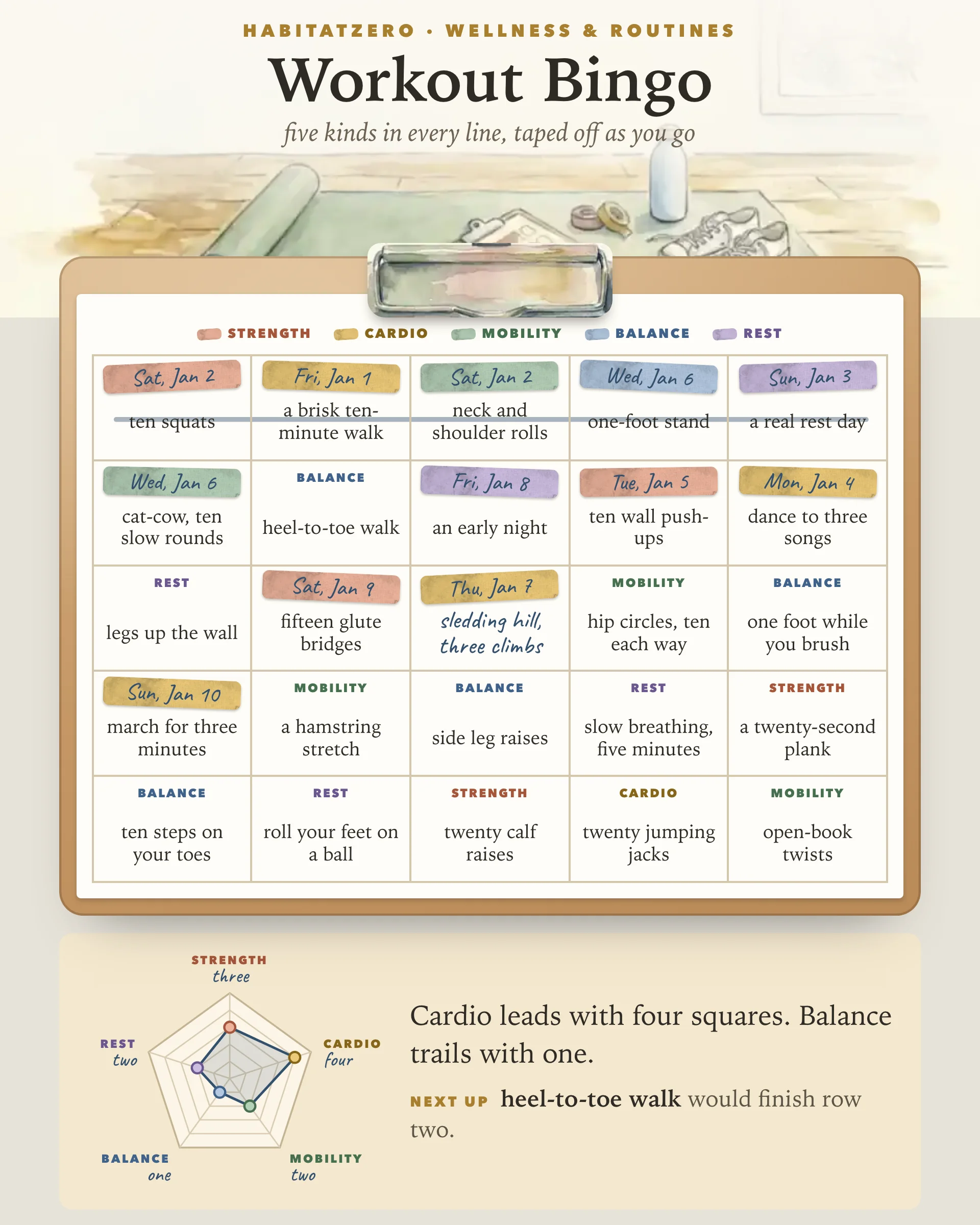
Plenty of Januaries start the same way: a burst of the one workout you already like, repeated until it gets dull or sore, then a quiet stop around week three. A workout bingo card offers a gentler deal. Instead of one plan to keep up with, you get twenty-five short workouts to take in any order, and the card tracks what kind of moving you actually do.
The twenty-five squares come in five kinds: strength, cardio, mobility, balance, and rest and recover. They are arranged so that every row, every column and both diagonals hold exactly one of each kind. You cannot finish a line with five sets of squats or five walks. A finished line is always one strength move, one stretch of cardio, one mobility square, one balance square and one planned rest: a small, balanced week.
Most squares take under ten minutes: ten squats, a brisk ten-minute walk, cat-cow for ten slow rounds, standing on one foot while you brush your teeth. Rest gets a square in every line on purpose, so a planned easy day moves the card forward instead of feeling like a miss.
Tap a square and it opens under its row. You see the move in a line or two, an easier version, and on the active squares a reminder to stop if something hurts. If a square doesn't suit you, swap in a suggestion of the same kind or write your own. The kind stays fixed, so the one-of-each rule survives your edits.
Once you've done it, pick the day, today or a few days back if you forgot to open the page, and tape it off. A strip of tape in that kind's color lands across the square with the date written on it. Complete a row, column or diagonal and a line is drawn through it.
Below the card, a five-sided shape grows one point per kind. An even card draws a round shape, and a kind you keep skipping shows up as a dent. The page puts the dent into words, for example "Cardio leads with four squares. Balance trails with one," and names the square that would finish your closest line. Since every line needs one of each kind, the kind you skip is usually the square your next line is waiting on. When the month ends, clear the tape and start over with your swaps still in place.
The five kinds follow the US physical activity guidelines, which ask adults for 150 to 300 minutes of moderate aerobic activity a week plus muscle-strengthening work on two or more days, and ask older adults to fold balance training into the mix. The same guidelines point out that the people doing the least gain the most from even modest increases, which is a good argument for squares this small.
Balance is easy to leave for later, and it is worth keeping. In a Cochrane review of 108 trials with adults over 60 living in the community, balance and functional exercises lowered the rate of falls by about a quarter. For the cardio squares, use a simple gauge: at a moderate pace you can talk but not sing.
Phrasing seems to matter too. When researchers followed just over a thousand people's New Year's resolutions for a year, goals framed as something to do beat goals framed as something to quit, with 59 percent against 47 percent reporting success. A bingo card is all things to add, with nothing to give up.
Bingo and exercise have been paired before. In a small trial of Bingocize, a game for older adults that mixes bingo calls with exercise, players who did the exercise gained more arm and leg strength than players who got the same game and health lessons without it, and attendance stayed above 93 percent. Those were small groups meeting twice a week, not a card on your fridge, and this card itself has never been tested. A full card is not a full program either: the five cardio squares add up to well under an hour, far short of the weekly target. Treat the card as a sampler that shows which kinds you avoid, and build the minutes around it: the Walking Challenge grows the cardio, and the Workout Calendar gives the week a shape.
Pain is a stop sign on this card. Sharp pain, joint pain, chest pain, dizziness or breathlessness that feels unusual means you stop, and the day becomes a rest square instead. If you live with a heart condition or a joint problem, or are coming back after a long break, go over the card with your clinician first, and use the easier versions until you know how your body responds.
Start on New Year's Day, on a Monday, or on any day you want a fresh start that doesn't lean on willpower. Open the card after each square, not before: taping off something you already did is its own small reward. On a day you can't decide, look for the dent in the shape and choose a square of that kind. If balance keeps coming up short, the Tai Chi Walking Plan builds it into an everyday walk.
It is a bingo card where every square is a short workout instead of a number. You do the squares in any order, mark each one when it is done, and try to complete rows, columns or diagonals, so a month of exercise turns into a game with visible progress.
The squares come in five kinds, arranged so every row, column and diagonal holds exactly one of each. A finished line is therefore one strength move, one cardio session, one mobility square, one balance square and one planned rest, which works out to a small, balanced week.
Short ones you can do at home without equipment: ten squats, wall push-ups, a brisk ten-minute walk, dancing to three songs, cat-cow, a one-foot stand while brushing your teeth, legs up the wall. Every square offers an easier version, and you can swap any square for another move of the same kind.
Not by itself. US guidelines ask adults for 150 to 300 minutes of moderate aerobic activity a week plus strength work on two or more days, and the card's five cardio squares add up to well under an hour. Use it to find the kinds you skip, and build the weekly minutes around it.
Looking is free and open: the page shows a sample card taped through the first ten days of January. To tape off squares of your own and keep your dates from one week to the next, personalize the card in HabitatZero at no cost.
By the team behind Fabulous, the science-based self-care app used by over 30 million people.


