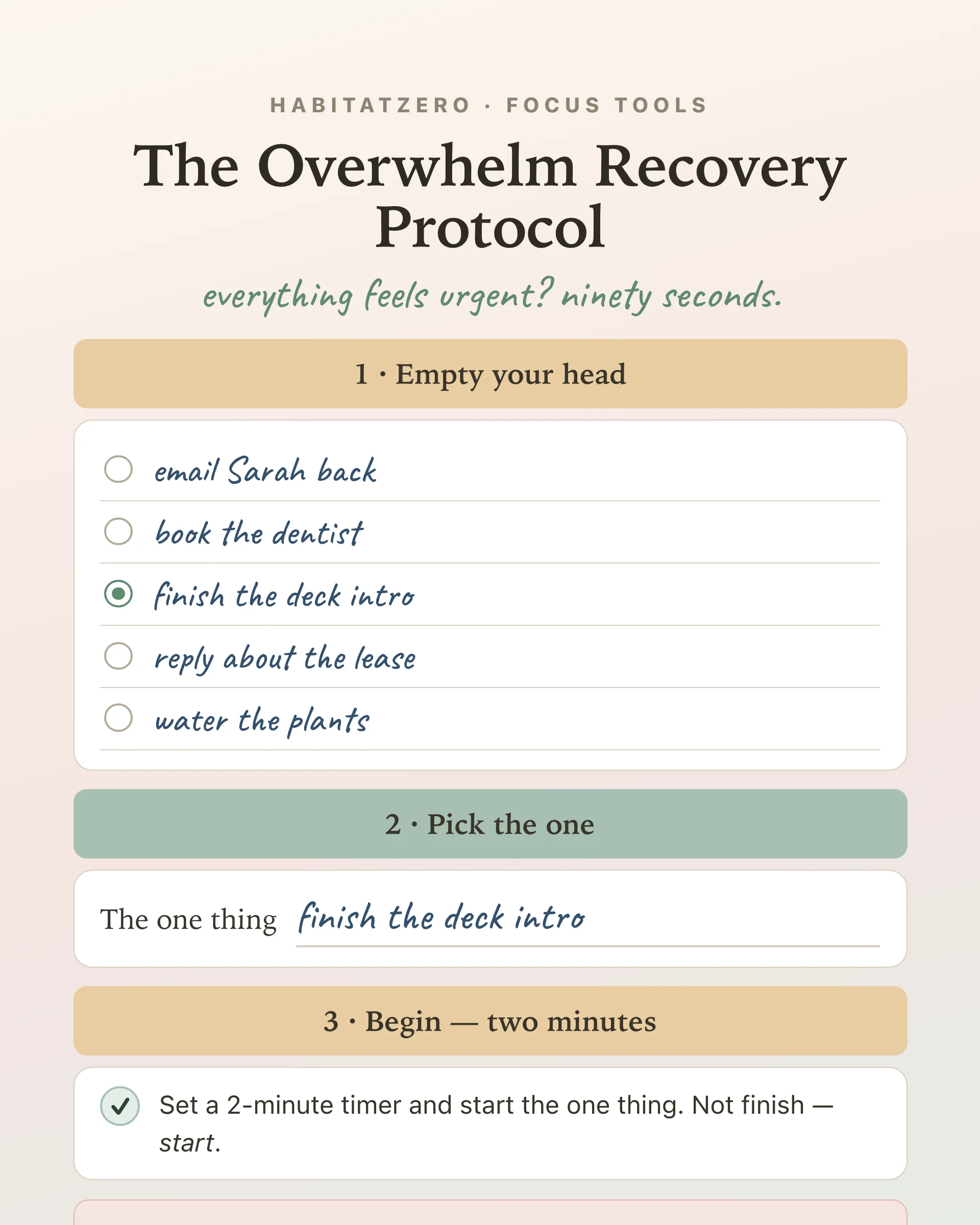
The Overwhelm Recovery ProtocolWellness & Routines · ~5 min
About this template · Updated September 2026
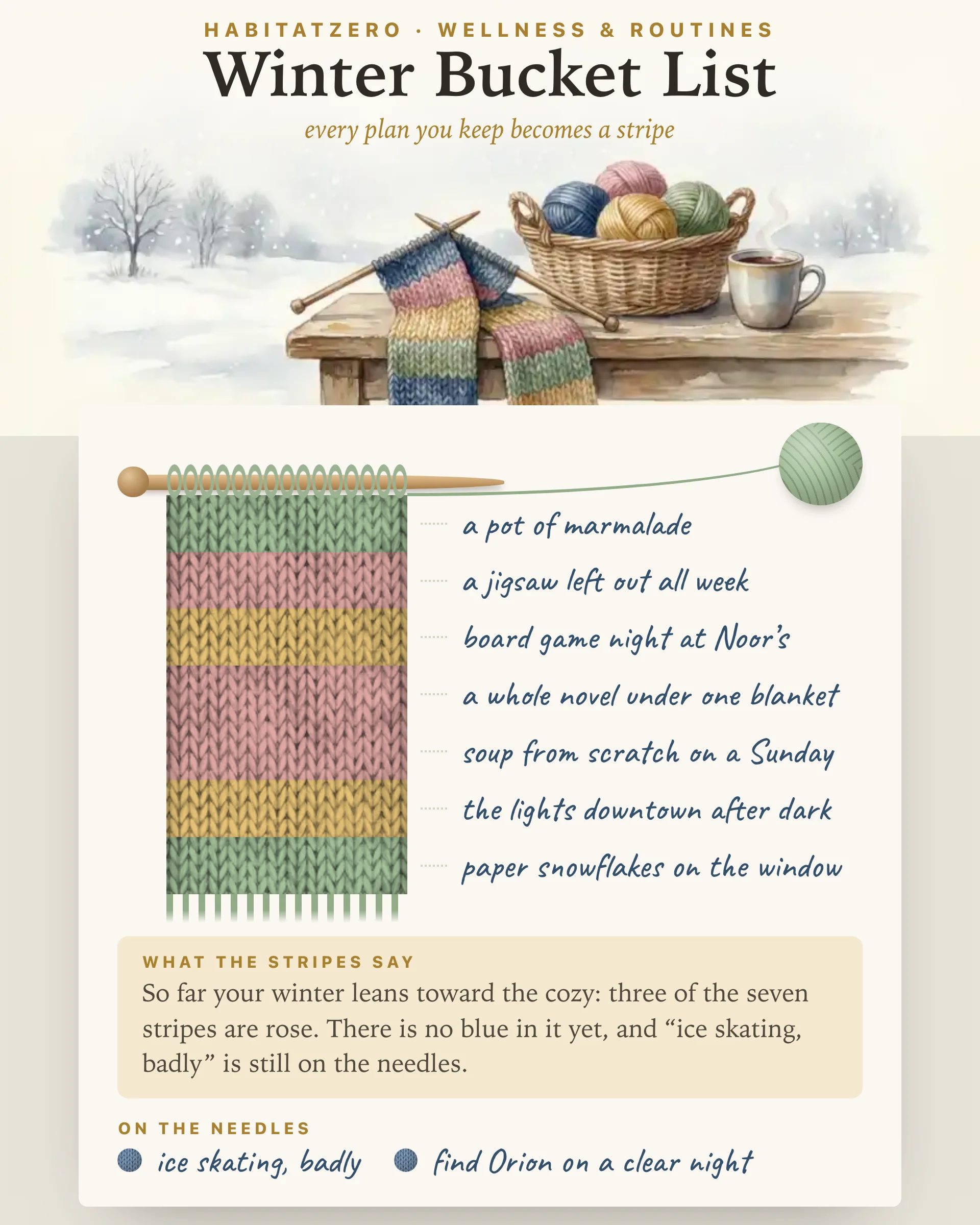
Winter has a planning problem that summer does not. In July the evening does half the work for you: it is light until nine, someone mentions the lake, and you go. In January it is dark by five, the couch is right there, and any plan has to beat the blanket before it can happen. A winter bucket list settles that contest in advance, on a day when you still have some appetite for the season.
This page holds twelve plans and keeps score in an unusual way. Every plan you keep is knitted into a scarf as a stripe, so by March the scarf is a record of the winter you had, in color.
There are about thirteen weekends between the first of December and the end of February. Twelve plans is one for each, with a weekend to spare for the flu. That is the cap; the list refuses a thirteenth plan until you let one go.
Keep each plan small enough for an ordinary weekend and ordinary money. A cabin in Lapland belongs on a bucket list with a longer horizon; what belongs here is ice skating, badly or soup from scratch on a Sunday, things you could do this Saturday if you decided by Thursday.
Each plan is cast on in one of four yarns.
The sorting matters because winter narrows people: left alone, most of us drift toward one yarn, usually rose, and wonder in February why the season felt so small. Four colors make the drift visible while there is still time to correct it.
Pick a yarn and tap a suggestion, or write your own plan in a few words. It lands under On the needles in handwriting, tagged with its color. When you have actually done it, press did it. The plan leaves the list and appears at the top of the scarf as a stripe, with your words beside it.
Under the scarf, a short reading says which yarn is leading, which is missing, and whether a plan in the missing color is already waiting on the needles. It describes a pattern and stops there; nobody is graded on their winter.
Two taps unravel a stripe pressed too early, and two taps let a plan go. A finished scarf has twelve stripes, and a six-stripe one is still six good days you might otherwise have spent deciding.
Three lines of research sit behind this page; none is about bucket lists as such.
The first is about attitude. In a survey of 238 people across southern Norway, northern Norway and Svalbard, Kari Leibowitz and Joar Vittersø found that people with a more positive attitude toward winter also reported higher life satisfaction and more positive emotions, and that this attitude was more common the further north people lived. It is a correlation from one country and cannot show that outlook causes anything, but it suggests that treating winter as a season with pleasures of its own is how people who get a lot of it cope.
The second is about doing pleasant things on purpose. A meta-analysis of twenty randomized studies found that behavioral activation, which means engaging in valued and enjoyable activities on a schedule, raised well-being in ordinary adults as well as in people with symptoms of depression. A list of winter plans with a button for did it is a homemade version of the same move.
The third is about getting outside. A large English survey found that people who spent at least two hours a week in nature were more likely to report good health and high well-being, however they split it up. That is an association too, but it is a fair argument for keeping some blue in the scarf.
None of this turns a list into a treatment. Feeling a bit flat in the dark months is common. A low mood that returns every winter and changes how you feel, think and behave can be seasonal affective disorder, which is a form of depression and worth raising with a doctor. To see how your own mood moves through the season, a month on the Mood Tracker shows more than memory does.
Cast on your plans in late fall, while the idea of snow is still charming. Look at the list on Thursday evenings: a Saturday plan not chosen by Thursday usually loses to the couch. Knit the stripe the same day you do the thing.
When the thaw comes, keep the scarf. It sits well beside a Year in Review, where the winter becomes part of a longer story, and it answers "what did you do all winter?" better than most of us manage.
Small, cheap, nearby plans you could do on an ordinary weekend: a walk while it is snowing, a winter sunrise with a thermos, soup from scratch, a board game night, a loaf of bread. Mix plans for outdoors, for staying in, for seeing people and for making something, so the season does not shrink to the couch.
This one holds twelve. There are about thirteen weekends between the start of December and the end of February, so twelve plans is roughly one per weekend with one to spare. A much longer list tends to turn into a page of ideas instead of something you finish.
Anything that breaks the evening routine without needing a vacation: ice skating badly, finding Orion on a clear night, a film night with the phones in a drawer, a potluck of winter dishes, a handwritten letter, a jigsaw left out all week. Couples and families can share one list and take turns choosing the yarn.
It can help you plan enjoyable things and follow through, and studies of that kind of activity scheduling find gains in well-being. It is not a treatment. A low mood that returns every winter and changes how you feel, think and get through the day may be seasonal affective disorder, which is worth raising with a doctor.
Yes. Once your list is filled in, printing it gives you the plans still on the needles and the scarf with a handwritten note beside every stripe, minus the buttons. Casting on plans, knitting stripes and keeping the scarf between visits happens in HabitatZero, which costs nothing.
By the team behind Fabulous, the science-based self-care app used by over 30 million people.