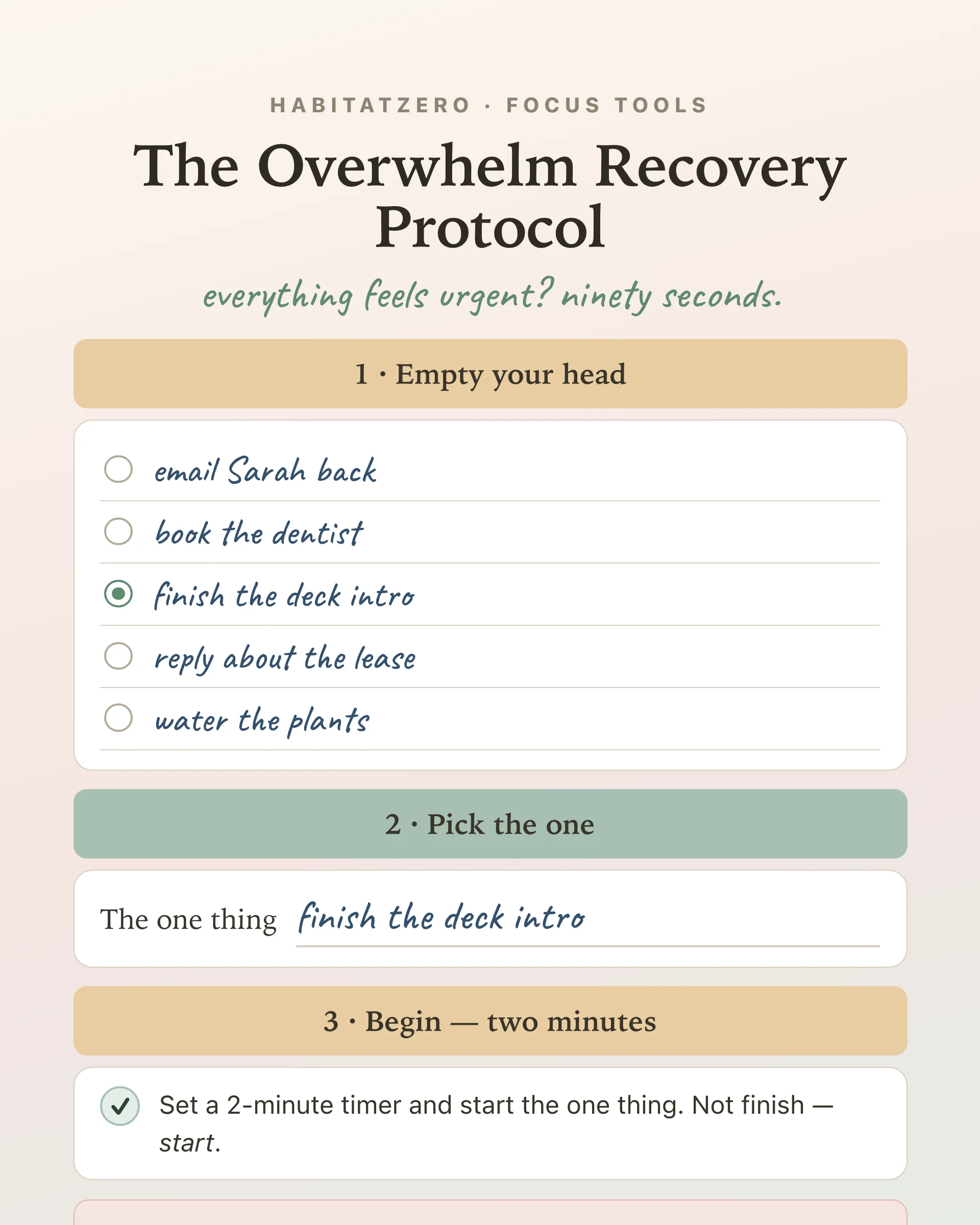
The Overwhelm Recovery ProtocolWellness & Routines · ~5 min
About this template · Updated July 2026
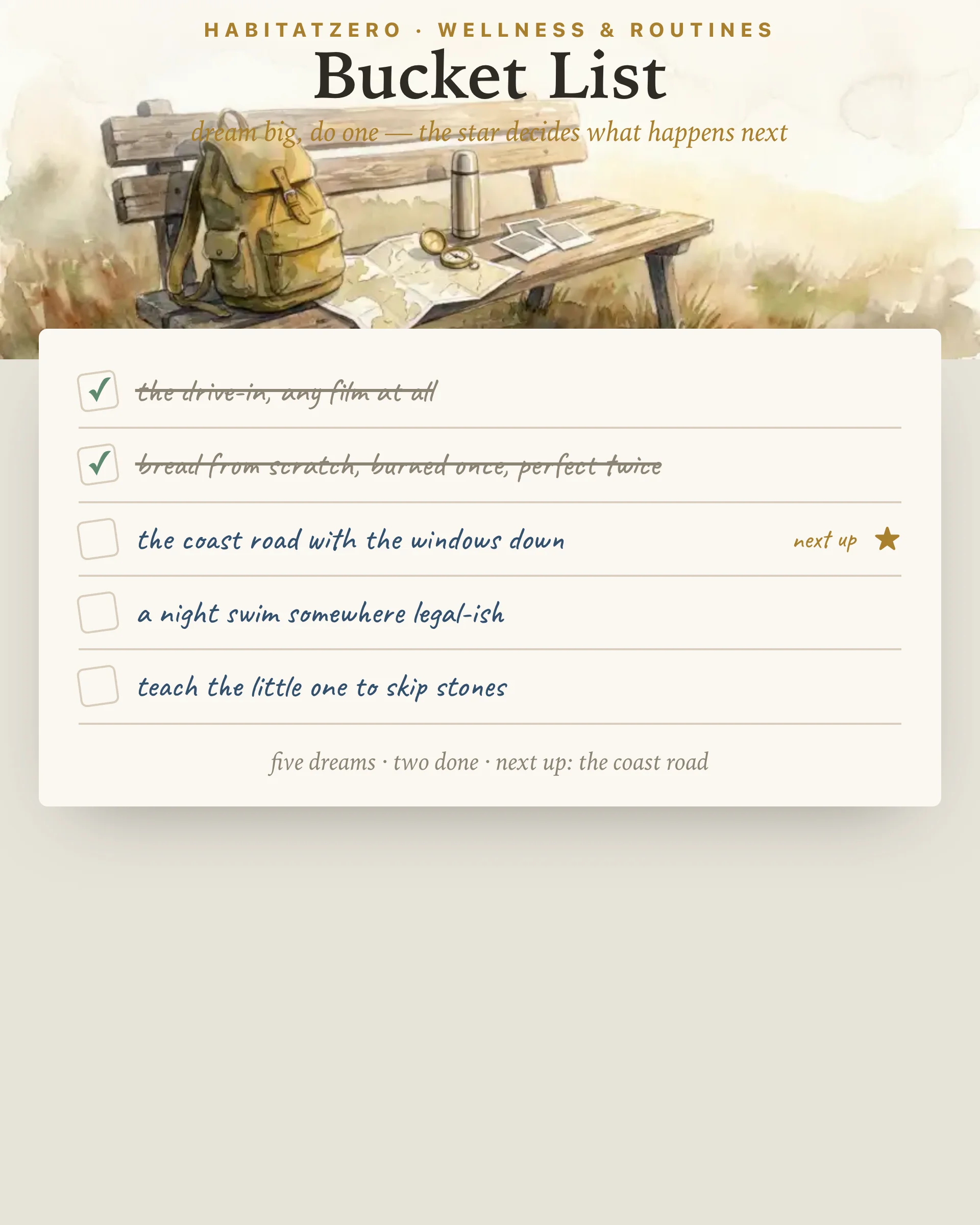
Every August produces the same archaeology: a summer bucket list, written in June with real joy, rediscovered under a magazine with two items done. The list wasn't the problem — the format was. An uncapped list with no next step isn't a plan; it's a mood board. This template fixes the format with two small mechanics: a cap, and a star.
The research here is unusually cheerful. Van Boven and Gilovich's classic studies — To Do or to Have? — found that experiences beat material purchases for happiness, and the gap widens in memory: the coast road appreciates, the gadget depreciates. Better still, the enjoyment starts before you leave the house. Kumar, Killingsworth and Gilovich's Waiting for Merlot found that anticipating an experience is itself more pleasant than anticipating a possession — which means a bucket list on the fridge is not just planning. It's a slow-release dose of the trip.
But both effects require the experience to eventually happen. Hence the mechanics.
The sheet holds twenty entries and then politely refuses. A cap sounds like a limitation and works like a promotion: on a capped list, every entry is a genuine candidate for a real Saturday, which is precisely what item forty-one on an uncapped list never was. The cap also forces the good question at writing time — which twenty, actually? — and the answers get specific. Not "go hiking" but the waterfall trail before it gets hot. Specific dreams get done; categories get admired.
Done dreams stay on the list, stamped with a springy checkmark and struck through in your own handwriting. A finished bucket list should read like a scrapbook, not empty itself like an inbox.
The star is the whole engine. One dream — never two — holds next up at any moment, and that dream is the standing answer to the next free afternoon. This kills the failure mode that eats most lists: the free Saturday arrives, the list gets scrolled, choosing feels like work, and the afternoon quietly becomes errands. With the star, the deciding was already done on some quiet evening. The Saturday just executes.
When the starred dream gets its stamp, the star moves to a new one. That's the maintenance ritual, entire: stamp, re-star, repeat until the list is a scrapbook.
Nothing on the sheet says summer except what you write on it. Point it at a summer, an autumn of small adventures, or a year of firsts; print a fresh sheet when the season turns and let the old one join the fridge-door archive. It pairs naturally with the word of the year — the word names the season's direction, the list names its scenes — and when a dream needs breaking into actual steps, the SMART goals worksheet takes it from there.
Twenty lines. One star. A checkmark that springs. The drive-in isn't going to attend itself.
The things you say out loud every year and never schedule: the drive-in, the night swim, the coast road with the windows down, teaching someone small to skip stones. The best entries are cheap, nearby, and specific — a list of flights and festivals mostly produces sighing. Write the specific version: not go hiking but the waterfall trail before it gets hot.
No — the sheet is deliberately season-neutral. Nothing on it says summer except what you write on it, so the same list works for an autumn of small adventures, a winter of firsts, or a year-long running list. Fill it at the start of whichever season you are pointing it at, and print a fresh one when the season turns.
Because doing is the point, and research on experiences keeps finding that the doing is what pays — experiences beat possessions for happiness, and even the anticipation of an experience is unusually pleasant. A capped list keeps every entry a real candidate rather than decoration, and the cap forces the useful question: which twenty, actually?
One at a time, chosen in advance — which is what the star is for. Exactly one dream holds next up at any moment, so a free afternoon already knows what it is for. Deciding is the expensive part, and the star pays that cost on a quiet evening instead of in the moment. When the starred one is stamped done, move the star and the machine keeps running.
Yes — the page carries a print stylesheet, so printing produces the clean sheet: your dreams in handwriting, the checkboxes, the star on the next one up. Fridge-ready. Signed-in HabitatZero users keep the interactive layer, where stamps spring, the star moves with a tap, and the list is saved between visits.
By the team behind Fabulous, the science-based self-care app used by over 30 million people.