
Leaves on a StreamEmotional Fitness · ~3 min
About this template · Updated September 2026
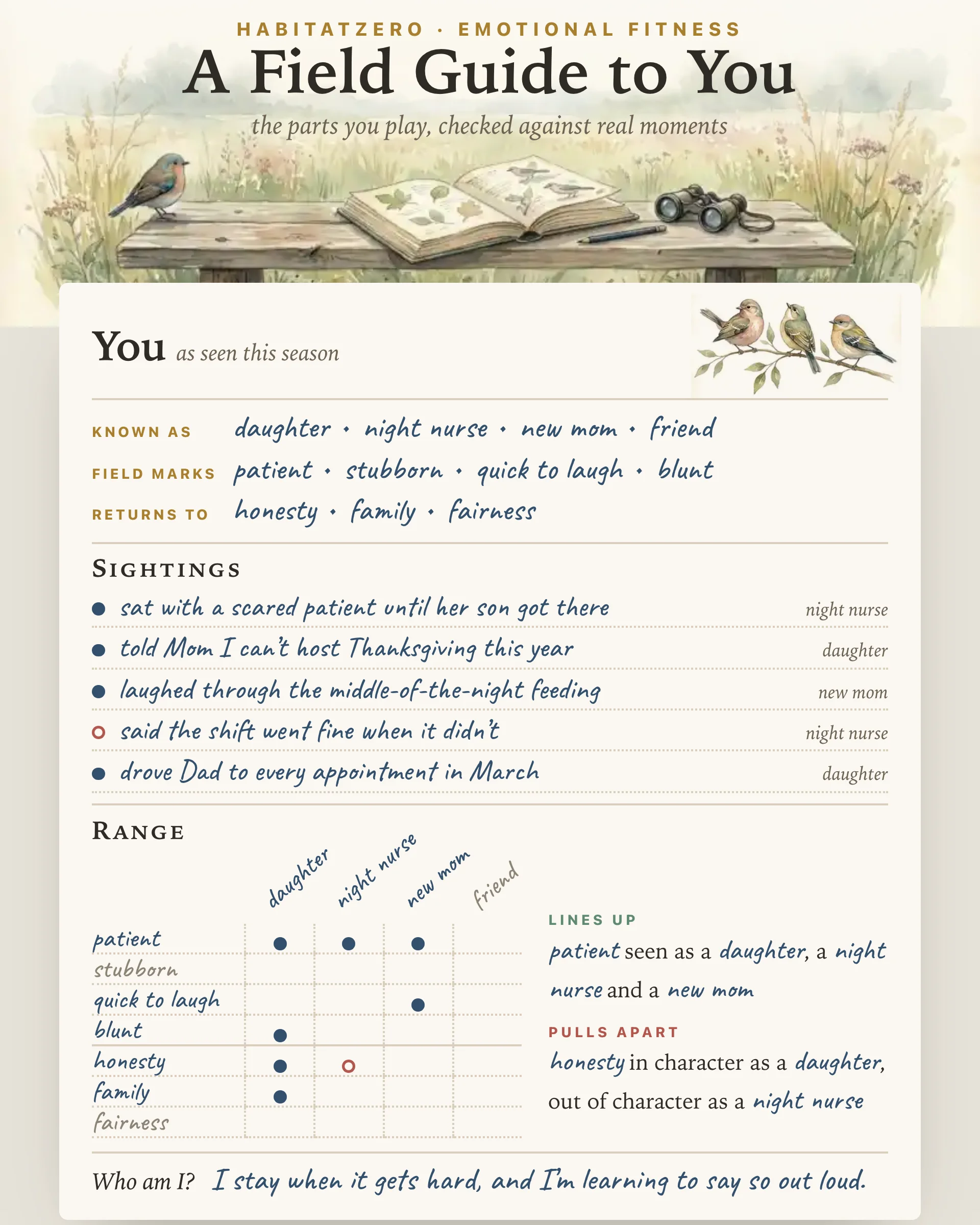
"Who am I?" is hard to answer head-on. Ask it directly and you tend to get a list of job titles, or a fog of adjectives that could describe almost anyone. Field guides handle this better. They never say what a bird is in its essence. They tell you how to recognize it: the marks that give it away, where it turns up, how it behaves, and how its feathers change from one season to the next. This who am I worksheet writes you up the same way, then checks the description against things you actually did.
In 1954, Manford Kuhn and Thomas McPartland built a research test around the question, asking people for twenty answers to "Who am I?" in An Empirical Investigation of Self-Attitudes. Their Twenty Statements Test still turns up in studies, and the identity worksheets therapists hand out today ask for much the same raw material: roles, qualities and values. This page is not that test and gives no score; it borrows the question and adds a way to compare the answers.
Nothing is scored. The chart only repeats what you logged, so it grows more honest as the notebook fills.
Psychologists have a name for the quality this page circles: self-concept clarity, meaning how clearly and confidently you can describe yourself and how consistent and stable those beliefs are. In the paper that introduced a scale for it, Jennifer Campbell and colleagues found lower clarity alongside higher neuroticism, lower self-esteem, and a ruminative, going-in-circles kind of attention to the self. Clarity also ran lower in their Japanese sample than their Canadian one, a reminder that a sharply drawn self is partly a cultural ideal. None of that shows that filling in a worksheet raises anyone's clarity. The link with rumination is one reason this page asks for specific moments instead of more open-ended self-scrutiny.
The pull between roles has been studied too. Eileen Donahue and colleagues looked at how differently people describe their own personality from one social role to another. In a group of college students and a group of middle-aged women, a more divided self-view went with poorer emotional adjustment, and frequent changes of job and relationship predicted more of that division years later. Those are group patterns, not a verdict on you, and some variety between roles is ordinary: most of us are livelier with friends than in a staff meeting. An open ring on your chart is an invitation to look, nothing more.
The sightings matter for a separate reason. Dan McAdams and Kate McLean describe narrative identity as the evolving story a person carries about their past and imagined future. They review work tying themes of agency and exploration in those stories to well-being, while noting that cause and effect have not been untangled.
Open it when a change has reshuffled your parts: a first baby, a new job, a breakup, a move, a graduation, a retirement. Teens can use it too, perhaps with a parent or counselor they trust. If you see a therapist, the finished entry makes good material for a session. Then come back a season later, log fresh moments, and see what has moved.
If the social groups you belong to feel more pressing than your roles, The Identity Wheel maps those. To cut a long list of values down to the few that deserve a vote, try the Core Values Worksheet. To set your description beside how someone else sees you, open The Johari Window.
If the question arrives with weeks of numbness, or a sense that nothing much matters anymore, talk with a doctor or therapist. A worksheet can sit beside that conversation but should not stand in for it.
It is a guided way to describe yourself that goes past a job title: the roles you fill, the traits people know you by, the values you steer by, and a few real moments that show them. Therapists often use one for identity exploration. This version adds a chart that compares the pieces with each other.
The most useful ones ask about a moment rather than for a verdict. When did someone last thank you, and what for? When did you last lose track of time? When did you last bite your tongue? When did you last feel you were playing a part? Every answer is a small story you can hold your self-description up against.
An identity wheel maps the social groups you belong to, such as age, faith, class or first language, and how they shape the way you are seen. A who am I worksheet like this one stays with the person you would describe in your own words, and asks whether that description holds across the parts you play.
Only that you logged a moment in that role when you acted against something you listed. It is not a flaw and not a diagnosis, and some difference between roles is ordinary. The useful follow-up is whether that part asks you to be someone you would rather not be, and what one small change there might look like.
It is free. The sample on this page belongs to an invented night nurse and new mom. To start an entry of your own, open the worksheet in HabitatZero, which holds on to every sighting you log until your next visit.
By the team behind Fabulous, the science-based self-care app used by over 30 million people.


