Leaves on a StreamEmotional Fitness · ~3 min
About this template · Updated September 2026
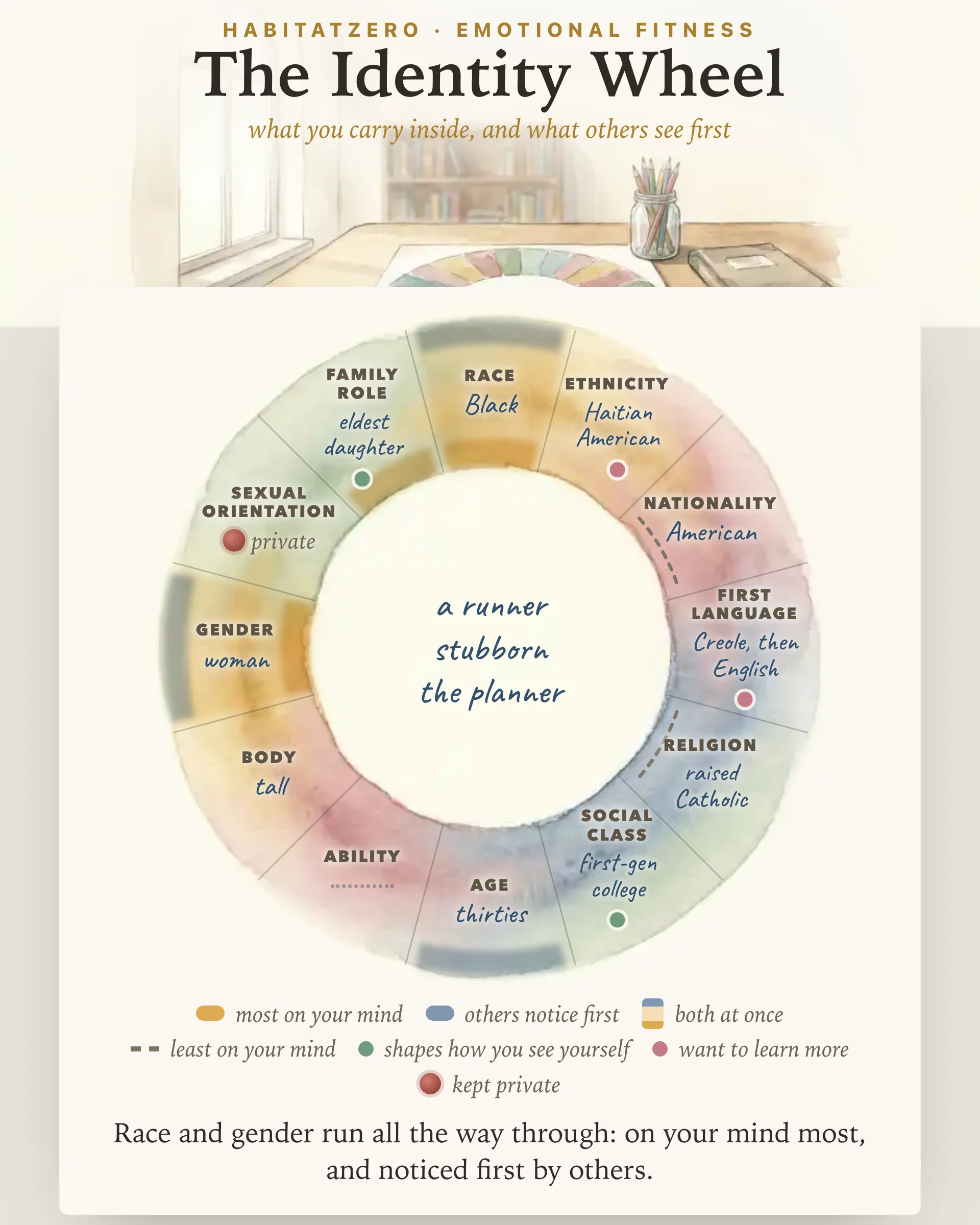
Credit where it belongs: the social identity wheel most teachers hand out was adapted by the University of Michigan's Program on Intergroup Relations and its Spectrum Center, and the university's teaching site still hosts the wheel with its activity guide. Fabulous made this painted, tap-to-mark version separately; Michigan had no hand in it and has neither reviewed nor endorsed it. Worth knowing before you begin: the program has since retired the wheel in favor of the Social Identity Snapshot, partly because the older handout listed Latino identity as a race rather than an ethnicity and used dated language about disability. The spokes and starter words here were written fresh with those corrections in mind.
A ring is split into the social groups people get sorted into. You write how you belong to each one, and five questions ask how those identities sit in your life. Which do you think about most often? Which hardly ever? Which would you like to understand better? Which shape how you see yourself, and which shape how other people see you?
Michigan pairs it with a lighter companion, the personal identity wheel, which asks for a favorite book, a skill you are proud of, a motto and three adjectives, and sets questions of perception aside. Side by side, the two show where the person you would describe and the categories you get filed under agree, and where they pull apart.
Twelve spokes circle the wheel: race, ethnicity, nationality, first language, religion, social class, age, ability, body, gender, sexual orientation, and one you name yourself. Michigan's handout also gives sex a category apart from gender; if that distinction matters to you, the last spoke is there for it. Tap a spoke and write in your own words. Starter words sit underneath for anyone who wants them, but none of them is a guess about you, and every spoke can stay blank. If you know what belongs on a spoke and would rather not write it down, choose keep it private, and the wheel shows a small seal instead of words.
The center is the personal wheel folded in: three words about you that no category holds, like a runner or the one who plans.
Then switch to the five questions and mark up to three spokes for each. A spoke cannot be both most and least on your mind. The marks paint themselves onto the ring, gold near the hub for what fills your thoughts and blue along the rim for what other people notice first. Where both land on one spoke, the whole wedge fills in. Underneath, the page says in plain sentences what runs all the way through, what stays mostly inside and what others see before you think of it, then offers three questions to sit with. Nothing is scored, and the page never tells you what your answers mean about you.
When William McGuire and colleagues asked schoolchildren to tell them about themselves, ethnicity came up more often among children whose group was a minority at their school, though the authors allowed that several findings had other plausible explanations. Identities that match the room seem to drop out of view, which is why the wheel asks about them at all.
Two of the five questions can sound alike. Sociologists Sheldon Stryker and Richard Serpe tested whether how readily an identity comes into play and how central it feels to your sense of self are one thing, and their answer was mixed: separate for some roles, overlapping for others. It is worth noticing when those two marks land on different spokes.
What the evidence does not show is that filling in a wheel changes anything by itself. It is a teaching prompt rather than a validated measure, and the writing or conversation afterward does most of the work.
Michigan's guide warns that the exercise can feel exposing for students whose identities are not visible and who may not want to disclose them, and it says sharing should always be voluntary. The seal exists for exactly that. In a classroom, ask people to talk about their marks rather than their words, and fill in your own wheel before you lead anyone through theirs; the program's redesign lead gives instructors the same advice about the Snapshot. For a unit on privilege and power, the Snapshot is built for that conversation, with columns asking which identities carry power and privilege in the United States.
Try it at the start of a course or a new team, before a conversation where you suspect you are being read by a single spoke, or after a move that suddenly makes one part of you more visible. To compare your view of yourself with someone else's, The Johari Window sets a friend's six words beside yours. If the question is how life is going rather than who you are, The Wheel of Life rates eight areas instead, and the Core Values Worksheet helps when the reflection turns toward what you stand for.
A wheel filled in this year will not match one from five years ago, and it is not supposed to.
It is a circle divided into the social groups people get sorted into, such as race, gender, class and religion. You write how you belong to each one, then reflect on which identities you think about most, which least, and which other people notice first. Classrooms and workshops use it as a reflection prompt, not as a test.
A social identity wheel covers group memberships like race, age or first language and asks how they shape the way you see yourself and the way you are seen. A personal identity wheel asks about favorites, skills, a motto or a few adjectives. This page joins them by putting three personal words at the center of the social ring.
Common ones include race, ethnicity, nationality, first language, religion, social class, age, disability, body size, gender and sexual orientation. Lists vary from one handout to the next. The newer Social Identity Snapshot from the University of Michigan keeps an open row for identities its list leaves out, and the last spoke here works the same way.
Fill in your own wheel first. Give everyone about fifteen minutes to complete theirs privately, then go through the five questions together and invite anyone who wants to talk about their marks. Keep sharing optional, and let people speak about a category without saying what they wrote in it.
Yes. The public page shows a finished example wheel to study. Opening your own copy in HabitatZero costs nothing, and it keeps your words, seals and marks from one visit to the next.
By the team behind Fabulous, the science-based self-care app used by over 30 million people.