Leaves on a StreamEmotional Fitness · ~3 min
About this template · Updated September 2026
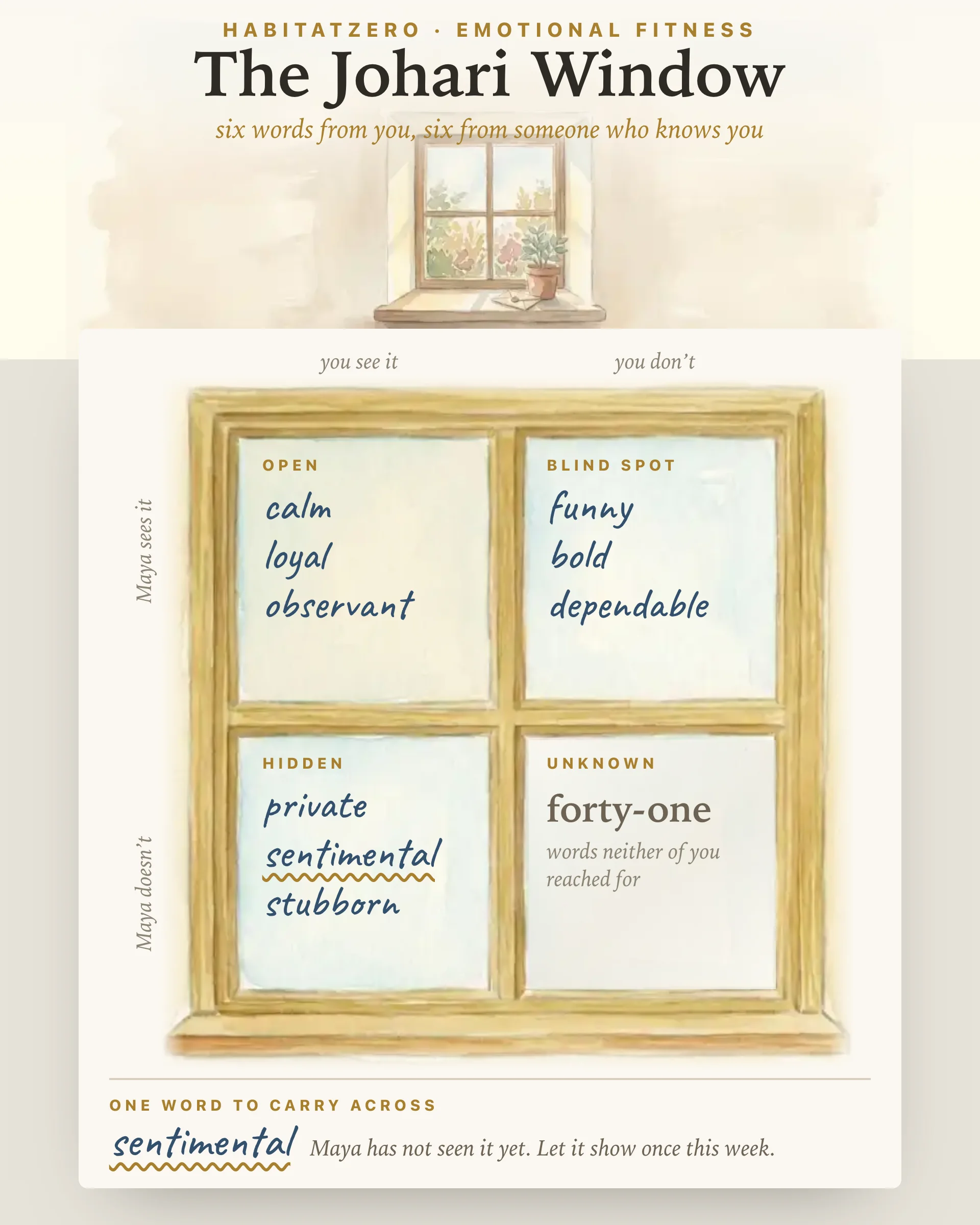
The Johari window comes from two psychologists, Joseph Luft and Harrington "Harry" Ingham, who first presented it in 1955 at the Western Training Laboratory in Group Development, run out of the University of California, Los Angeles. The name is simply Joe and Harry run together. Luft's own short paper, reprinted by the NTL Institute and hosted by Columbia University's Ombuds Office, is still the clearest introduction to it. What you are using here is a separate worksheet that Fabulous built around their model; it has no tie to either author, their estates or NTL, and none of them has reviewed or approved it.
The model crosses two questions: do you know this about yourself, and do other people know it about you? Two yes-or-no answers make four panes.
Luft's claim was modest and practical: the smaller the open pane, the poorer the communication. That pane grows in only two ways. You disclose something, and a word crosses from hidden to open. Or you ask for feedback, and a word crosses from blind to open.
The adjective exercise most people meet today is a later adaptation; Luft's paper contains no word list at all. The format that circulates hands everyone one list of roughly fifty-five adjectives, and each person takes five or six. The shared list is the point, because two people can only overlap if they choose from the same words.
This page keeps that format with fifty adjectives of its own. Tap the six that sound like you on an ordinary day. They land in the hidden pane first, which is accurate: until somebody else names them, they are yours alone. Then switch to the second view, give it a first name, and choose between two honest options.
Once both sides are in, the window sorts itself. Words you both chose move to open, theirs alone fill the blind spot, yours alone stay hidden, and the unknown pane counts every adjective neither of you reached for. A short reading describes which way your answers lean, in plain phrases rather than a score. Last, you pick one hidden or blind word to carry across this week, by letting it show once or by asking about it once.
The Johari window is a teaching model, not a validated psychological test, and no study shows that sorting adjectives changes anybody. Treat the result as the opening of a conversation.
The idea underneath it has real support, though. In a study where people rated themselves, were rated by friends and strangers, and then completed behavioural tasks, Simine Vazire found a genuine asymmetry in who knows what: people were the best judges of their own neuroticism-related traits, the ones that live mostly on the inside, while friends were the better judges of intellect-related traits. Some panes really are easier to read from the far side of the glass, a fair argument for asking instead of guessing.
The disclosure half holds up as well. A meta-analysis by Nancy Collins and Lynn Miller found that people who share more personal things tend to be liked more, and that we come to like the people we have opened up to.
One caution comes from Luft himself, whose principles of change include this one: forced awareness is undesirable and usually ineffective. Nobody owes you their six words, and you owe nobody your hidden pane.
Bring it out before a feedback conversation at work, in the first weeks of a new team, or with a partner or friend when you sense you are being read differently from how you feel inside. Then repeat it with a second person, since a colleague and a sibling will rarely fill your blind pane with the same adjectives.
If a blind-spot word stings, replaying the moment behind it from the other seat in the Perspective Journal usually takes the heat out. If your hidden pane is crowded with things you care about and never show, the Core Values Worksheet helps you decide which of them deserves daylight first. And if the person on the other side of the glass is your partner, the Couples Check-In gives the two of you a weekly place to keep widening the open pane.
Six adjectives cannot hold a whole person. They are enough to start one good conversation.
It is a four-pane picture of self-awareness created in 1955 by psychologists Joseph Luft and Harrington Ingham. It crosses what you know about yourself with what other people know about you. That produces an open pane, a blind spot, a hidden pane and an unknown pane, and the aim is to widen the open one through disclosure and feedback.
Everyone picks from one shared adjective list. You choose the words that fit you, other people choose words for you, and the overlap decides which pane each word lands in. It is a reflection exercise rather than a scored or validated personality test, so the result describes a pattern in the answers and nothing more.
Partly. You can fill the second view with your guess at how a named person would describe you, and this page labels it as a guess. That reveals what you suspect others see. A true blind spot only appears when another person chooses the words, so pass them the list whenever you can.
Say you pick calm, loyal, observant, private, sentimental and stubborn, while a friend picks calm, loyal, observant, funny, bold and dependable. The first three land in the open pane. Funny, bold and dependable fill your blind spot, and private, sentimental and stubborn stay hidden.
Yes. The public page shows a finished example window you can study. To choose your own six words, invite a second view and keep the result, open the template in HabitatZero, which costs nothing.
By the team behind Fabulous, the science-based self-care app used by over 30 million people.