Leaves on a StreamEmotional Fitness · ~3 min
About this template · Updated July 2026
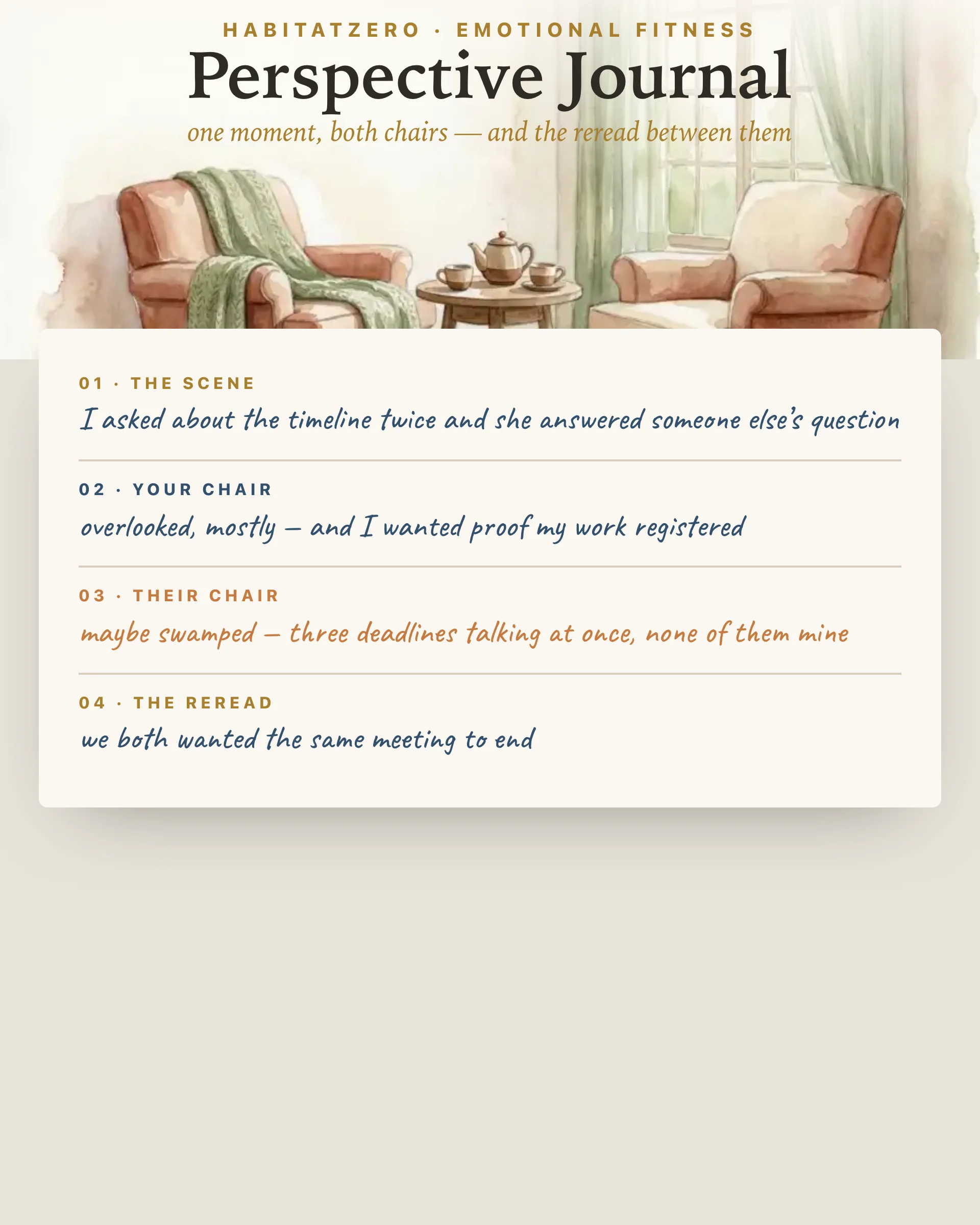
Most advice about emotional intelligence has a strange shape: it tells you what the skill looks like — read the room, consider their side, know what you're feeling — without ever handing you a rep to do. This journal is the rep. One moment, written twice: once from your chair, once from theirs, followed by the reread where the actual learning lives.
The term has been stretched thin by three decades of airport books, so it's worth going back to the source. When Peter Salovey and John Mayer coined emotional intelligence in 1990, they defined it as a set of abilities: perceiving emotions accurately — in yourself and in others — and using that information to guide thinking. In their later work, Mayer, Salovey and Caruso defended exactly this framing against the looser versions, asking whether EI is a new ability or a grab-bag of traits and answering: an ability, measurable, narrower than the hype and more trainable than a temperament.
That distinction matters practically. Traits you have; abilities you rep. And the two abilities at EI's core — what am I feeling? and what might they be feeling? — happen to be exactly the two questions a journal can drill.
The scene. One moment with one person, camera-honest: I asked about the timeline twice and she answered someone else's question. No adjectives yet; the facts are the stage, not the play.
Your chair. What you felt — and beneath it, what you wanted. The want is the honest layer: overlooked is a feeling, but I wanted proof my work registered is the engine under it. Writing both is the first EI rep.
Their chair. The rep that separates this journal from a diary: what might they have felt and wanted? The word might is load-bearing — this is a generous guess, not a verdict, and it gets its own ink color on the page to keep the two voices honest. Maybe swamped — three deadlines talking at once, none of them mine.
The reread. Both accounts, back to back. Write what you couldn't see from inside the moment. Run this practice a dozen times and one pattern shows up with embarrassing regularity: the two chairs wanted overlapping things. We both wanted the same meeting to end.
Next time. One line, kept: ask her when works better instead of asking again. The shelf below the sheet holds fifteen of these filed practices, and the next-time lines quietly become your own playbook, written by the only author with full context.
The head replays moments as a highlight reel with one camera — yours. Writing forces the second camera into existence, and the reread puts both feeds on the same screen, which the head simply never does on its own. It's the difference between stewing and studying.
The practice chains naturally with its siblings: when your chair is hard to write because the word won't come, the feelings wheel walks you to it. When the moment is less about another person and more about a feeling that keeps circling solo, the emotion processing sheet is the right room. This journal is specifically for the moments with two chairs in them.
One scene. Two seats. The reread between — and a next-time line you'll actually have ready.
By turning its two core skills into repeatable moves on paper. In the research tradition started by Salovey and Mayer, emotional intelligence is a set of abilities — perceiving and understanding emotions in yourself and others — not a personality trait you either have or lack. Abilities respond to practice: writing what you felt trains the first skill, and writing what the other person might have felt trains the second. This journal is those two reps, dated and kept.
You replay one moment twice: once from your own seat — what you felt and what you wanted — and once from the other person's, guessing generously about the same two questions. Then you reread both accounts side by side and write what you could not see from inside the moment. The reread is where the practice pays; the two accounts usually want more of the same thing than the argument suggested.
The ability model says yes, with the usual caveat that practice beats reading about practice. Reviews of the field distinguish emotional intelligence as a measurable set of skills from the looser pop-culture claims made in its name — and skills, unlike traits, move with deliberate reps. What this journal offers is the rep: a small structured exercise you can run on real moments a few times a week.
Moments with other people that are still muttering at you a day later — the meeting answer that landed sideways, the message that read colder than it was meant. Big blowups are actually poor practice material at first; medium-sized friction is where the two-chair reread teaches most, because you can still be honest about both seats. One filed practice a week is a real cadence.
No — their chair is written in the language of might, not verdicts. You are not ruling that they were right or that you were wrong; you are practicing holding two accounts of one moment at once. Plenty of filed practices end with a next-time line that holds the boundary and the understanding in the same sentence, which is the skill in a nutshell.
By the team behind Fabulous, the science-based self-care app used by over 30 million people.