The Overwhelm Recovery ProtocolWellness & Routines · ~5 min
About this template · Updated August 2026
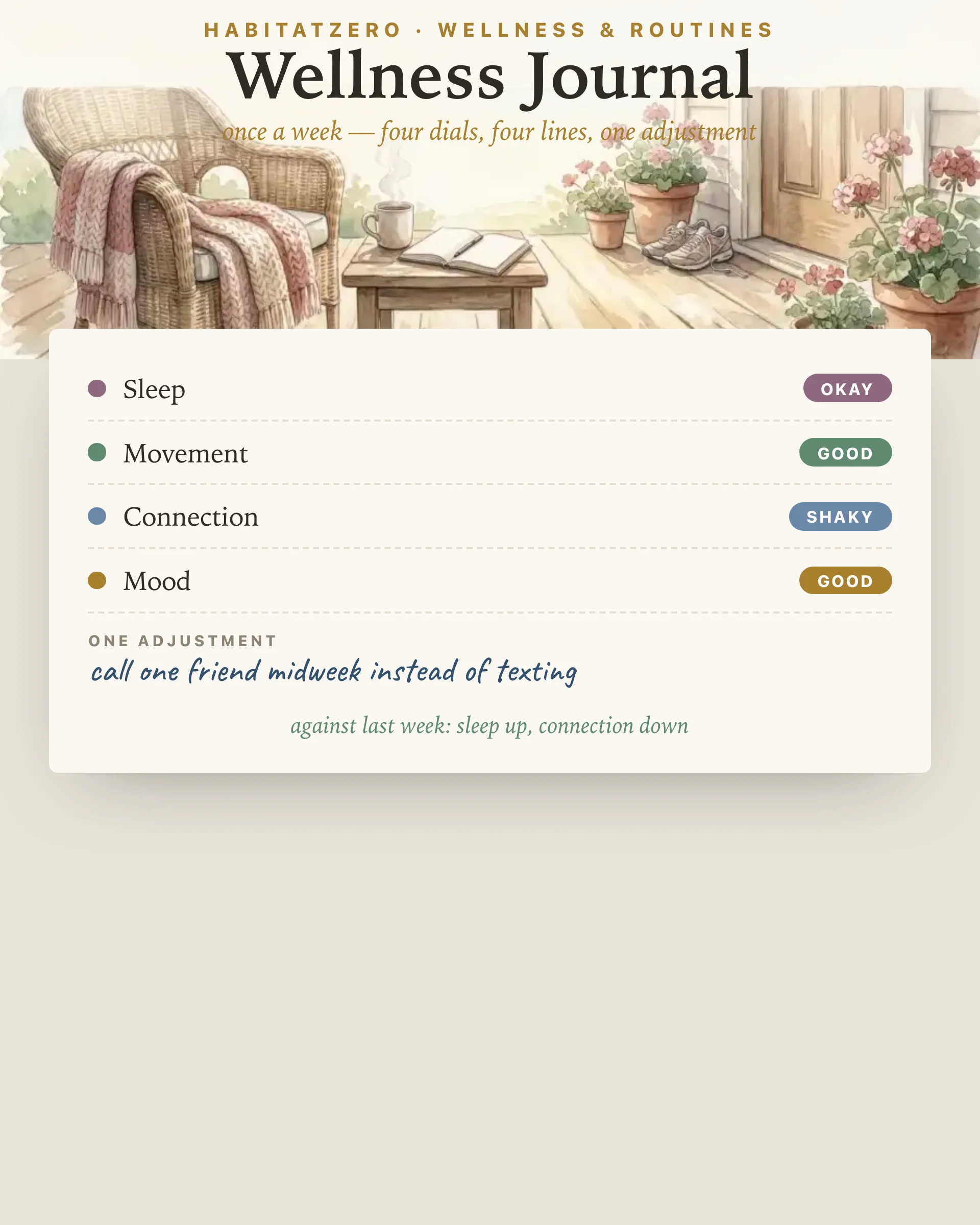
Most weeks don't fail loudly. They slide — half an hour of sleep here, a skipped walk there, three weeks since you saw a friend without a calendar invite — and by the time the slide is obvious, it has momentum. A wellness journal is the instrument for catching the slide early, and it works best at the week's altitude: high enough to see patterns, low enough to still steer.
Every Sunday (or whichever day you make yours), this journal asks for the same four readings:
Sleep. Movement. Connection. Mood. Each rated rough to strong, each given one honest line — asleep late twice, but up with the alarm. Two walks and the Saturday ride. Saw nobody outside work. The four were chosen because they're the levers that most reliably shape how a week feels, they're checkable in seconds without a gadget, and — crucially — each one responds to a small adjustment within a single week. Mood sits last on purpose: read after the other three, it usually stops being a mystery.
Then one decision: a single adjustment aimed at the lowest dial. Not a new regimen — lights out by eleven. One call instead of texts. One per week is a rule, not a suggestion; two adjustments is how none happen. Close the week, and next Sunday the journal reads the movement back to you: against last week: sleep up, movement steady, connection down.
Writing about one's life has a genuine research literature, and this page represents it honestly rather than generously. Smyth's meta-analysis of written emotional disclosure found real benefits for health and adjustment in healthy participants; Frattaroli's later and much larger synthesis across nearly 150 studies confirmed the effect while sizing it modestly. Neither describes miracle journaling — they describe a small, reliable return on structured self-examination.
The weekly review adds the mechanism with the stronger everyday case: self-monitoring. You can't adjust a dial you aren't reading, and four readings a week for twelve weeks turns "I've been off lately" into "sleep has read shaky for three straight weeks, and it started when the early meetings did." That sentence is actionable; the vague version isn't. The twelve-week record — a season, roughly — is kept on the page, each closed week with its chips and its adjustment.
This journal deliberately flies at one altitude, and its neighbors cover the others. The Self-Care Journal works nightly — what drained and refilled today — and stacks under this weekly review naturally: nightly noticing, weekly steering. When a dial needs sustained work rather than one adjustment, the ground-level tools take over: the Sleep Hygiene Quiz finds where the sleep leaks actually are, the Daily Habit Tracker turns move more into stamped days, and a connection dial that keeps reading low pairs well with the Gratitude Jar's habit of noticing people while they're still in the room.
Four dials. Four lines. One adjustment. The slide, caught on Sunday instead of in October.
A recurring check-in on the handful of things that carry a week: here, four dials - sleep, movement, connection, and mood - each rated and given one line, plus a single adjustment for the week ahead. It is a dashboard with a pen, not a diary.
Because the four dials move at a weekly rhythm. A single bad night or skipped workout is noise; a week of them is signal. The weekly cadence also keeps the habit cheap - four minutes on Sunday survives busy seasons that daily journaling does not.
Structured writing about ones life has a real but modest research record: meta-analyses of written disclosure studies report small positive effects on psychological and physical outcomes on average. This page leans on the sturdier mechanism - regular self-monitoring - and keeps its promises to what a weekly review can honestly do: catch a sliding dial early.
Sleep, movement, connection, and mood are the four levers that most reliably shape how a week feels, and each is checkable in seconds without gadgets. If your week has a fifth lever, the line fields are yours - many people fold nutrition into movement or faith into connection.
Small, singular, and aimed at the lowest dial: lights out by eleven, one call instead of texts, a walk before the first meeting. One adjustment per week is a rule, not a suggestion - two adjustments is how none happen.
Altitude. A nightly self-care entry catches how today drained or refilled you; this weekly review reads the four big dials and steers the next seven days. They stack well - nightly noticing, weekly steering - but either works alone.
By the team behind Fabulous, the science-based self-care app used by over 30 million people.