The Overwhelm Recovery ProtocolWellness & Routines · ~5 min
About this template · Updated July 2026
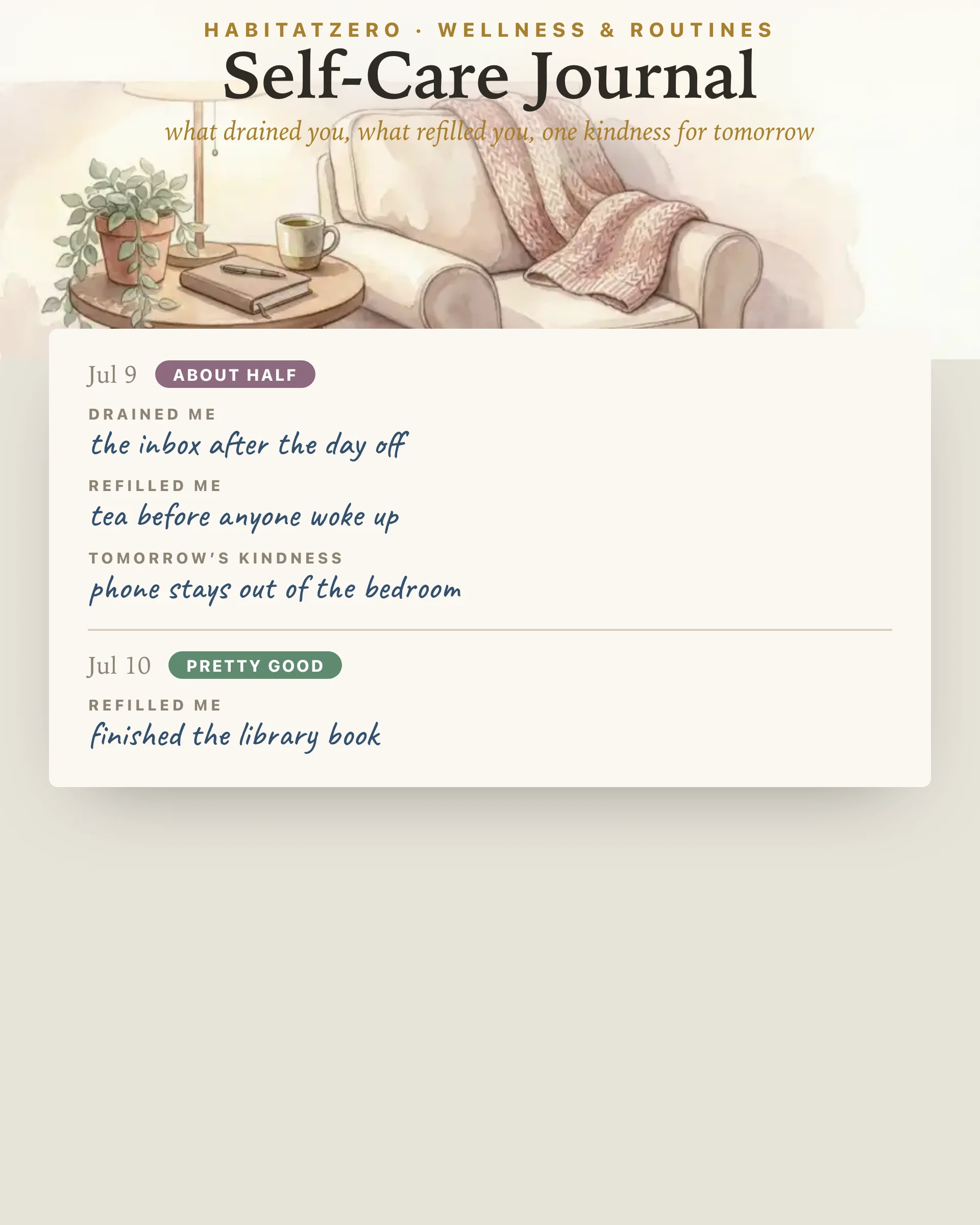
Search for a journal for self care and the results are mostly things to buy — clothbound, gilt-edged, shrink-wrapped promise. The journal itself was never the hard part. The hard part is a form of attention: knowing how empty you actually are before the empty makes the decisions. This page is that attention, kept to three minutes a night.
Each night asks four small things.
A tank reading. From running on fumes to full, one tap for where the day actually left you. It's deliberately the only required part of an entry — the reading is the data, and a week of readings says more about your life than a month of good intentions. The journal quietly averages your recent entries and tells you how the tank has been running, which is how a bad stretch becomes visible on day three instead of week three.
What drained you. One honest line. Not a diary of the day — just the one thing that took the most. Over a couple of weeks this column develops a personality: the same meeting, the same commute, the same 10pm scroll. You can't renegotiate a drain you haven't named.
What refilled you, even a little. The counterweight question, and the one people skip in their heads — which is precisely the case for writing it down. There is a long research tradition behind briefly writing about what's good: in Emmons and McCullough's studies, people who kept short weekly notes on what they were grateful for reported better wellbeing than those logging hassles. The refill line borrows that mechanism and points it at energy: the walk between errands counts, and noticing that it counts is the skill.
One kindness for tomorrow. The entry ends looking forward — one concrete, small act of care with a name on it: lunch away from the desk. The early night, no negotiating. Not a routine overhaul; a single appointment with yourself that tomorrow-you can actually keep.
Brief writing about difficult experiences has one of the older evidence trails in psychology — Pennebaker and Beall's original expressive-writing experiments and the literature that followed, summarized in reviews like Baikie and Wilhelm's, report wellbeing benefits from short, regular sessions. This journal keeps its own claims modest: its clearest value is pattern-noticing — which days drain you, what reliably refills you — caught early enough to do something about. And one boundary worth keeping: if the tank reads running on fumes for weeks, that's a signal for a conversation with someone qualified, not for journaling harder.
The book keeps thirty entries and then asks you to let an old one go before adding tonight's. That's not a storage limit dressed up as philosophy — a self-care journal works as a recent story. The question it answers is "how am I running lately," and lately has a horizon.
When the journal shows a pattern, the neighbors on this shelf pick up the work: a tank that's chronically low pairs well with the Self-Care Checklist (what got skipped?), evenings that drain into scrolling belong to the Evening Digital Detox, and if what refills you keeps being gratitude-shaped, the Gratitude Jar was built for exactly that.
Three minutes. Four lines. The tank, finally on the record.
A short daily record of how you are actually doing and what you are doing about it. This one keeps each entry to four parts: a tank reading from running-on-fumes to full, what drained you, what refilled you, and one kind thing planned for tomorrow. Three minutes, usually at night.
Less than you think. One honest line about the day's drain, one about anything that gave energy back, and one small kindness you intend for tomorrow. The tank reading does the tracking; the lines do the noticing. Entries with one word still count.
Writing briefly about stressful experiences has a long research history, going back to Pennebaker's expressive-writing studies in the 1980s, with reviews reporting benefits for wellbeing when the writing stays short and regular. This page keeps its claims modest: the clearest value is noticing patterns - which days drain you, what reliably refills you - early enough to act on them.
A checklist tracks whether you did caring things; this journal tracks how you are doing and why. They pair well: when the tank reads low for a week, the checklist is a good place to go looking for what got skipped.
The journal keeps a rolling month so the page stays a notebook rather than an archive. When the book is full, you let an old entry go before adding tonight - a small ritual that keeps the recent story in view.
If the tank has read running-on-fumes for weeks, or low mood is getting in the way of daily life, that is a signal to talk to someone qualified rather than to journal harder. This page is a self-help habit, not a treatment.
By the team behind Fabulous, the science-based self-care app used by over 30 million people.