
The Overwhelm Recovery ProtocolWellness & Routines · ~5 min
About this template · Updated November 2026
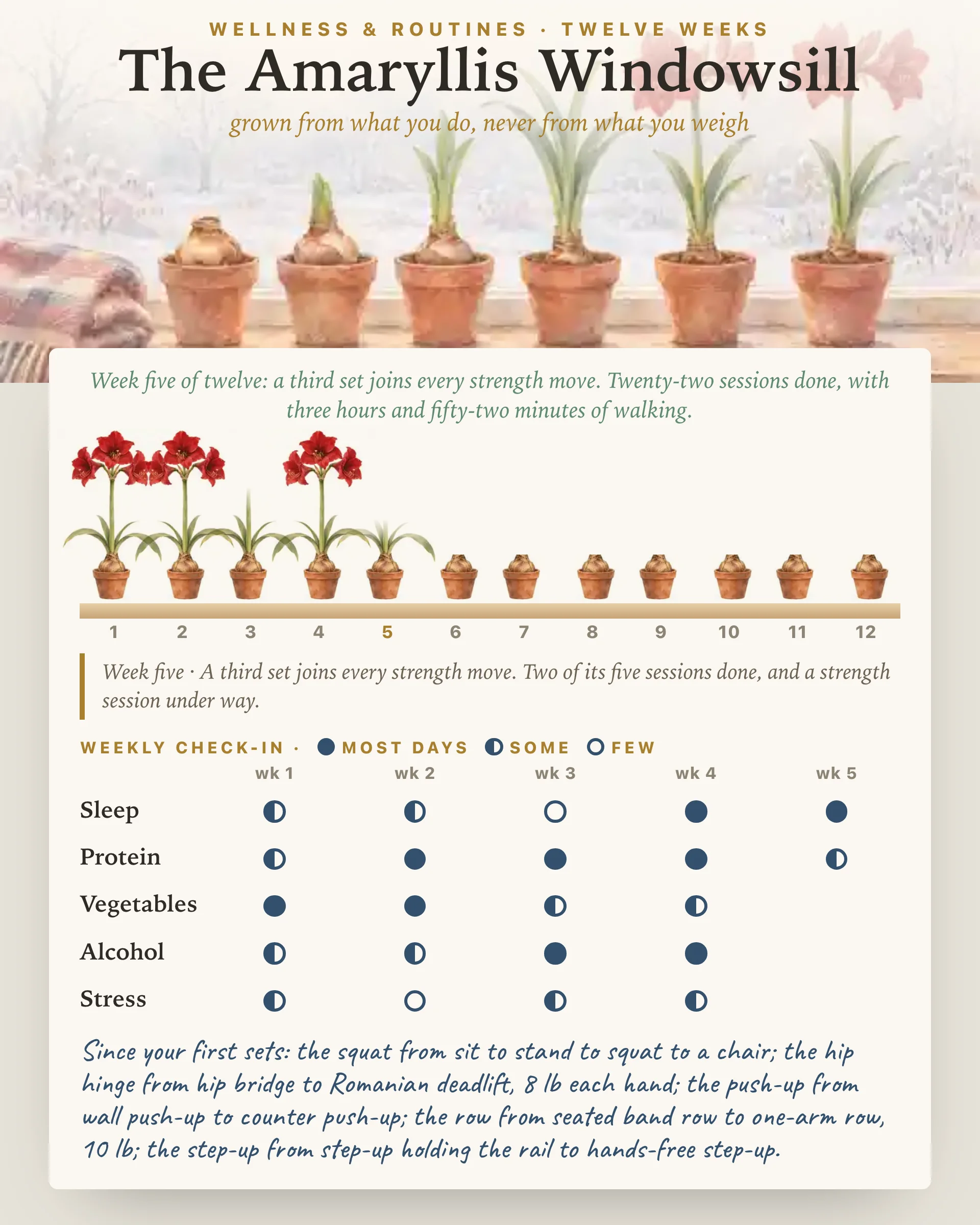
Weight loss for women over forty gets sold with big promises. This page makes none. It gives you twelve weeks of two strength sessions and three walks, a short weekly check-in on habits you rate yourself, and a windowsill of amaryllis bulbs that grow from what you do. There is no scale here, no calorie count and no tape measure, and nothing you log is compared with anyone but you.
Eating does most of the work on the scale. In a year-long trial of 439 postmenopausal women, run by researchers at a cancer research center in Seattle, women who changed what and how much they ate lost several times more weight than women who only took up aerobic exercise, and the two together did best. The volunteers were inactive, mostly white and fifty-eight on average, and the exercise was aerobic only, so the trial says nothing about strength work or about women in their forties who have not reached menopause.
Movement earns its place differently. A 2026 review of thirty-four randomized trials by sport scientists in Germany pooled 1,455 adults with overweight or obesity who ate less to lose weight. Adding exercise kept close to half of the lean mass that eating less alone would have taken. Strength work, and strength mixed with aerobic exercise, looked strongest, though the gaps between kinds of training were not clear-cut. Most trials measured lean mass as a whole rather than muscle itself, and the review was not limited to women over forty.
Body composition shifts around menopause as well. A long-running study that followed women across the United States with regular body scans found that fat gain sped up and lean mass began to fall as the menopause transition started, and both trends ran on until about two years after the final period before leveling off. Weight itself kept rising at the same steady pace it had before. This kind of study shows timing, not cause, and it describes averages.
Is your metabolism to blame? Less than you might think. An international team measuring daily energy use in people aged eight days to ninety-five found it held steady from about twenty to sixty once lean mass was taken into account. It did not study menopause itself, but it is a fair reason to distrust anything sold as a metabolism fix.
Put together: eating shapes the scale, while strength work and walking help you keep muscle and fitness whatever the scale does.
Each week holds two strength sessions and three walks in any order, and the next week opens once all five are in. A strength session runs twenty-five minutes for the first four weeks: five of marching and arm circles, then ten sets of about two minutes each, rest included. From week five a third set joins every move, making thirty-five minutes.
The five moves are a squat, a hip hinge, a push-up, a row and a step-up, each at three levels, such as sit to stand at a chair up to a goblet squat. Log the level, any weight and the reps for every set. Once two sessions in a row bring every set of a move to twelve reps at the same level and weight, the sheet offers the next step; a session at another level, or one ended early, breaks the run. A set under eight suggests easing off.
Walks grow from fifteen minutes to forty-five: three easy, a brisk middle where you could talk but not sing, and three easing off. The clock keeps real time while your phone sleeps, waits while you pause, and counts only whole minutes walked, so a walk ended early keeps the minutes you did.
Every week is a pot on the sill, its stem rising with the sets and minutes you finish and flowering when all five sessions ran whole.
This page sets no eating rules and lists no foods to avoid. The check-in asks how often five plain things went the way you wanted: sleep, some protein at meals, vegetables or fruit, alcohol, and stress. You rate each as most days, some days or few days, and each answer sits beside your own earlier weeks. If thoughts about eating, food or your weight begin to feel heavy or hard to manage, please bring them to a doctor. Questions about your thyroid, your medicines or weight-loss treatment belong there too.
Strength Training for Women Over 40 is three lifting days a week on a whiteboard of rotating workouts, with no walks or habits. The Walking Plan for Weight Loss is four weeks of walks strung as beads and restrung from how each week felt. The Training Consistency Planner is about showing up at all, with session stamps and no sets or minutes. Use this one for strength, walking and habits in one honest view.
Talk with a doctor or physical therapist before week one if you have had a fall, dizzy spells, a joint replacement, a heart or blood pressure condition, or pain that comes and goes. Stop any move that hurts. Keep a sturdy chair or the kitchen counter close for step-ups and every other standing move, and hold on whenever you need to.
Body composition shifts around menopause. A long study of women in the United States found that fat gain sped up and lean mass began to fall at the start of the transition, even though weight itself kept climbing at the same steady pace. Sleep, stress and moving less can add to it.
Changes to eating drive most of the weight that comes off, and exercise adds a little more on top. What exercise does best is protect muscle: in a review of trials, strength work, especially mixed with aerobic exercise, kept the most lean mass while people lost weight. This plan pairs two strength sessions with three walks a week.
No. This sheet asks for neither. It keeps your strength sets, your walking minutes and five habits you rate yourself, and it compares them only with your own earlier weeks.
Probably less than you have been told. A large study of daily energy use found it held steady from about twenty to sixty once the size of a person's lean mass was accounted for. It describes averages and did not study menopause itself, so it cannot speak for any one woman.
Before starting, if you have had a fall, dizzy spells, a joint replacement, a heart or blood pressure condition, or ongoing pain. A doctor is also the right person for questions about your thyroid, your medicines or weight-loss treatment, and for thoughts about food or your weight that feel hard to manage.
By the team behind Fabulous, the science-based self-care app used by over 30 million people.


