
The Overwhelm Recovery ProtocolWellness & Routines · ~5 min
About this template · Updated September 2026
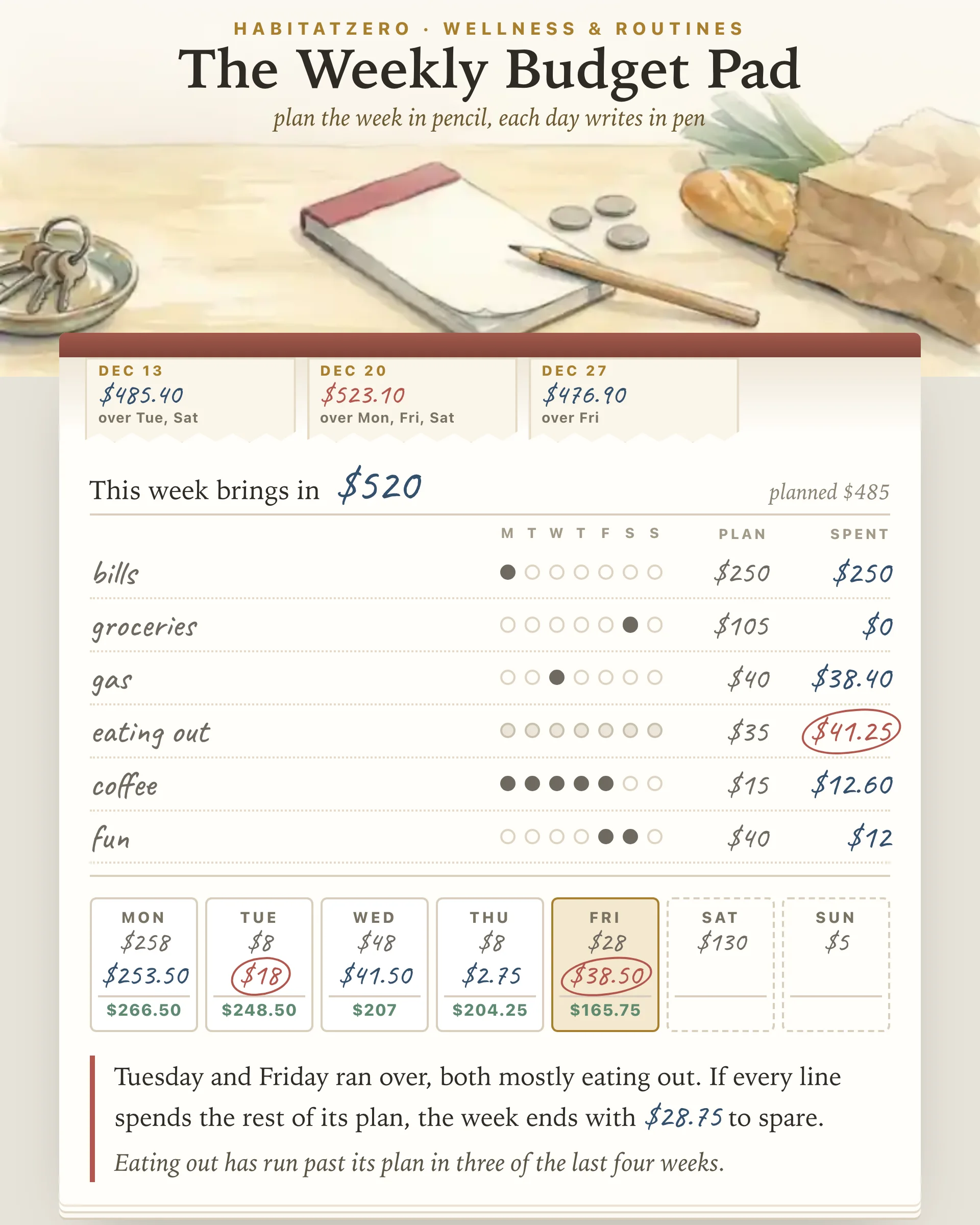
A month is a long stretch to steer by. The budget that looked tidy on the first has usually drifted by the twentieth, and nobody remembers which Tuesday started it. A week is short enough to hold in your head, and one expensive day has six others around it to make up the difference.
This page is a weekly budget worksheet made as a tear-off pad. You plan the week in pencil, each day writes in pen, and the sheet does the adding: what every day was meant to spend, what it did spend, and what the week has left.
Start at the top with what the week brings in. That can be a weekly paycheck after tax, an allowance, or the spending money that remains once this week's share of the rent is set aside. If your pay lands on a Friday, tap the week's span until it runs Friday to Thursday.
Then write the plan. Tap a line such as groceries or gas, or name your own, give it an amount, and tap the day it usually lands on. A line you leave unpinned is shared evenly across the seven days, so $35 for eating out becomes $5 a day. The plan holds eight lines.
Under the plan sits the week itself, seven boxes in a row. Each shows its planned amount in gray pencil, what it spent in blue pen, and underneath, what the week still holds once that day is done. Tap a day, pick the line, type the amount and jot it. A single day takes up to ten lines.
The pad circles two different things in red, and the difference matters.
A day runs over when it spends more than its share of the plan. A line runs over when its total for the week passes the amount you gave it. The two often move together, but not always. If the big grocery run happens on Tuesday instead of Saturday, Tuesday gets a circle, Saturday will come in far under, and the groceries line is fine. A circled line is the stronger signal: that kind of spending has already outgrown its plan, and the rest of the week has to absorb it.
The note at the bottom puts both into plain words: which days ran over and what pushed them, which lines are past their plan, what is left, and how the week ends if every line spends only the rest of its plan.
When the week is done, tear it off. The stub keeps the week's total and the days that ran over, the plan and the pay stay for the next sheet, and each line shows what it took last week. Once a few stubs pile up, the note starts naming the line and the weekday that run over most often. The pad keeps six.
Planning the coming week is harder than it feels. In four studies of personal spending forecasts, Peetz and Buehler found that people expected to spend a good deal less in the next week than they actually did, and less than they remembered spending the week before. Wanting to save pulled the forecasts down without pulling the spending down with them. That is why each line here shows what it took last week: a stub is a steadier guide to next week than a hopeful number.
Ten studies by Howard and colleagues help explain the gap. Estimates lean on the typical costs that come to mind easily, and because the occasional large bill pulls the average up, a typical stretch costs less than an average one. Asking people why their spending might differ from usual made their forecasts larger and more accurate. So before you plan, ask what could make this week unlike the last, such as a birthday, a school trip or a car that sounds wrong, and give it a line or leave some money unplanned.
The Consumer Financial Protection Bureau's spending tracker adds things up the way this pad does, with totals by category and one column for each week of the month. It recommends tracking a full month when you can, since a month shows all your income and expenses in one place, and suggests trying one or two weeks when a whole month seems too hard. Four or five stubs make that month.
None of this shows that a weekly worksheet will, by itself, leave you with more money. The research is about forecasts and attention, not about savings. This pad does arithmetic and puts the answer where you can see it. It is not financial advice, and it cannot tell you what your week ought to cost.
Reach for it when pay comes every week, when one bad day can sink the week, or when a monthly budget keeps slipping away by the fifteenth. January, with December still fresh on the bank statement, is a natural place to start. If you are paid every other week, The Biweekly Budget matches each bill to the paycheck before it, and The Zero-Based Budget gives every dollar of the month a job before the weeks begin. If one line keeps collecting circles, The No-Spend Challenge can give that kind of spending a rest.
Begin with the money this week really brings in after tax. List the kinds of spending it has to cover, give each one an amount, and note the day it usually happens, such as groceries on Saturday. Then write down what goes out each day and hold it against that day's share of the plan. Whatever the plan leaves unclaimed is your cushion for surprises.
Five pieces do nearly all the work: the week's income, a planned amount for each spending line, a record of each day's spending, a running figure for what is left, and a way to spot which days and lines went past their plan. This pad keeps all five on one sheet and does the arithmetic as you write.
A weekly budget suits pay that arrives every week, weeks where one expensive day changes everything, and anyone who loses the thread of a monthly plan by the middle of the month. Rent and other monthly bills still need a month view, so a common approach is to set aside a fixed share of them each week and plan the rest of the week around what remains.
Read it as information, not as a verdict. Check what pushed it over, then either take the difference from a line that still has room or trim the days that are left. The note at the bottom of the pad shows whether the week can still finish above zero if the remaining lines keep to their plan.
The filled-in example on this page can be read by anyone without signing in. Planning your own week, jotting each day and keeping a stub for every week you tear off all happen in HabitatZero, at no cost.
By the team behind Fabulous, the science-based self-care app used by over 30 million people.


