
The Overwhelm Recovery ProtocolWellness & Routines · ~5 min
About this template · Updated September 2026
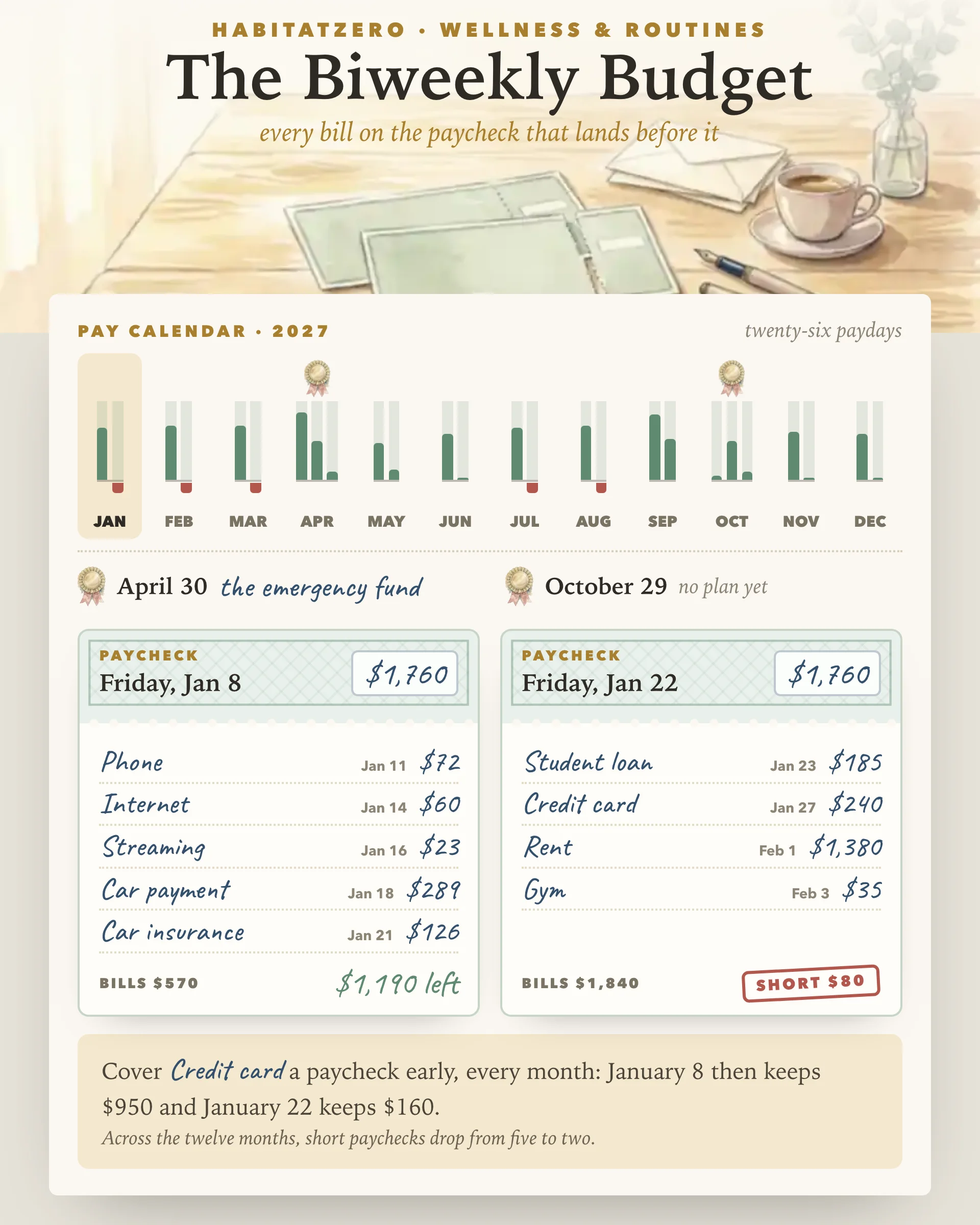
If you are paid every other Friday, your money runs on a two-week clock while your bills run on a monthly one. Most of the strain in a biweekly budget comes from the gap between those two clocks, and the schedule is common: in a Bureau of Labor Statistics count for February 2023, 43.0 percent of private establishments paid every two weeks, more than used any other pay period.
Twenty-six paychecks do not divide evenly into twelve months. In most years ten months bring two paydays and two months bring three. Two paydays only span four weeks, so they land up to three days earlier in each new month, until one month is long enough to hold three and the cycle starts again. Your rent stays due on the 1st, so the paycheck that covers it keeps changing. For someone paid on January 8, 2027, February's rent comes out of the January 22 paycheck, May's out of the April 30 one, and October's out of the paycheck that lands on October 1 itself.
That drift is why one paycheck in the month so often feels thin. It tends to carry the late-month bills and the next rent together, while its partner carries a handful of small early ones. A plan that splits every month into paycheck one and paycheck two hides this, because it assumes the pairing never changes.
You start with one paycheck: the amount it brings home and the day the next one lands. The page counts forward fourteen days at a time and lays out the next twelve months as paychecks, each drawn as a check with a stub.
Then you add bills, tapping the usual ones and giving each a due day and an amount. Every bill is filed under the last paycheck that arrives on or before its due date, so a bill due on payday itself counts on that paycheck. Each stub lists what its paycheck carries and what is left once those bills are paid.
When a paycheck cannot cover its stub, it is stamped short and the page looks for a fix. It tries paying one or two of that paycheck's bills a paycheck early, every month, and keeps the option that closes the gap without leaving the earlier paycheck short, favoring whichever leaves the fewest short paychecks across the year. The offer shows what both paychecks would keep, and one tap applies it or puts it back.
The pay calendar above the paychecks draws one bar for each, tall for a light one and red below the line for a short one. Months with a third payday wear a gold seal, and each of those paychecks gets a line for what it is meant to do.
Over a year, twenty-six paychecks cover twelve months of bills, two more paychecks than a twice-a-month schedule would bring. That is where the bonus-paycheck idea comes from, and the arithmetic holds. The timing is less tidy. A month's third payday always falls on the 29th, 30th or 31st, so if your rent is due on the 1st, that paycheck is the one paying next month's rent, and the spare room turns up in the paychecks before it, sometimes back in the previous month. The bars show where it lands for your own bills. Naming a job for that money before it arrives is the point of marking it.
The Consumer Financial Protection Bureau's cash flow budget tool also trades months for shorter stretches. It asks you to track the timing of your income and expenses from week to week and reads a negative ending balance as a week where you are falling short. A companion tool notes that you may be able to change the due dates of some bills or loan payments so they better match when your income arrives, which can do the same job as moving a bill to an earlier paycheck.
Working from transaction and balance data, Michael Gelman and colleagues found that spending rises when anticipated income arrives, but that the rise comes largely from regular bills being timed to land with regular pay. What remains is concentrated among people with less cash to fall back on. Many households, in other words, already pair bills with paychecks by instinct; this page writes the pairing down.
No study has tested this worksheet, and it only does arithmetic. It works from a single figure for every paycheck, so it cannot follow pay that changes with your hours, and it does not know about federal holidays, when a deposit usually arrives a day early. It will not tell you what to cut or where your money should go.
The week between Christmas and New Year suits it well: the new year's paydays are set, and what the holidays cost is still fresh from The Christmas Budget. It is just as useful after a new job, a raise or a move. If the third paychecks need somewhere to go, give that money a target on the Savings Tracker. If one pay period keeps coming up short, run The No-Spend Challenge across those two weeks to see how much the small purchases were taking.
It is a budget built on paychecks that arrive every other week rather than on the calendar month. Each bill is matched to the paycheck that lands before its due date, so every paycheck carries a known set of bills and a known amount left over for everything else.
Write down every bill with its due day and usual amount, then hand each one to the last paycheck that arrives on or before that day. Subtract to see what each paycheck leaves. When one comes up short, pay a bill from the paycheck before it, or ask the company whether the due date can move, a step the Consumer Financial Protection Bureau also suggests.
Biweekly pay arrives every two weeks on the same weekday, which makes twenty-six paychecks in most years. Semimonthly pay arrives twice a month on fixed dates such as the 1st and the 15th, which makes twenty-four. This page is built for the every-two-weeks kind, where the paydays drift against the calendar.
It depends on which Fridays you are paid. With paydays on January 8 and 22, April and October each bring a third paycheck. With paydays on January 15 and 29, July and December do, and January as well unless the New Year's Day deposit moves back to December 31. Enter your next payday and the pay calendar seals those months for you.
The filled-in example on this page can be read without an account. Entering your own pay, payday and bills, and keeping them from one payday to the next, happens in HabitatZero at no cost.
By the team behind Fabulous, the science-based self-care app used by over 30 million people.


