The Overwhelm Recovery ProtocolWellness & Routines · ~5 min
About this template · Updated September 2026
December rarely breaks a budget with one big purchase. It does it with forty small ones, each of which felt like a one-off at the register: the extra candle for the hostess, the roll of ribbon, the second grocery run because more people are coming. This page is a Christmas budget template built to keep all of those under a single number that you chose in advance.
Most gift lists get built from the bottom up. You write names, think of presents, and find out what the season cost sometime in January. Across seven studies, Abigail Sussman and Adam Alter found that people are fairly good at predicting what they spend on ordinary things and consistently underestimate what they spend on exceptional ones, partly because each unusual purchase gets treated as a unique event instead of one member of a large family of unusual purchases. Holiday spending is that family. A present, a party outfit and a tin of cookies for the mail carrier do not feel related, so nobody adds them up.
Starting from the total reverses the order. Every name and every errand has to take its share out of one figure you settled beforehand. The U.S. Consumer Financial Protection Bureau lays out the same sequence in its holiday guidance: settle what you can afford for the season first, count gifts, travel, parties and decorations inside it, and keep track of what you spend as you go.
The gifts are the part everyone remembers to budget. The rest is where plans leak. In the National Retail Federation's 2025 survey, shoppers expected to spend $890.49 each on the winter holidays, and only $627.93 of that was for presents. The remaining $262.56 was earmarked for food and candy, decorations, greeting cards and similar seasonal items. Put differently, close to thirty cents of every holiday dollar in that survey went to something nobody unwraps. Those are averages of stated plans, not a target. The point is narrower: a budget that lists only people is missing nearly a third of itself.
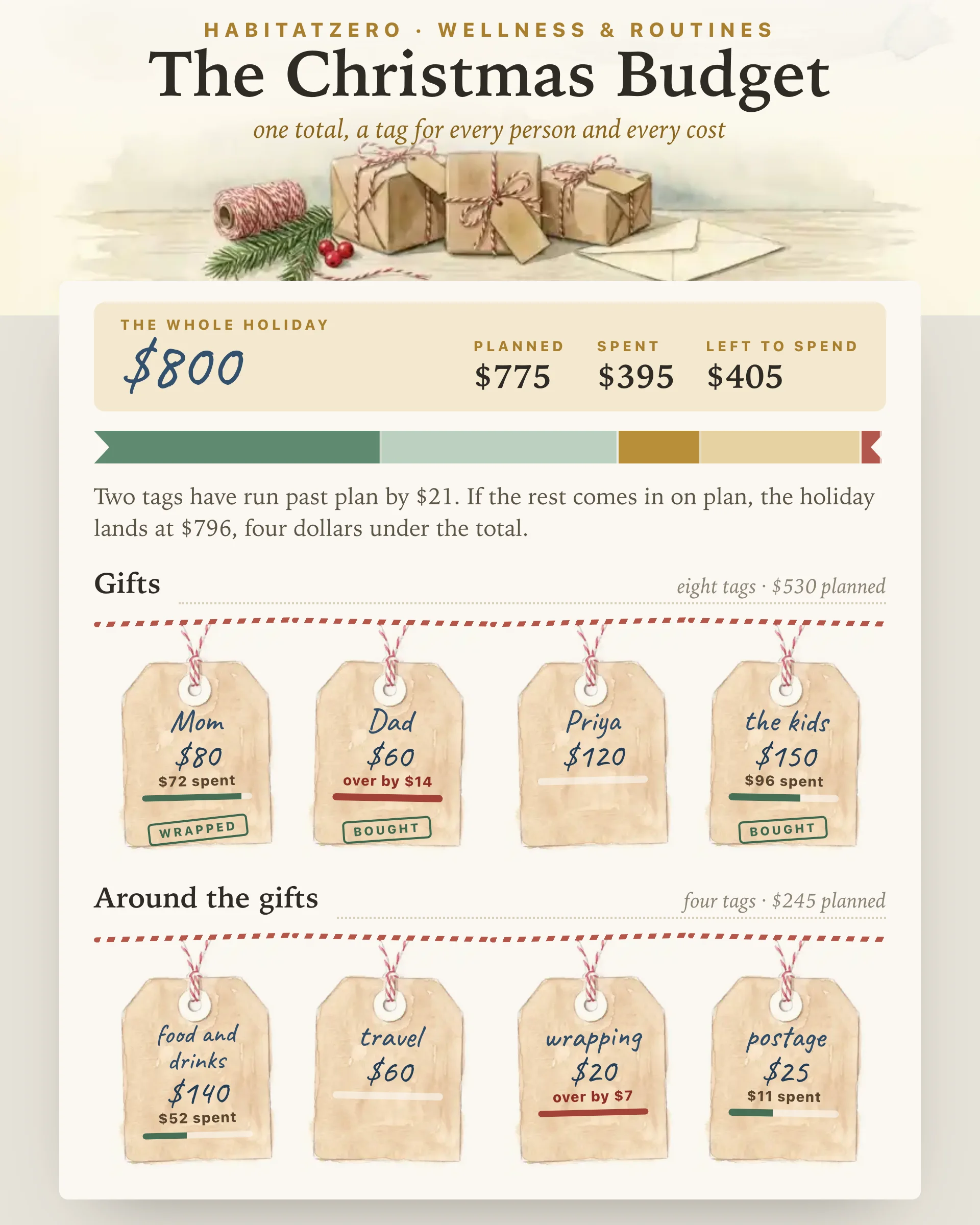
That is why the page has two strings of tags: one for people and one, Around the gifts, for food, travel, wrapping, postage and the rest.
Write the total at the top, or tap a round figure to start, and choose the dollar, pound or euro sign. Then hang tags. Faded tags on each string suggest the usual names; tap one and it becomes yours, or write a name on the line beneath. A fresh tag opens at once so you can set its amount by tapping a round number, nudging it by fives, or typing. Price the people you are sure about, then press share out the rest: the money with no job yet is divided evenly across the gift tags still blank.
When you buy something, open that tag and log what you paid. Purchases stack up on the tag, so two small presents for the same person add themselves. A bar on the tag fills as you spend, a gift tag gets stamped bought and later wrapped, and a tag that passes its plan shows a red bar and says by how much.
Above the strings, a ribbon the length of your total shows the whole picture: green for gifts, gold for everything else, dark where money is already spent, pale where it is still to come, red for overruns and a hatched stretch for money with no job yet. Under it the page states the standing in sentences: how much is unassigned, how much is left, which tags ran over and, most useful of all, where the holiday will land if everything still unbought comes in on plan.
Chip Heath and Jack Soll showed that consumers set budgets for kinds of spending and track purchases against them, and that a purchase counts against a budget more reliably when it is a typical member of its category. They also found the flip side: because no budget can foresee everything, a fixed allocation sometimes leads to spending too little in one place and too much in another. So treat a tag as a plan, not a verdict. When one runs over, decide where the difference comes from, another tag or a higher total; the page shows both numbers.
None of this research tested this worksheet, and no study promises that writing a budget lowers what you spend. The page does arithmetic. It does not tell you how much a holiday should cost, who deserves what, or how to pay for it.
Set it up before the first purchase, a few weeks out if you can. Come back after each shopping trip, while the receipts are still in your pocket. If the total is something you are still saving toward, a Goal Tracker will show the fund filling up. If the food tag is a guess, plan the actual dinners in the Meal Planner and price the grocery list. Once the wrapping paper is cleared away, the final numbers here are the best starting point for next year's total, worth noting beside your New Year Goals.
Begin with a single figure for the whole season, then divide it. Give every person on your list a share, give the non-gift costs their own shares, and record each purchase against its line as you go. This template does the adding and tells you what is left after every entry.
Food and drinks, travel, wrapping paper and tape, postage for packages and cards, decorations, the tree, party clothes and charity donations are the usual ones. The second string of tags on this page exists for exactly these, because they tend to get paid for without ever being planned.
In the National Retail Federation survey for 2025, US shoppers expected to spend $890.49 each on average, of which $627.93 was for gifts and $262.56 for food, decorations, cards and other seasonal items. Those figures are averages of stated plans, not a recommendation for your household.
The bar on that tag turns red and the tag states the overrun. The standing at the top names every tag that went past its plan, totals the damage, and recalculates where the holiday will finish, so you can see whether to trim another tag or lift the total.
Yes. The filled example on this page is open to anyone. To keep a budget of your own, with your names, amounts and purchases saved between shopping trips, open it in HabitatZero, which costs nothing.
By the team behind Fabulous, the science-based self-care app used by over 30 million people.