
The Overwhelm Recovery ProtocolWellness & Routines · ~5 min
About this template · Updated September 2026
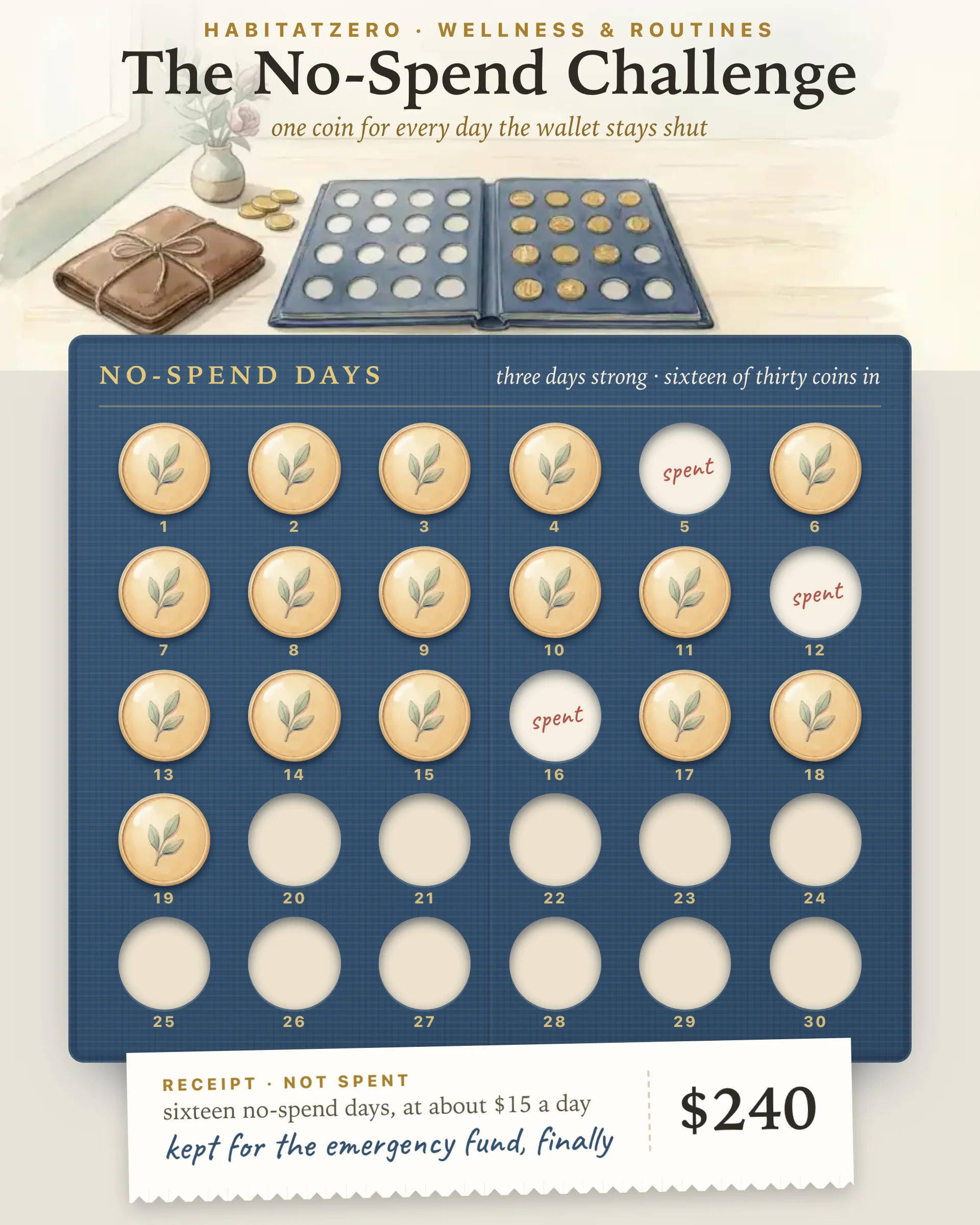
A no-spend challenge is a fixed stretch of days, usually a week, two weeks or a month, during which you pay for what you need and nothing else. Rent goes out. Groceries come in. The takeaway coffee, the delivery order and the cart you filled at eleven at night all wait until the stretch is over. January is the classic month for it, though any clear first day will do.
It is closer to an experiment than to a budget. For a few weeks you remove the small automatic purchases and watch what happens: which ones you miss, which ones you forget entirely, and what time of day the itch arrives.
Most challenges that collapse do so in the gray zone, not in a store. Is a colleague's birthday gift a slip? Is a replacement phone charger? If you decide in the moment, the answer will always be the convenient one, so decide now.
The worksheet gives you two short lists. Still allowed holds the needs that never count against you: housing, bills, groceries from a list, transport to work, medicine, anything already promised. Off the table holds the wants this particular challenge is about, named the way you would name them. Each list stops at six lines, and one item cannot sit on both sides. If a purchase turns up that neither list covers, you have just discovered a rule; write it down before you decide.
The page is built as a coin collector's folder with one round slot for each day. At the end of a day with no spending outside your allowed list, tap that day's slot and a coin is pressed in. If you did spend, tap again and the slot is marked spent in red pen. A third tap clears it.
A spent day asks what set it off: a long day, boredom, a sale or an ad, being out with people, stress, or plain autopilot. One tap answers.
Below the folder, a receipt adds everything up. It counts your no-spend days, your longest unbroken run and your days with spending. Tell it roughly what an ordinary day of extras costs you, and it multiplies that figure by your coins to estimate what stayed in your account. When two or more slips share a cause, the receipt says so in a single line. Pick what the money is for and that lands on the receipt too, in your handwriting.
A slip costs one slot and nothing else. Your run restarts with the next coin, and every earlier coin stays where you pressed it.
We could not find a controlled trial of no-spend challenges themselves, so nobody can honestly promise you a result. The moving parts have each been studied.
A meta-analysis of 138 studies on progress monitoring found that checking in on a goal made reaching it more likely, and that the effect grew when progress was physically recorded instead of carried in the head. A folder filling with coins is that kind of record.
The slip rule has some backing as well. In a study that followed people building everyday habits, missing a single opportunity did not materially affect how the habit formed. That work looked at habits like eating fruit at lunch, not at money, so read it as a case for patience and not as proof about spending.
The pattern line on the receipt exists to feed an if-then plan. Across ninety-four tests of plans phrased as "if this situation comes up, I will do that", people who wrote such plans reached their goals more often than people who simply meant to.
What the challenge cannot do is close a gap between income and essentials. If the allowed list alone outruns your pay, the useful next step is a full picture of the month, and the Consumer Financial Protection Bureau's guide to creating a budget begins where this page does, with logging what you actually spend. The kept figure on the receipt is an estimate built from your own guess, not a bank balance, and nothing on this page is financial advice.
Say the receipt tells you that two of your three slips came after a long day. That points at Thursday evenings, and willpower has little to do with it. Write the plan in the shape the researchers used: if I get home wrecked and want to order in, then I eat the freezer meal first and decide afterwards. When the pull is strong and specific, Urge Surfing gives you a fifteen-minute timer for riding it out with your card still in the drawer.
Start one after a costly month, ahead of a savings target, or whenever your card statement surprises you. Begin with a week if a month sounds grim; a finished week teaches more than an abandoned month. If the money has a destination, give it a home on the Goal Tracker so the total keeps climbing after the folder is full.
Decide before the last day what happens on the day after it, because a challenge that ends in a celebratory spree has only postponed the spending.
It is a set number of days, often seven, fourteen or thirty, in which you only pay for needs you listed in advance. Everything else waits. The aim is to see where small automatic purchases go and to send that money somewhere you chose instead.
You write them yourself before the first day. One list names what is still allowed, such as housing, bills, groceries, transport to work and medicine. A second list names the wants you are pausing. Anything that appears on neither list becomes a new rule the first time you meet it.
A week is long enough to notice your habits and short enough to finish. Two weeks covers a full pay cycle for many people. A month shows the most, including the weekends that usually cost you. This tracker offers all three and keeps your coins if you decide to extend.
You mark that day as spent and carry on the next morning. The folder keeps every coin you already earned, and only your current run restarts. If you tap a reason for the slip, the receipt points out when the same trigger keeps showing up.
The filled folder shown on this page is only an example. To press your own coins and find them still there tomorrow, open the template in HabitatZero with the personalize button. There is no charge for that.
By the team behind Fabulous, the science-based self-care app used by over 30 million people.


