
The Overwhelm Recovery ProtocolWellness & Routines · ~5 min
About this template · Updated November 2026
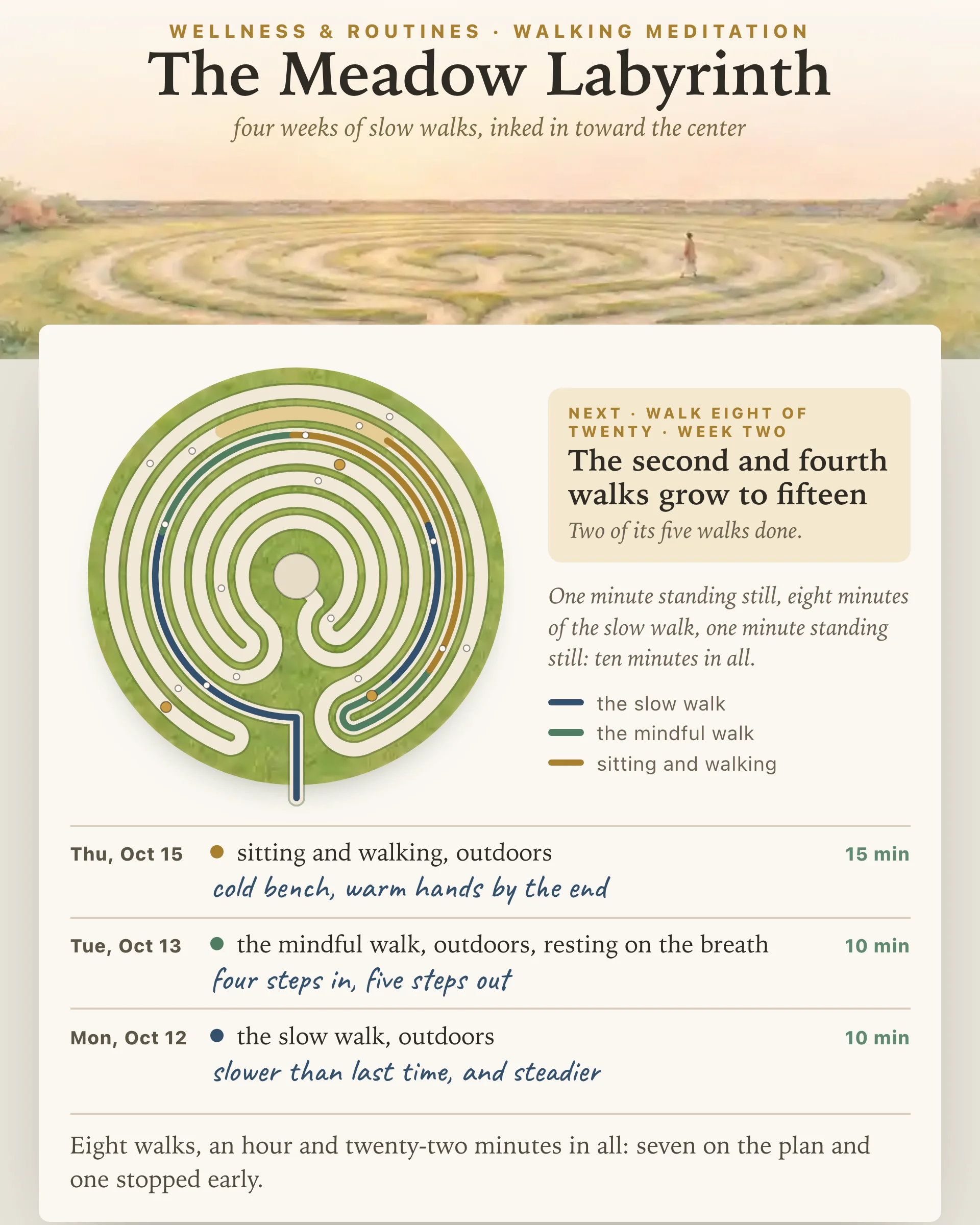
Walking meditation is ordinary walking with the hurry taken out. You walk a short path slowly and give your attention to the walking itself: the heel lifting, the foot traveling forward, the sole settling onto the ground. When your mind drifts off to the shopping list, you notice, and you come back to your feet.
The practice comes from Buddhism, where slow walking up and down a short path has long been paired with sitting meditation, so practice can go on when the body needs to move. You do not have to share that tradition to take up the walk, but it deserves the credit.
The slow walk. Find a lane of ten to twenty steps on a quiet path, or a hallway. Stand still for a minute, then walk the lane far slower than usual, silently noting lifting, moving and placing with each foot. At the end, stop, turn slowly, take one breath and walk back.
The mindful walk. Walk at your normal pace on a quiet route, or in loops through two rooms, resting your attention on one thing: the press of your feet, how many steps fit into each breath, or the sounds around you. This is what most people mean by mindful walking.
Sitting and walking. Five minutes seated with your attention on the breath, then five minutes of slow walking beside your chair or bench, taking turns until the time is up.
The plan runs four weeks, five walks a week, growing from ten minutes to twenty. Choose a walk and a place, indoors or out, and the cue card lays out its parts, each with its minutes and a few spoken lines. Read it once, start the timer and put the phone in your pocket.
The timer keeps true time while the screen is locked. End a walk early and only the whole minutes you walked go in the log, marked stopped early, and that walk comes up again. The plan moves on only when a walk runs its full length, and only once a day; a second walk the same day goes in as an extra.
Every planned walk owns a stretch of the labyrinth's single path, as long as its minutes. Finish a walk and its stretch inks in, in the color of the walk you chose; stop early and a pencil line shows how far you got. The twentieth walk reaches the center. Afterward you can add a short line about what you noticed.
This page stays with the walking itself. To set out looking for something vast or new, try The Awe Walk. To sit instead, The Fold-Out Script paces a seated practice you can read aloud, and The Meditation Timer keeps time for a sit of any length.
Trials of walking meditation are few and small, and their results are mixed.
So treat walking meditation as a practice, not a treatment. It never replaces care for anxiety, depression or any other condition. If worry or low mood is wearing you down, talk with a doctor or therapist and let the walks sit alongside that help.
The slow walk spends long moments on one foot, so it asks more of your balance than it looks. If you have had a fall, dizzy spells, a joint replacement or pain when you walk, check with a doctor or physical therapist first and keep a wall or counter within reach. Keep your eyes open, walk where the ground is even and the light is good, and sit down if you feel unsteady or unwell.
Any day you can spare ten to twenty unhurried minutes: first thing in the morning, after a long stretch at a desk, or in the evening when the day is still buzzing. On cold or crowded days the hallway counts as much as the path outside.
Stand still for a moment, then walk slowly along a short path, giving your full attention to each step: the heel lifting, the foot moving forward, the foot placing down. At the end of the path, stop, turn and walk back. Whenever your mind wanders off, notice where it went and return to your feet.
The words overlap, and many people use them for the same thing. Here, walking meditation means the slow, formal kind done back and forth on a short lane, while mindful walking means an ordinary walk at your usual pace with attention resting on one thing, such as your feet, your breathing or the sounds around you.
Ten minutes is a good first length, and many people settle at fifteen to twenty. This plan starts at ten and reaches twenty in the fourth week. A shorter walk you actually take is worth more than a long one you keep putting off.
Yes. A hallway or the longest clear line across a room works well for the slow walk, since ten steps each way is plenty, and a loop through two rooms or around a table suits the mindful walk. Indoors you also get a wall to touch if your balance needs it.
Some small trials found lower stress or anxiety scores after mindful walking or a short meditation, but the studies are few, small and mixed, and none shows that it treats an anxiety disorder. Take it up as a practice. If worry or low mood is getting in the way of your days, talk with a doctor or therapist, and keep walking alongside that care rather than in place of it.
By the team behind Fabulous, the science-based self-care app used by over 30 million people.


