Leaves on a StreamEmotional Fitness · ~3 min
About this template · Updated September 2026
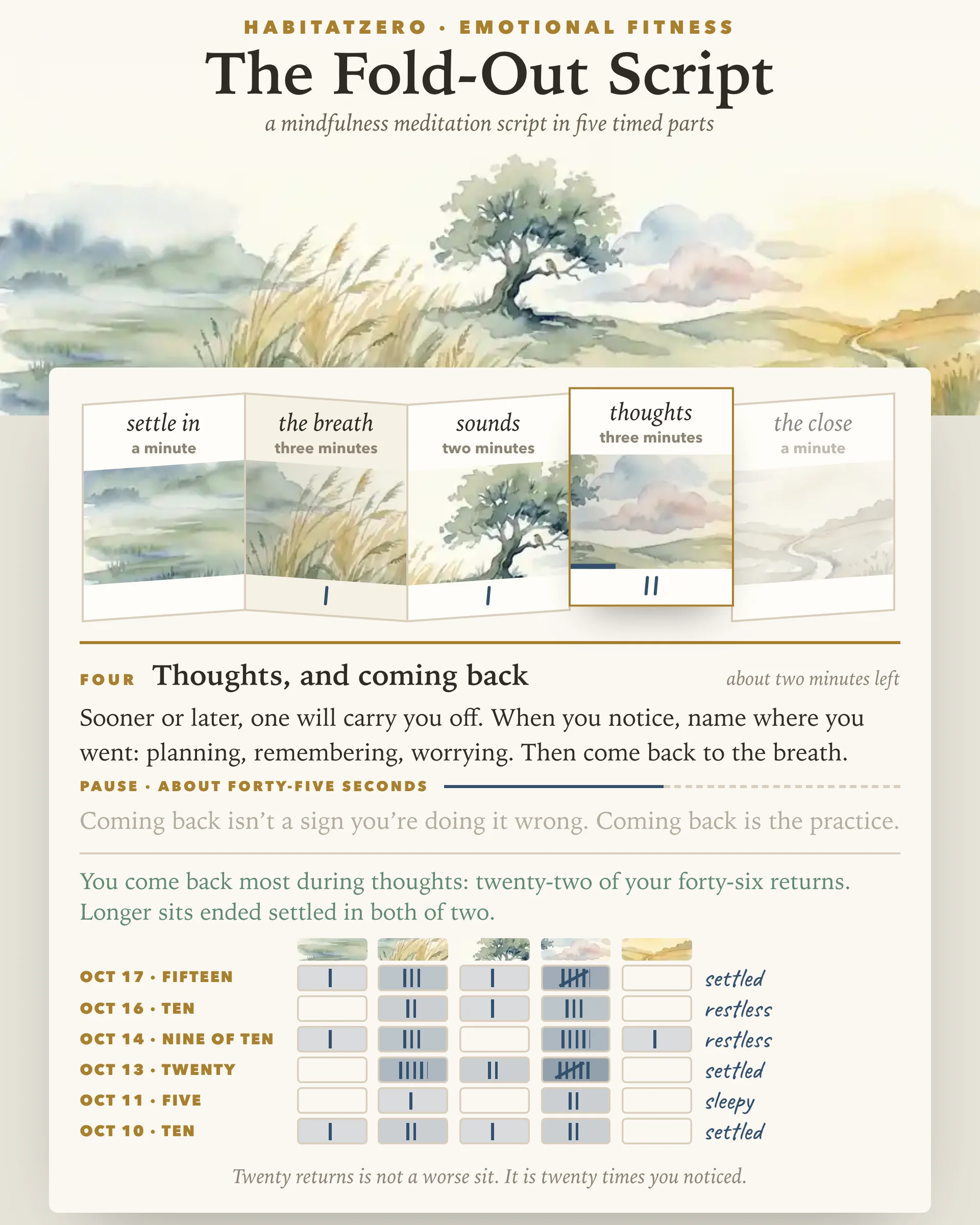
A mindfulness meditation script is a few plain instructions and a lot of silence. Most scripts online get the instructions right and leave the silence vague: a line that says pause, with no hint of how long. Here you pick a length, from five to thirty minutes, and every pause is timed to fit it, so the quiet has a shape whether you sit alone or read to a room.
Five parts, in a fixed order, each on its own panel of the fold-out.
At ten minutes that means a minute to settle, three with the breath, two with sounds, three with thoughts and a minute to close. A five-minute sit keeps only the core lines; from fifteen minutes up a few more join, such as noticing that every sound has a start, a middle and an end.
Tap unfold the first panel and that part's words appear in large type. With the silent timer on, a thin line runs along the open panel, each line lights up when it is due, and the pause marks fill as their time passes. Nothing makes a sound, and nothing moves on without you: when a part has had its time, the page says so and waits.
During the sit you do one thing: tap came back whenever you notice you drifted and return. Each tap leaves a tally mark on the open panel. Afterward you say how the sit felt (settled, restless, sleepy or somewhere between), note what pulled you away, and keep it. The log holds twelve sits as a grid, one row per sit and one column per part, so the column you come back from most darkens over time. The reading above it names that part, says roughly how often you come back, and compares how your longer and shorter sits end.
A high count is not a bad score. Every tap marks a moment you noticed, and noticing is the skill this practice trains.
Leading a class or a group? Use the full script under the panels. Speak at about half your talking speed and let each pause run its full length; silence feels longer to the reader than to the people sitting. Lines in gold italics are notes for you alone, such as telling people their eyes can stay open. The script prints with the timings for your length.
Wandering is the normal state, not a lapse. When Killingsworth and Gilbert sampled people's thoughts through their phones, people were thinking about something other than what they were doing almost as often as not.
The came-back tap borrows its design from the lab. In a study by Hasenkamp and colleagues, fourteen meditation practitioners focused on the breath inside a brain scanner and pressed a button each time they realized their mind had wandered, then returned to the breath. The researchers described a repeating cycle of wandering, noticing, shifting attention back and staying with the breath. Your tallies are a rough, low-tech record of the same loop.
On outcomes, the best-known review is careful. Goyal and colleagues pooled 47 trials with 3,515 participants and found moderate evidence that mindfulness programs bring small to moderate improvements in anxiety, depression and pain, but no evidence that meditation beat active treatments such as medication, exercise or other behavioral therapies. Those programs ran for weeks, not single sits.
Safety is mostly good news, with a caveat. The National Center for Complementary and Integrative Health says these practices are usually considered low risk, but notes that in one review about 8 percent of participants had a negative effect, most often anxiety or depression. If sitting with the breath leaves you more wound up, stop, open your eyes and try something that faces outward instead. This page is a practice tool, not a treatment, and no reason to put off seeing a clinician about a health problem.
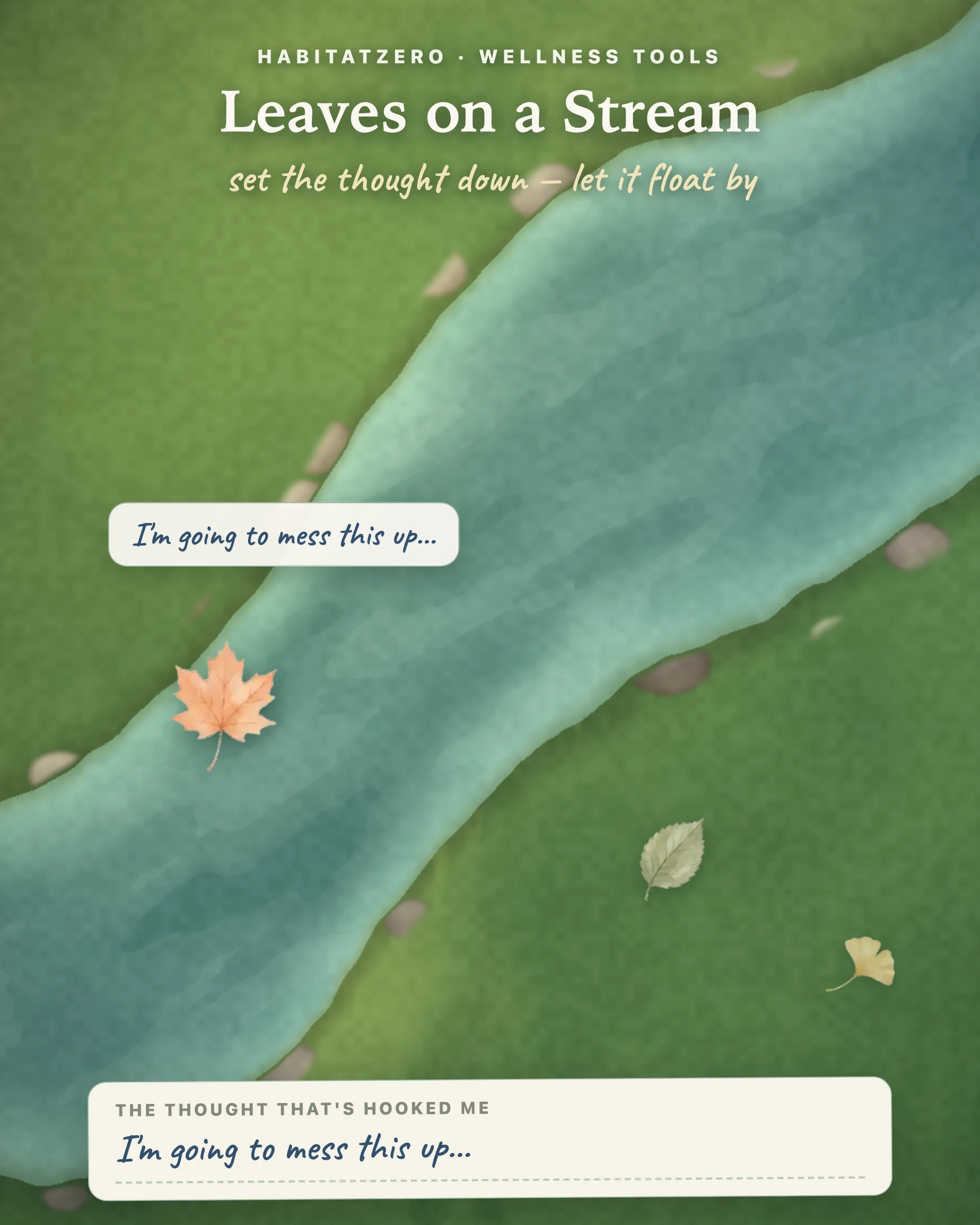
Reach for it before work, after a crowded afternoon, or at the start of a class. If your chest is tight and the breath feels like the wrong place to rest, 5-4-3-2-1 Grounding turns attention toward what you can see and touch. If one thought keeps winning the fourth panel, Leaves on a Stream practices letting a sticky thought float past. And when you know the words well enough to sit without them, The Meditation Timer keeps the minutes for you with a singing bowl.
It is the handful of words someone reads, aloud or silently, to steer a short sit: where to rest attention, when to stay quiet, and how to come back once the mind drifts. This one runs through five parts, from settling in to the breath, sounds, thoughts and a close.
Five minutes is enough to learn the shape of the practice, and ten to twenty is common once it feels familiar. Longer is not automatically better, so this script times its pauses to whatever you pick and later compares how your shorter and longer sits ended.
Read at roughly half your normal talking speed and let every pause run its full length, since silence feels longer to the reader than to the people sitting. Inside the worksheet, the full script marks each pause with a duration for the length you chose, plus a few notes meant only for you.
Notice where it went, then return to the breath or to whichever part you are on. Drifting is not a failure; noticing it and returning is the exercise itself, which is why this page counts returns rather than scoring how focused you were.
The article on this page walks through all five parts, and the filled-in example shows a sit already under way. Picking your own length, running the silent timer, tallying returns and keeping a log of sits all come with personalizing it in HabitatZero, which costs nothing.
By the team behind Fabulous, the science-based self-care app used by over 30 million people.