The Overwhelm Recovery ProtocolWellness & Routines · ~5 min
About this template · Updated September 2026
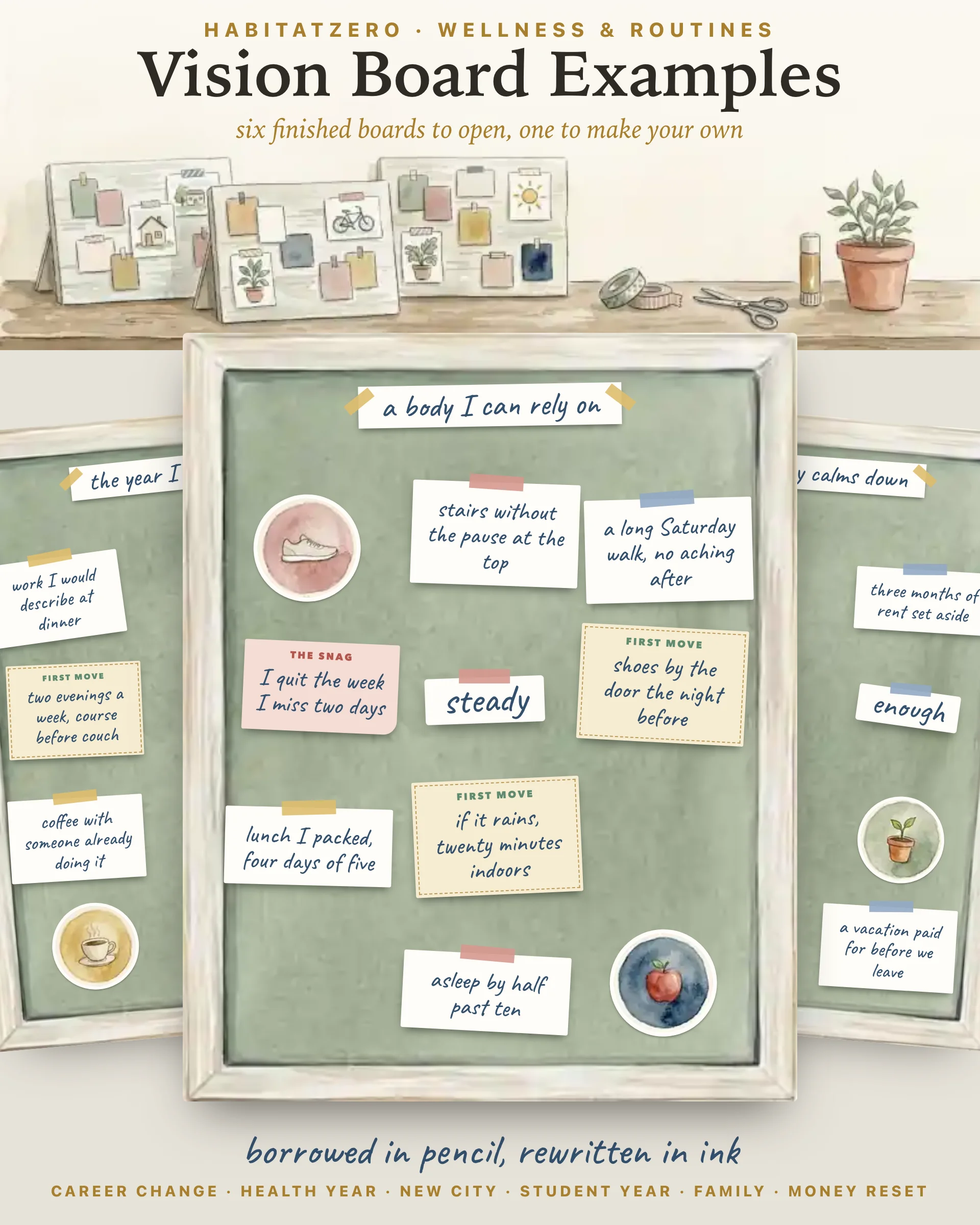
Search for vision board examples and you get thousands of collages: beaches, kitchens, a quote in gold script. They are pretty and hard to learn from, because a photo of someone else's dream says nothing about how the board was built. The six boards here are made to be read. Each is finished, and each can be opened, taken and rewritten until it is yours.
Career change. Scenes from an ordinary working week, like work you would describe at dinner, plus the fear that stalls most career moves: the pay cut. Both first moves fit into a weeknight.
A health year. No scale and no target weight. The pictures are days that feel different, such as stairs without the pause at the top, and one move is an if-then written for the week you miss two days.
A new city. Belonging, pictured as small things that repeat: a cafe where they know your order, three people you can text on a Friday. The snag admits how fast a free weekend turns into staying in.
A student year. Grades are nowhere on it. The board shows the habits that produce them and names the phone as the thing in the way.
Family. Every picture has other people in it, and none of them costs much. The snag, work leaking into every evening, is owned in the first person.
A money reset. No mansion, no sports car. The pictures are about calm, and the snag names the exact hour the money goes.
Side by side, the pattern shows. Every board holds three kinds of card. Pictures are scenes you could photograph once they have happened. Snags are the honest obstacle, the one you would rather not pin up. First moves are either small enough for this week or phrased as an if-then for the bad day. One word and a few painted stickers do the decorating. Most boards online are all picture; the snag and the move turn a collage into a plan.
The wall at the top holds all six boards in miniature. Tap one and it opens full size, with a note on why it works. Start from the closest one and the whole board becomes yours, every card in pencil.
Pencil means borrowed. Tap a card, rewrite it in your own words, and it turns to ink; if the example said it exactly right, ink it as written. A count above the felt, five in ink and four in pencil, shows how much still belongs to someone else. You can peel cards off, tape on new ones, swap the stickers, nudge pieces around and rename the board. It holds twelve pieces at most, because a board you can take in at a glance is the only kind that gets looked at.
Underneath, the sheet reads the mix back to you. Peel off the last snag and it will tell you what is left: all view, no way in.
No research says that looking at a picture of a future makes it arrive, and the closest studies point the other way. Gabriele Oettingen and Doris Mayer followed job seekers, students and hip surgery patients and found that the rosier people's fantasies about the outcome, the less effort they made and the worse they did, even though expecting to succeed helped.
What does help is putting the obstacle next to the wish. In Oettingen's experiments on mental contrasting, people who pictured the future and then the thing standing in its way committed firmly to goals they could reach and let go of the ones they could not; people who only daydreamed, or only brooded, did neither. Peter Gollwitzer's work on if-then plans adds the last piece: deciding ahead of time that when a given situation comes up you will do a given thing makes the doing much more likely. Taught together to schoolchildren, the two techniques improved grades, attendance and conduct compared with classmates taught positive thinking alone.
That is why every example here carries a snag and a first move. A vision board is a planning and motivation aid that keeps a few chosen directions specific and in sight. It is not a request to the universe, and no board on this page is a promise.
Change the nouns first: a friend's name, your own park, your street. Then test the snag; if it would not embarrass you slightly to hear it read aloud, it is probably the polite version. Last, shrink each move until it fits inside this week and needs nobody's permission.
Open it when you want a vision board and the blank page is what stops you. If you are unsure which part of life the board should cover, The Wheel of Life shows which area is thinnest. When a picture needs a real route, hand it to the Goal Map, which splits one big goal into monthly milestones. To practice being the person in those pictures one day at a time, keep a Future Self Journal.
Come back once a month. Ink another card, replace a move you have outgrown, and peel off anything you no longer mean.
Smaller and plainer than most of the ones online. The examples here hold about eight cards each: a handful of scenes you could photograph, one honest obstacle, a couple of first moves, one word and two or three painted stickers. You can read the whole thing in ten seconds, which is the point.
Yes. The student year board pictures the habits behind good grades and names the phone as the thing in the way. The career change board shows ordinary scenes from the working week you want and admits that the pay cut is the scary part. Four more cover health, a new city, family and money.
An obstacle and a plan. Research on mental contrasting finds that pairing a wished-for future with what stands in its way builds real commitment, and an if-then plan for the hard moment helps further. That is why each example board carries a card labeled the snag and at least one labeled first move.
Not by attraction or manifestation, and pleasant daydreaming on its own is linked to less effort rather than more. A board earns its place as a planning aid: it keeps a few specific directions where you can see them. It works best when the obstacle and the next step are pinned up next to the pictures.
On this public page the boards can be opened and read, and a filled-in sample is shown. To take one, rewrite the cards and have your board remembered between visits, personalize it in HabitatZero, which costs nothing.
By the team behind Fabulous, the science-based self-care app used by over 30 million people.