The Overwhelm Recovery ProtocolWellness & Routines · ~5 min
About this template · Updated July 2026
Credit first: the future self journal as a daily practice was popularized by Dr. Nicole LePera — The Holistic Psychologist — whose free version has walked millions of people through it. The shape this page borrows, one pattern examined daily with the future self in the room, is her contribution to the culture. This is an independent interactive sheet inspired by that practice, offered with plain credit; it is not affiliated with, endorsed by, or connected to Dr. LePera or The Holistic Psychologist.
People search for future self journal examples for an honest reason: the blank version is hard. Writing a letter from someone who doesn't exist yet feels like a creative writing assignment at 7 a.m. So this page opens with the example already on it.
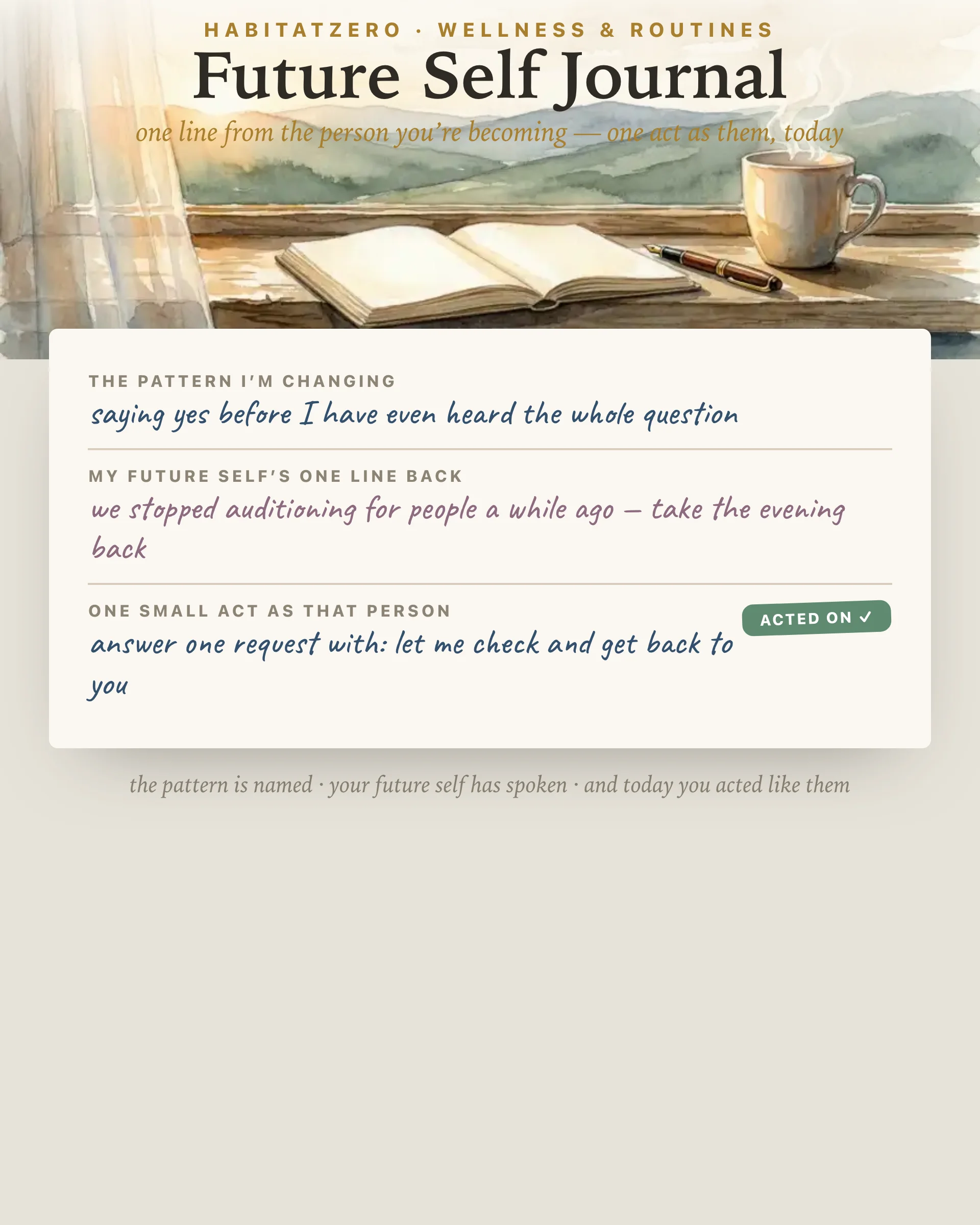
The sheet arrives filled in. The pattern: saying yes before I have even heard the whole question. The future self's line back: we stopped auditioning for people a while ago — take the evening back. The act: answer one request with "let me check and get back to you." Stamp: acted on.
Three moves worth stealing before you overwrite it. The pattern is named without a verdict — no "because I'm weak," just the behavior, observed like weather. The line back is written in the future self's voice, first person plural even, as if the change is already old news to them — that grammatical trick is most of the magic, because a wish says I hope I stop while a future self says we stopped. And the act is almost embarrassingly small, which is the point: it has to actually happen before midnight to count.
This isn't just an affirmation with better staging. In 1986, psychologists Hazel Markus and Paula Nurius gave the field a name for the selves we carry around — possible selves, the vivid personal versions of who we might become — and argued they are the missing link between self-knowledge and motivation. An abstract goal ("be more assertive") gives you nothing to consult at the decision point. A possible self does: when the request lands and the automatic yes rises, the person who stopped auditioning is someone whose behavior you can borrow on the spot.
The one-line-back format is that research made small enough for a morning. You are not describing a five-year plan; you are letting one specific future person say one specific sentence to you, and then acting as them once before the day ends.
The page holds exactly one day. Tomorrow you write it again — same pattern, probably, for weeks. That is by design, and it is the part most people get wrong by treating the journal as an archive to fill instead of a rehearsal to repeat. Patterns learned over years do not renegotiate after one entry; they renegotiate after the fortieth small act.
So the sheet keeps no history and asks for none. It is a whiteboard, not a ledger: today's pattern, today's line, today's act, rewritten until acting like your future self stops feeling like acting. If you want to understand the machinery of the pattern you keep writing at the top — the cue that fires it, the loop that sustains it — the atomic habits worksheet takes that same habit apart on paper. If the practice makes you want a fuller morning page around it, the morning journal gives the day's first minutes more room, and when a pattern graduates into a concrete goal with edges, the SMART goals worksheet is where it goes to grow up.
Name the pattern. Let them answer. Do the one small thing. The future self in this practice was never a stranger — just you, minus one autopilot, plus about forty mornings.
No. The daily future-self journaling practice was popularized by Dr. Nicole LePera, The Holistic Psychologist, and her original Future Self Journal lives on her own site. This page is an independent interactive sheet inspired by the idea, with credit given plainly; it is not affiliated with, endorsed by, or connected to Dr. LePera or The Holistic Psychologist.
Filled-in days of the practice — because the blank version is genuinely hard to start. A worked example shows the moves: a pattern named without self-attack, a line written in the future self's voice rather than a wish, an act small enough to finish today. This sheet opens pre-filled with one for exactly that reason; read it, then replace it with yours.
Because psychology's possible-selves research suggests people are moved less by abstract goals than by vivid versions of who they might become — the hoped-for self is motivating precisely because it is a person, not a number. The one-line-back format borrows that: a sentence in your future self's voice makes the destination someone you can act like today.
Until acting like your future self stops feeling like acting. That is usually weeks, not days — the sheet is built to be rewritten daily on purpose, and repeating one pattern for a month is the practice working, not a lack of imagination.
Yes. Write today's page here and it saves until you rewrite it tomorrow, or print the blank sheet and keep the practice on paper by the kettle.
By the team behind Fabulous, the science-based self-care app used by over 30 million people.