The Overwhelm Recovery ProtocolWellness & Routines · ~5 min
About this template · Updated July 2026
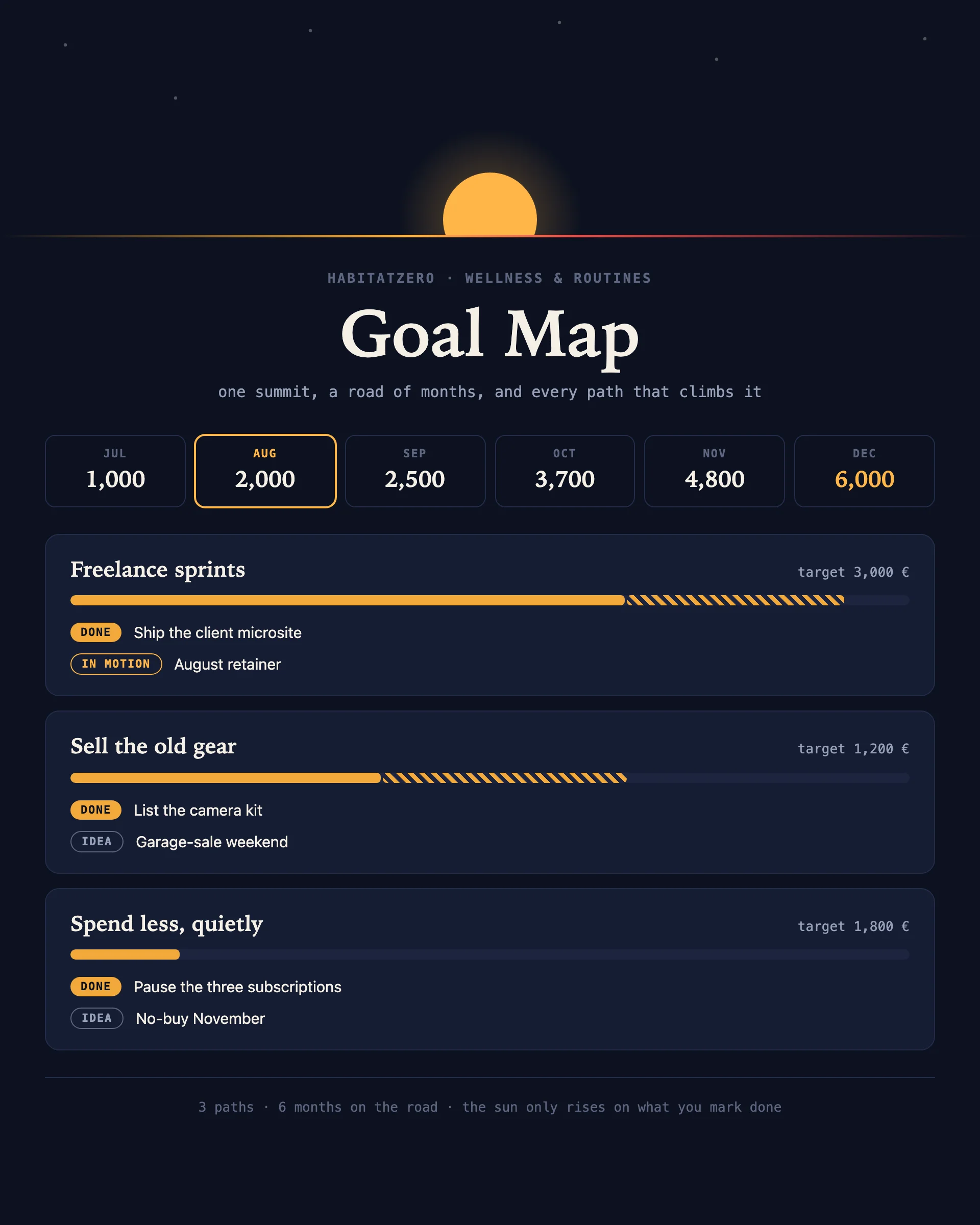
A big goal fails in a characteristic way: not from lack of wanting, but from formlessness. "Save six thousand euros," "finish the book," "launch by winter" — each is one sentence hiding forty decisions, and on any given Tuesday none of those decisions is visible. A goal map is the old cure: put the destination, the road, and the terrain on a single page, so the next step is never a research project. This one is interactive, and it is deliberately set at night — one summit, a horizon, and a sun that rises only as things actually get finished.
The map answers the three questions a long goal keeps asking. How far is there to go? The summit holds your goal with its parameters — a target, a unit, a start, a deadline — and the sunrise gauge converts finished work into altitude. Am I on schedule? The road splits the distance into monthly milestones, evenly at first, and re-balances around any month you adjust — a lighter December because of the holidays means the fall months quietly pick up the slack, while the final month stays the summit. The pace line does the arithmetic you'd rather not: what is left, divided by the days that remain, and whether today's total is ahead of the ramp or behind it.
And what do I actually do? That is the third layer: the paths. Each card is one front you are advancing on — the freelance sprints, the things to sell, the spending to quiet — with its own checklist of concrete steps. Steps cycle through idea, in motion, done, and blocked, and each can carry a number in the goal's unit. There is a century of evidence behind this decomposition: Gollwitzer's work on implementation intentions showed that goals broken into specific, situated actions get acted on far more reliably than goals held as intentions, because the deciding was done in advance.
The gauge has one rule: only steps marked done raise the sun. Work in motion is honored — it shows as the hatched stretch of each path's meter — but it buys no altitude. That strictness is a feature borrowed from how progress actually motivates: the goal-gradient effect — effort accelerating as the goal visibly nears — only works when the progress display is credible. A gauge that rises on promises teaches you to ignore it. A gauge that rises on receipts becomes the reason to close one more small step tonight.
The reorderable paths carry the quieter insight. Dragging the active front to the top costs nothing, but it turns the map into a statement of priority — and a stalled card sitting at the top of the page is a very hard thing to keep ignoring.
If your goal is a single accumulating number and nothing else, the Goal Tracker's thermometer is the simpler, purer instrument. If what you need is to think a goal through before committing — obstacles, first steps, wording — start with the Goal Planner and bring the result here. The map earns its keep when the goal is big enough to have several fronts and a real deadline: the kind of climb where the danger isn't laziness, it's losing sight of the mountain.
Name the summit. Draw the road. Then go walk the nearest path.
A one-page visual plan for a single big goal: the destination with its numbers, the milestones between here and there, and the concrete actions grouped by the different fronts you will advance on. This page makes that picture interactive, so marking an action done visibly moves the whole map.
A tracker measures one accumulating number, and this site has a thermometer page for exactly that. A map adds the two layers a big goal needs: a timed road of monthly milestones, and separate paths of actions so you can see which front is moving and which has quietly stalled.
Leave the target empty and the map runs on completion instead: the sun rises with the share of steps marked done, and each path's meter fills by count. Numbers unlock the extras, like the milestone ramp and the per-day pace line, but they are optional.
Evenly at first: the target divides across the months between your start and deadline. Any milestone you edit becomes yours and holds; the untouched months re-balance around it, and the final month always equals the full target.
Yes, and it matters more than it sounds: drag a card by its header, or use the arrow buttons, and the order sticks. Keeping the front you are actively pushing at the top turns the page into a priority list, not just a record.
Because plans inflate and half-done work argues for itself. The gauge counts nothing that is merely in motion — that effort shows separately, as the hatched part of each path's meter — so when the sun clears the horizon, it clears it honestly.
By the team behind Fabulous, the science-based self-care app used by over 30 million people.