
The Overwhelm Recovery ProtocolWellness & Routines · ~5 min
About this template · Updated November 2026
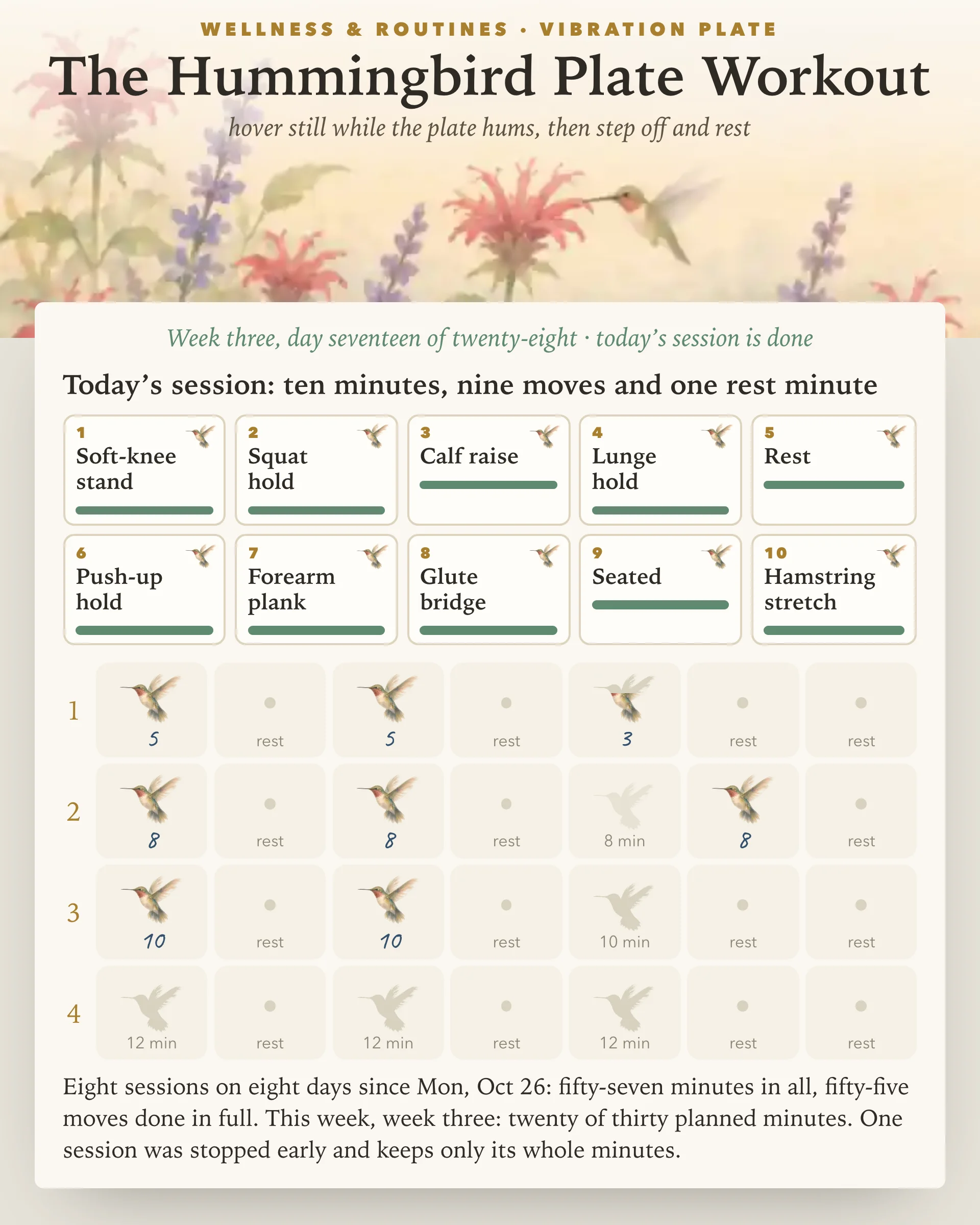
A vibration plate shakes many times a second while you hold still on top of it, which makes it closer to a hummingbird than to a treadmill: busy underneath, steady above. This page turns that into a short routine with twelve vibration plate exercises, a session builder that lays them out minute by minute, a timer that keeps real time even when your phone locks, and four weeks of plate days that fill in as a flock of hummingbirds.
Every round lasts one minute and has two parts. First comes time off the plate to rest and set up, then the move itself on the plate. A squat hold, for example, is thirty seconds off and thirty on. Standing with soft knees gets forty-five seconds on the plate, and the forearm plank gets twenty. A rest round keeps you off the plate for the whole minute.
Day one is five rounds: standing with soft knees, a squat hold, calf raises, sitting on a chair with your feet on the plate, and a calf stretch. Week two adds a lunge hold, a push-up hold and a glute bridge, week three brings a forearm plank and a rest minute, and week four reaches twelve minutes, always on three days a week. You can set any length from five to fifteen minutes, tap a round to swap its move, and switch any move to its easier level, which trims your time on the plate.
The triceps dip stays out until you mark your plate as stable, because a plate that tips when you press on its edge is no place for your hands.
The timer credits only what you did. A move counts once its whole time on the plate has run. If you stop early, the log keeps whole minutes, so stopping at two minutes and fifty seconds records two. Afterward you mark how it felt, and a mark of dizzy or unwell tells you to stop for the day and check with your doctor.
Shaking travels up through whatever is held straight. In a lab study of sixteen healthy adults doing slow squats at 30 Hz (thirty shakes a second) with 4 mm of travel, the shaking measured at the head changed with the angle of the knees, and it was greater on plates that push both feet up together than on plates that rock from side to side. The authors judged that ten minutes a day at their settings went past the daily exposure an international vibration standard recommends, and that the risk looked lower in a half squat than in upright standing. That is why every move here keeps your knees and elbows bent, never locks a joint and never puts your head on the plate, and why sessions stay short with rest built in.
The broadest summary is a 2026 systematic review of thirty-six studies in adults aged sixty and over, living at home, in care homes or attending clinics. About two-thirds of those studies found stronger legs after training on a plate. About half found better balance or everyday function, mostly in frailer people, while others found no edge over ordinary exercise. The training plans varied so much that the reviewers could not pool the numbers, and no study was large enough to show whether a plate prevents falls.
Results also vary by machine, and nobody yet knows the best settings. A sports medicine physician interviewed by Cleveland Clinic says there is no evidence on which settings to use or for how long, advises beginning at the lowest frequency and amplitude, and points out that a plate alone will not keep weight off and shows no real bone advantage over regular exercise. So this page makes no promises about fat, cellulite, detox or bone density. Treat the plate as a way to make a few holds more interesting, alongside walking and strength work.
Research teams screen people out before anyone steps on. One feasibility study in adults over eighty, which used five one-minute squats at 35 Hz and 2 mm with forty seconds off the plate between them, excluded 41 of the 320 people it screened, for reasons such as a hip or knee replacement, a pacemaker, a recent fracture or major surgery, a blood clot or a high risk of one, kidney stones or gallstones, a hernia, a tumor, nerve damage from diabetes, severe vertigo and epilepsy. Cleveland Clinic adds pregnancy, trouble with balance, a leg or ankle injury that is still healing, joint, neck or back pain, and heart disease, and a 2020 report in BMC Ophthalmology describes a retinal tear after a single session.
If any of these fit you, or you have had a fall, dizziness, a heart or blood pressure condition or ongoing pain, talk to your doctor or physical therapist before you start. Stop at once if anything hurts, and keep a counter or a sturdy chair within reach.
For balance practice on the floor, The Balance Ladder builds steadiness rung by rung. If the forearm plank turns into your favorite move, The 30-Day Plank Challenge takes it further on a mat, and The Stiffness Map gives your rest days some gentle stretching.
Start with moves that keep your knees bent and your weight low: standing with soft knees, a squat hold, slow calf raises, and sitting on a chair with your feet on the plate. Hold each for thirty to forty-five seconds at the lowest setting, with rest off the plate in between. Lunge holds, push-up holds and glute bridges can come once those feel easy.
Short. One study with adults over eighty used five one-minute squats with forty seconds of rest between them, about ten minutes in all. This plan begins at five minutes on three days a week and climbs to twelve, and only part of each minute is spent on the plate. Lengthen the session only when the shorter one feels easy the next day.
Yes. A lab study found the shaking that reached the head changed with how far the knees bent, and its authors judged a half squat safer than standing straight. Keep knees and elbows soft in every move, never lock a joint, and never rest your head on the plate.
Ask your doctor first if you are pregnant, have a pacemaker or a hip or knee replacement, had surgery or a broken bone recently, have a blood clot or a high risk of one, epilepsy, severe vertigo, a retinal tear, kidney stones or gallstones, a hernia, nerve damage in your feet from diabetes, heart disease that is not well controlled, or joint, neck or back pain.
For some things, in some people. A 2026 review of 36 studies in adults over sixty found stronger legs in about two-thirds of them and better balance or daily function in about half, mostly in frailer people. Results differed by machine and settings, no study could show fewer falls, and there is no good evidence that a plate burns fat, smooths cellulite or builds bone on its own.
By the team behind Fabulous, the science-based self-care app used by over 30 million people.


