
Leaves on a StreamEmotional Fitness · ~3 min
About this template · Updated September 2026
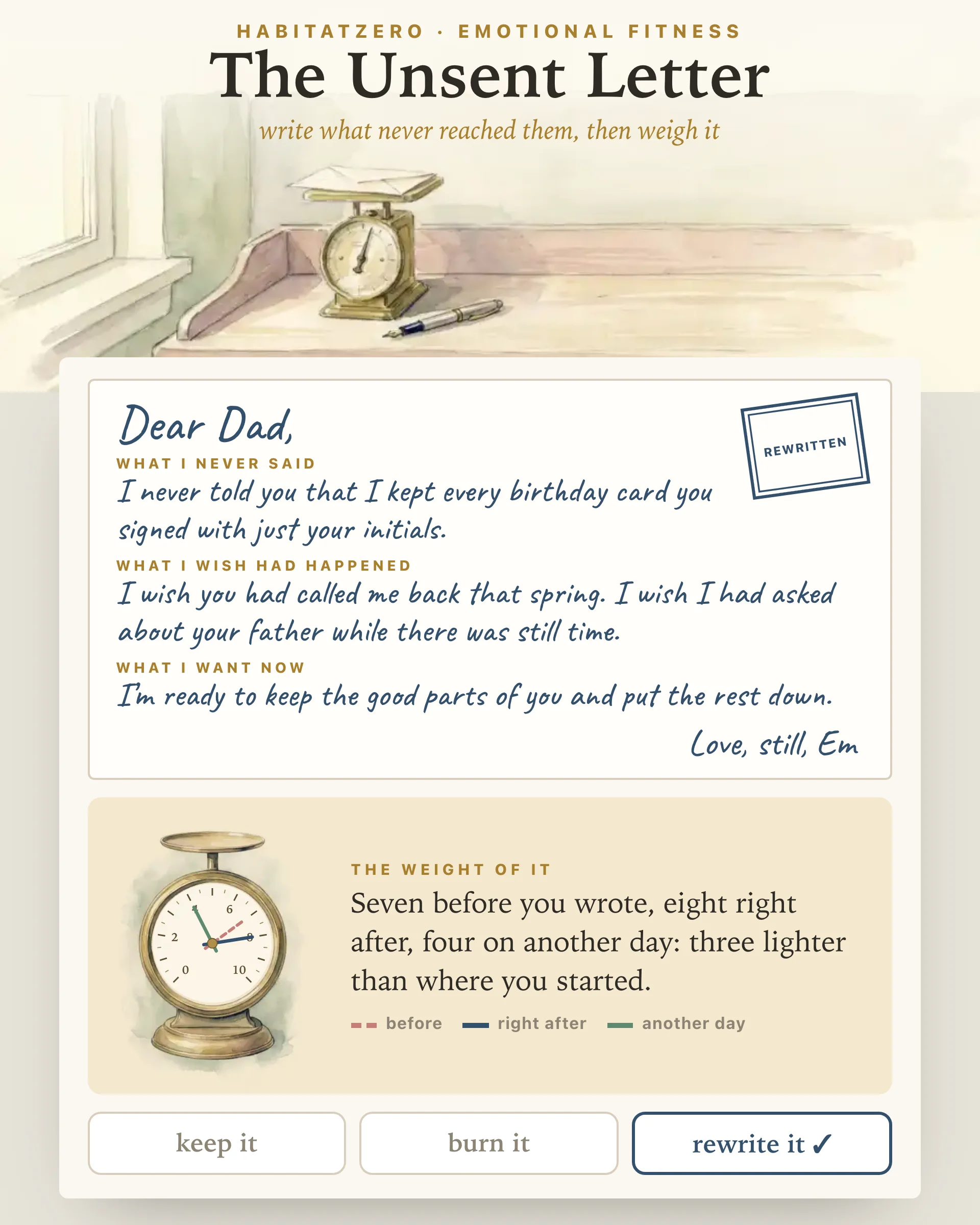
There is a conversation you keep having in your head. It runs in the shower and on the drive home, and never ends well, because the other person is not in it. Maybe they died. Maybe you are no longer in touch, or you shouldn't be. Maybe the person you most need to talk to is you, at nineteen. An unsent letter gives that conversation somewhere to land: a letter to one real person, written in full, knowing it will never be mailed.
Because nobody will read it, you can stop editing. The unkind sentence and the loving one can share a paragraph. Therapists hand out versions of this exercise for grief, estrangement and breakups, and for anger with nowhere to go, where it tends to be called an anger letter. Writing to someone, rather than about them, keeps you inside the relationship long enough to notice what you wanted from it.
Begin with who it is for: tap a name like Mom, Dad or younger me, or type your own.
Then weigh it. Before you write a word, the page asks how heavy this feels, from nothing up to ten. That first weight locks as soon as the letter holds any words, so it stays an honest starting point.
The letter has three parts: what I never said, what I wish had happened and what I want now. Each offers a few ways to begin that you can tap when the line stares back at you, and each holds about a hundred words. Sign off however it fits: love, goodbye, I miss you.
Once it is written, weigh it again on the brass letter scale. The dial keeps a needle for each weighing, and the page reads the difference back in plain words. On another day, reread it and weigh it a third time. If you change the letter after weighing it, that weighing is cleared, because it described a different letter.
Last, decide what becomes of it:
Nothing on this page is ever sent; there is no send button. If you decide to send the rewritten version, you copy it out yourself.
An unsent letter is a close relative of expressive writing, a well-studied way of putting feelings on paper. In the first study, James Pennebaker and Sandra Beall asked college students to write for fifteen minutes on four days in a row about the most upsetting experiences of their lives. Those who wrote about both what happened and how they felt about it visited the health center less often during the six months following the experiment, even though the writing raised their physiological arousal at the time (Pennebaker & Beall, 1986).
That harder-first pattern held up. A research synthesis found that writing raised distress from just before a session to just after it, and that this rise was unrelated to the health outcomes measured later (Smyth, 1998). A review for clinicians puts it plainly: the immediate effect is usually more distress and lower mood, the gains show up at longer follow-up, and the practice appears reasonably safe (Baikie & Wilhelm, 2005).
Keep the size of the effect in view. A large meta-analysis, pooling 146 randomized studies, found an average effect that was positive and significant but small (Frattaroli, 2006). Those studies tested expressive writing in general; unsent letters have far less research of their own. Treat the scale as a mirror, not a scorecard: a heavier needle right after you finish is not a failure, just a first reading.
Write one when a conversation keeps replaying and the other person can't or shouldn't be part of it: after a death, after a breakup, when a parent is gone or not safe to contact, or when you owe your younger self an explanation. If they have died and you want to keep writing to them, the Grief Journal is built for letters that continue. If you would rather write forward, to the person you are becoming, try A Letter to My Future Self. And if anger is the loudest thing on the page, the Anger Journal helps you see what keeps setting it off.
Give it twenty minutes somewhere private, and stop when it is said.
An unsent letter is a writing exercise, not therapy, and this page treats nothing on its own. If a letter stirs up more than it settles, or the weight keeps climbing in the days after, bring it to a therapist; it is good material for that room. And if writing to them ever turns into thoughts of ending your life, put the pen down and call or text 988 in the US, or your local emergency number, so a person can hear it with you tonight.
It is a letter addressed to one real person, a parent, an ex, a friend you lost or your younger self, written in the knowledge that it will never be mailed. Since they will never read it, you can finish every sentence you would soften face to face. Written in the heat of the moment, the same form is often called an anger letter.
It borrows from expressive writing, which has been tested in well over a hundred randomized studies with a small but real average benefit. On average, people in those studies felt more upset straight after writing, and the benefits showed up at follow-ups weeks or months later, which is why this page asks you to weigh the letter again on another day rather than judge it the minute you stop.
Only if burning it means something to you. Some people keep the letter to reread, some copy it out by hand and burn it in a sink, a metal bowl or a fire pit with water nearby, and some turn a few lines into a message they do send. Tearing it small or soaking it until the ink runs works when fire is not safe.
No. His studies asked people to write for fifteen to twenty minutes on three or four days in a row about their deepest thoughts and feelings. This page is an independent letter exercise informed by that research, and it is not affiliated with or endorsed by him or the University of Texas.
Nothing is ever sent, posted or mailed, and the page has no send button at all. To write and keep your own letter, personalize this page in HabitatZero, which is free; the public page only shows a filled-in example.
By the team behind Fabulous, the science-based self-care app used by over 30 million people.


