Leaves on a StreamEmotional Fitness · ~3 min
About this template · Updated September 2026
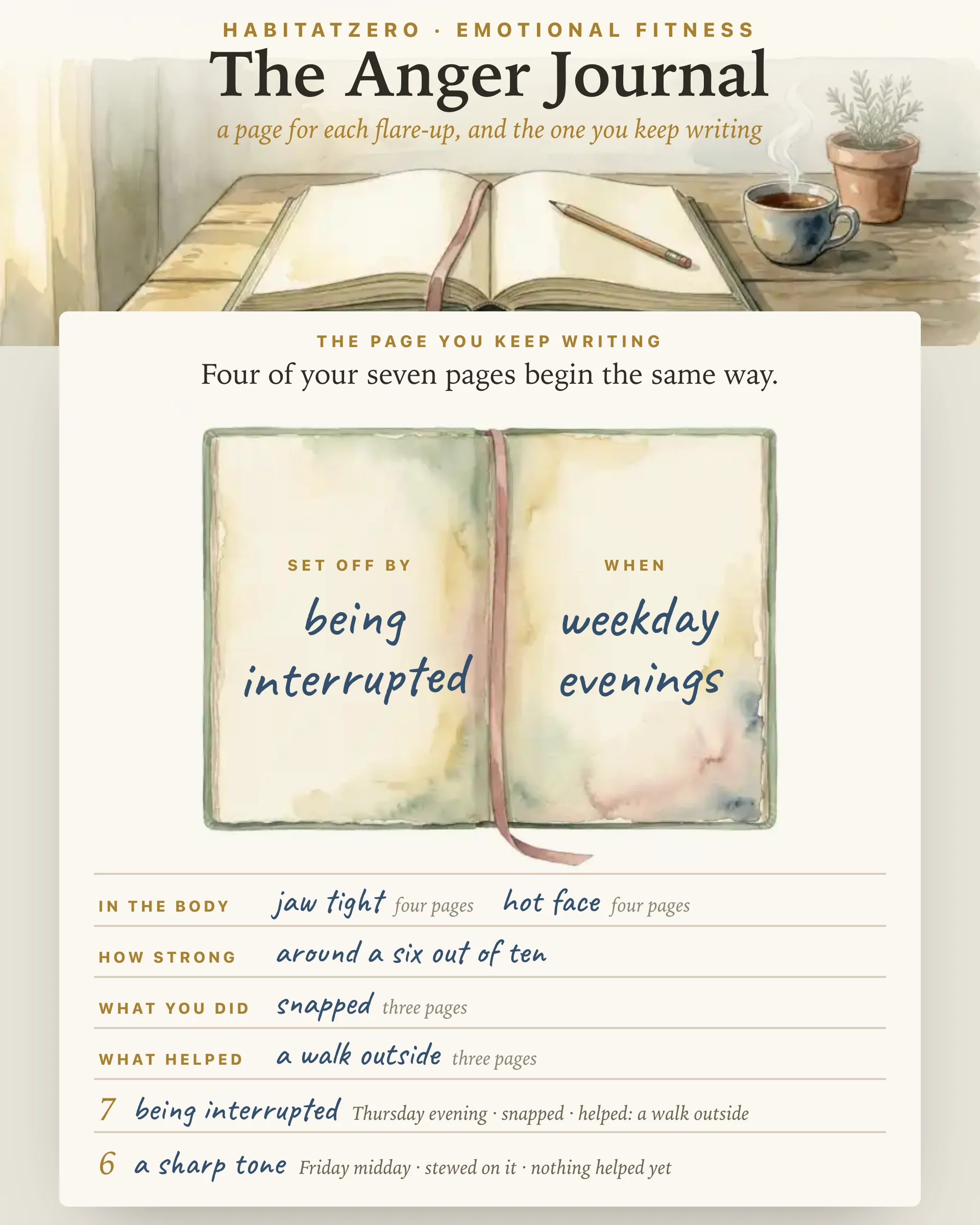
Anger usually feels like it arrives out of nowhere. Read back a few weeks of it, though, and it rarely does. The same kind of moment keeps setting it off, often at the same hour of the day, and your body tends to send the same warning a minute before your voice rises. An anger journal is a way to catch that pattern on paper instead of in the middle of the next argument.
It is the anger log or anger diary a counselor might hand you, rebuilt so most of it is taps.
Each flare-up gets one page, written once you have cooled down. The page asks the same things every time:
The limits are deliberate: a page you can finish in a minute is one you will actually write on a bad day, and short entries stay factual. Turn the page when it is done and it joins the numbered pages below. The book holds thirty, and a page you no longer want tears out with two taps.
Three pages in, the journal starts reading your pages back. The painted spread at the back shows the trigger and the time of day that keep appearing together, so a line such as "four of your seven pages begin the same way" sits over being interrupted on one leaf and weekday evenings on the other. Underneath, it lists the body signs that come up most, the middle of your strength ratings, what you usually do, what it usually costs and your best help so far. Every number comes straight from your own pages, so you can check it against the list.
That pairing of trigger and hour is the useful part. The American Psychological Association's guide to controlling anger recommends exactly this kind of timing change: if you and a partner tend to fight when you discuss things at night, move the important conversations to another time, and schedule some quiet time into the parts of the day you already know are stressful. You cannot plan around an hour until you know which hour it is.
It is tempting to use a journal to get it all out, filling furious pages about whoever set you off. The evidence is not kind to that idea. In a well-known experiment, people who hit a punching bag while thinking about the person who had provoked them ended up angrier and more aggressive than people who were distracted or did nothing at all. Going back over a grievance keeps it warm.
Reflection can still help when it happens at a distance. When researchers asked people to recall an experience that had made them angry, those who looked at it from a self-distanced perspective and asked why it happened could think it through without stirring up the same heat. A short, factual page written after you have settled, then read weeks later as part of a pattern, is built for that cooler kind of looking.
What this page cannot do matters too. Nobody has tested this journal in a trial, a handful of pages is a small sample, and a pattern is a clue rather than a verdict. It is a place to practice noticing, not a treatment. If anger keeps costing you relationships, work or sleep, see a counselor who works with anger; your pages make a good place to start that conversation.
Some pages should not stay in a book. If anyone has been hurt, or someone at home is afraid of you, put the journal aside and call the National Domestic Violence Hotline at 1-800-799-7233, or text START to 88788. Its advocates talk with people on the giving end of hurtful behavior as well as the receiving end, and the call is confidential. If someone is in danger at this moment, call 911. When a page records either one as a cost, the journal shows this hotline first.
Anger can also turn inward. If yours ever does and thoughts of hurting yourself or ending your life come with it, call or text 988 in the US, or your local emergency number, right away, and tell someone you trust.
Write a page the same day, once the heat has gone out of it, while the details are still sharp. Read the back of the book every week or two. Once you know the trigger and the hour, The Anger Iceberg helps you look at what sits underneath that trigger, Steady the Flame gives your breath something to do in the moment itself, and The Road From a Trigger turns a known flash point into an early warning plan.
It is a running record of the moments your anger flared, written after the fact, with the same short questions each time: what set it off, when, how strong it got, what you did and what it cost. Because every entry has the same shape, repeats stand out after a few weeks. Counselors often call the same tool an anger log or an anger diary.
The most useful prompts are the ones you answer on every page. What set it off? Where did I feel it first? How strong did it get, from one to ten? What did I do, and what did it cost? What helped, even a little? Asking the same handful of questions each time is what lets a pattern surface.
It depends on the kind of writing. Pouring out page after page about who wronged you can stoke the feeling, much as replaying an argument in your head does. A brief, factual entry written once you have calmed down, then read later for patterns, works differently: it shows you the situations and hours worth planning around.
No. A journal is a practice tool for noticing patterns and a handy thing to bring to a counselor, but it is not a treatment. If anyone has been hurt or someone at home is afraid, skip the journal and call the National Domestic Violence Hotline at 1-800-799-7233, or text START to 88788.
You can look through the filled example on this page for free. To write your own pages and have the back of the book update as they add up, personalize the journal in HabitatZero, which costs nothing and saves each tap as you go.
By the team behind Fabulous, the science-based self-care app used by over 30 million people.