Leaves on a StreamEmotional Fitness · ~3 min
About this template · Updated July 2026
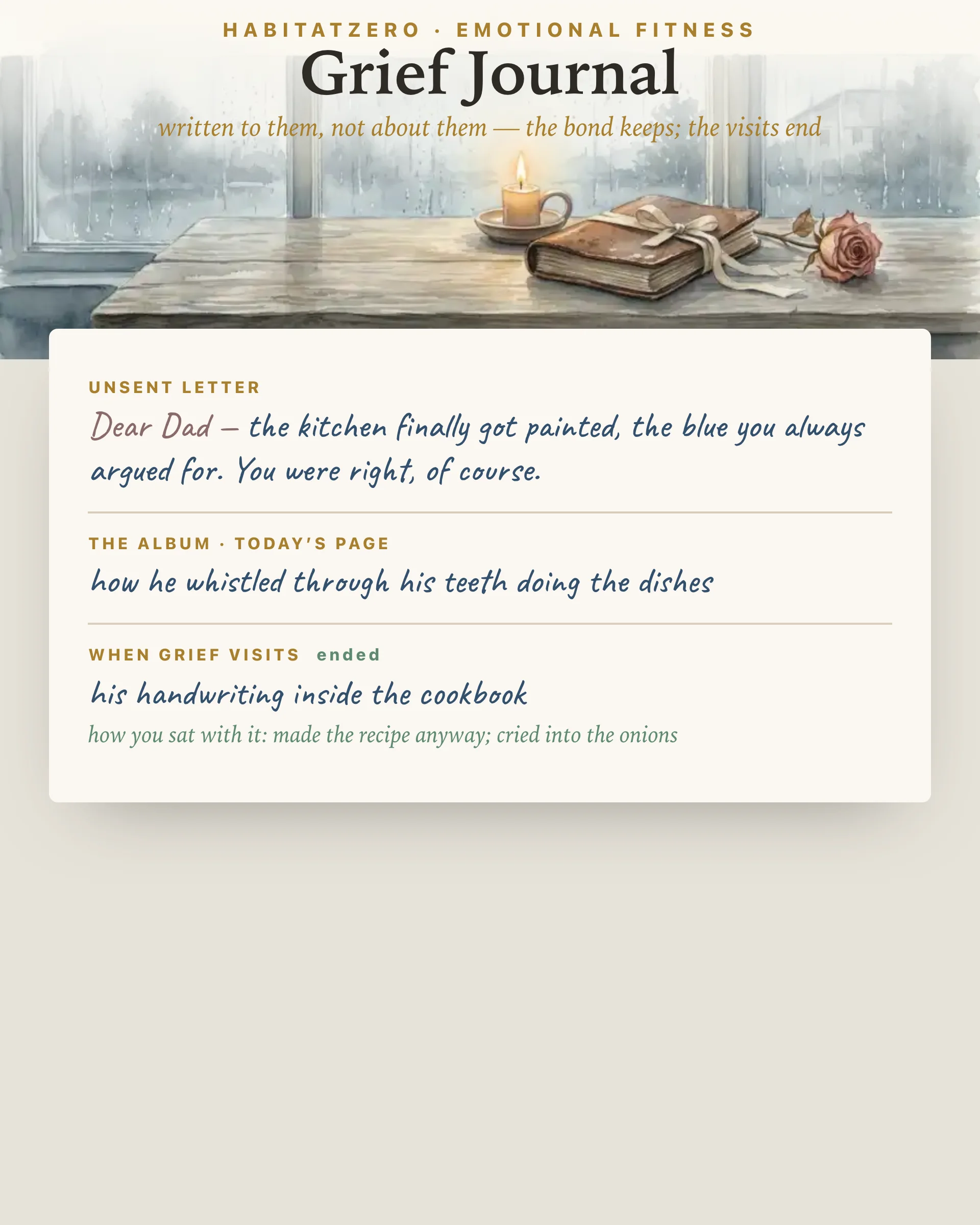
An honest label first, because grief deserves nothing less: the worksheets on this page are the kind used in grief therapy — unsent letters, memory keeping, and a grief log are staples of bereavement counseling — adapted here as a self-help journal. The page is not therapy, cannot replace a counselor, and will say so again before it ends. What it can be is a quiet, private place to do the three things grieving people have always done on paper: keep talking to them, keep remembering them, and notice that the hardest moments, every single one so far, have ended.
The journal's first practice is the unsent letter. You write their name once at the top — Dad, Nora, Grandpa Joe — and after that, you simply write to them when there is something to say. The kitchen got painted. The niece said her first full sentence. The thing you never finished saying, finished.
For a long time, popular grief advice pushed in the other direction — toward "letting go," "closure," "moving on." Bereavement research largely moved past that framing: the continuing bonds perspective holds that staying connected to the person — through ritual, memory, inner conversation — is often part of healthy grieving, not a refusal of it. The relationship does not end; it changes shape. An unsent letter is that idea at its most practical. Nothing gets mailed. Nothing needs an answer. The conversation keeps its voice, and the love keeps its address.
The second practice is the album, and it has one strict rule: one page per day. A single memory, any size — and the ordinary ones age best. How he whistled through his teeth doing the dishes. The way she said "well then" before every decision, big or small.
The ration is the design. Grief will sometimes offer you the flood — every memory at once, at 2 a.m., unsorted — and the flood mostly hurts. A daily page turns remembering back into a ritual: small, chosen, finishable. It also means the album is still being written in month four and month nine, long after the casseroles and the cards have stopped, which is exactly when a growing record of them matters most.
The third practice is the log. Grief does not stay; it visits — brought in by a song, a smell, handwriting inside a cookbook, a stranger with the same walk. When a visit comes, you log what brought it and how you sat with it, and the entry files itself under the one word every entry shares: ended.
This is not wishful framing; it is how grieving actually moves. The dual process model of bereavement describes healthy grief as oscillation — turning toward the loss, turning back toward ordinary life, and returning again, on no fixed schedule. The visits ending is not avoidance and not disloyalty. It is the rhythm working. And on a hard day, rereading a log in which every line ends the same way is the kind of evidence a 2 a.m. visit cannot argue with.
You will notice this journal never asks which stage you are in. The five stages are a beloved folk model — genuinely useful to some people as vocabulary — but decades of bereavement research describe grief as oscillating, particular, and unscheduled rather than a queue of phases to clear. So the journal tracks nothing linear on purpose. There is no stage to be behind on, no order the visits are supposed to arrive in, and no date by which the album is supposed to be finished. Grief does not owe anyone a timetable, and this page will never hand you one.
If the wider work of processing a hard season — not only bereavement — is what you need, the emotional healing journal is this journal's nearest neighbor, built for hard things of every kind.
A journal can keep the bond; it cannot carry the grief alone, and it was never meant to. Some griefs need more hands: if months are passing and the weight is not softening — if eating, sleeping, or wanting anything at all has gone missing from your days, or the visits are not ending so much as moving in — that is not failed grieving, it is a signal. A grief counselor or a bereavement group is the right companion for it, and going is not giving up on them; it is looking after what they loved. Bring the letters if you want; counselors know exactly what they are. If you are in crisis or thinking about hurting yourself, call or text 988 (US) right now, or reach your local emergency number.
Three practices that grief counselors have used for decades, adapted honestly for a journal. Unsent letters: you write to the person, not about them — news, small stuff, unfinished sentences. The album: one memory kept per day, deliberately rationed so remembering stays a ritual instead of a flood. And the visits log: when grief arrives, you note what it brought and how you sat with it, and the log quietly accumulates its one repeated fact — every visit ended.
They are the kind used in grief therapy — unsent letters, memory keeping, and grief journaling are staples of bereavement counseling — but this page is a self-help adaptation, not therapy, and it does not pretend otherwise. If you are seeing a grief counselor, the journal makes genuinely good session material: many counselors assign exactly these exercises, and arriving with letters already written is a head start, not a duplication.
Because the relationship does not end; it changes shape. Grief research calls this continuing bonds — the finding that staying connected to the person, rather than seeking closure from them, is often part of healthy grieving rather than a failure of it. An unsent letter is the simplest continuing-bonds practice there is: the conversation keeps its voice, the love keeps its address, and nothing about writing one means you are stuck.
Deliberately absent. The five stages are a beloved folk model, but decades of bereavement research paint a different picture: grief does not move through an orderly queue of phases, it oscillates — turning toward the loss, turning back toward daily life, and returning again, on no schedule. This journal tracks nothing linear on purpose. There is no stage to be behind on, and no order your visits are supposed to arrive in.
Then the journal has done its most important job: showing you clearly. If months are passing and the weight is not changing — if eating, sleeping, or wanting anything at all has gone missing from your days — a grief counselor or bereavement group is the right companion, and going is not giving up on them; it is looking after what they loved. If you are in crisis or thinking about hurting yourself, call or text 988 (US) right now, or reach your local emergency number.
Free, in your browser — this public page shows a filled-in example so you can see the letters, the album, and the visits log working together. Inside Fabulous, everything you write saves privately to your account and is visible to no one else. The letters especially depend on that privacy: they are written the way you actually talk to them, which is nobody else's to read.
By the team behind Fabulous, the science-based self-care app used by over 30 million people.