Leaves on a StreamEmotional Fitness · ~3 min
About this template · Updated July 2026
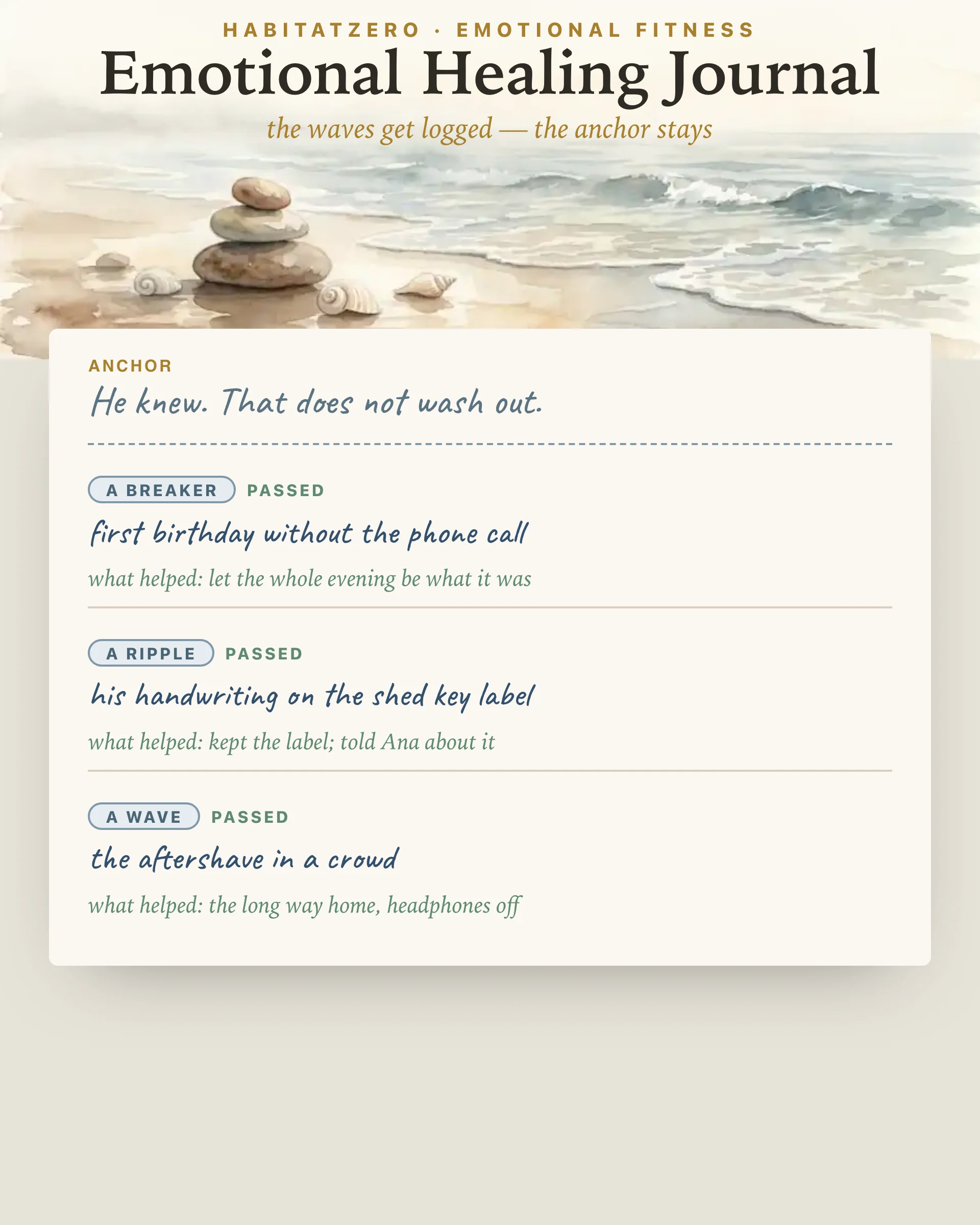
Hard things do not hurt on a schedule. A loss, an ending, a season that broke something — the pain arrives in waves: a quiet Tuesday, then a song, a date on the calendar, a smell in a crowd, and suddenly you are back in it. Most journals are built for days. This one is built for waves. You name the hard thing once, you keep one anchor line that stays true, and you log each wave as it comes — how big it was, what set it off, and what helped this time. It is a self-help tool, not treatment, and it does not ask you to hurry.
The top of the journal holds the hard thing, named one time in your own words — "the year dad has been gone," "the marriage ending," "what happened in March." Once is deliberate. Naming gives the page its subject; renaming it every entry would turn the journal into a rehearsal, and rehearsing pain is not the same as processing it. After the first line, the journal already knows what it is holding, and every entry after that gets to be about the wave in front of you, not the whole ocean.
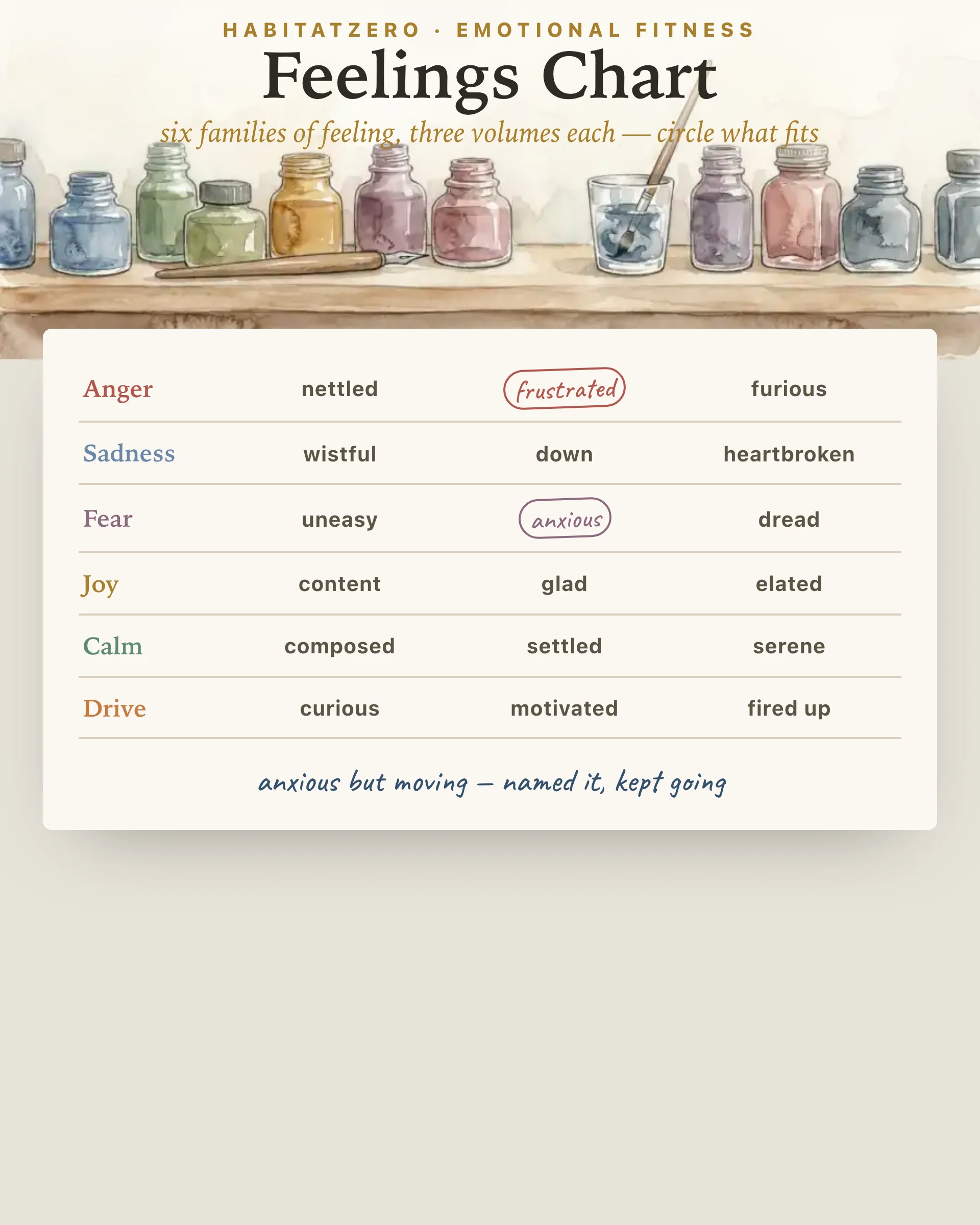
If finding words for feelings is itself the hard part, the feelings wheel is a good warm-up — it exists to turn "bad" into something more precise.
Under the hard thing sits one sentence that stays true no matter what kind of day it is. Not a pep talk, not a goal — a fact you can stand on. "He knew I loved him." "I did the leaving because I had to." "We had twelve good years." The anchor is there because emotional healing is routinely misunderstood as forgetting, and the fear of forgetting keeps people gripping the pain. The anchor line settles that fear in writing: the thing worth keeping is kept, permanently, at the top of the page. The waves can move through you without taking it.
When a wave hits — or just after — the entry takes about two minutes. You pick its size honestly: a ripple, a wave, or a breaker. You can note what set it off, because triggers lose some of their ambush power once they are named in daylight. And you can note what helped this time — the walk, the call, letting it be a bad hour — because you are quietly building your own instruction manual, written by the only person who knows what actually works on you.
There is real research posture behind writing things down instead of only feeling them. The paradigm goes back to a 1986 study that first asked people to spend a few sessions writing honestly about their most difficult experiences, and the decades of work that followed were pooled in a meta-analysis of 146 expressive-writing experiments, which found small but reliable benefits to psychological wellbeing — clearest when the writing is honest rather than polished. Small and reliable is exactly what a wave log offers: no single entry fixes anything, and the accumulating record still moves the needle.
What the log never does is grade you. There is no streak, no trend line, no verdict about whether you are healing fast enough. Grief does not owe anyone a slope.
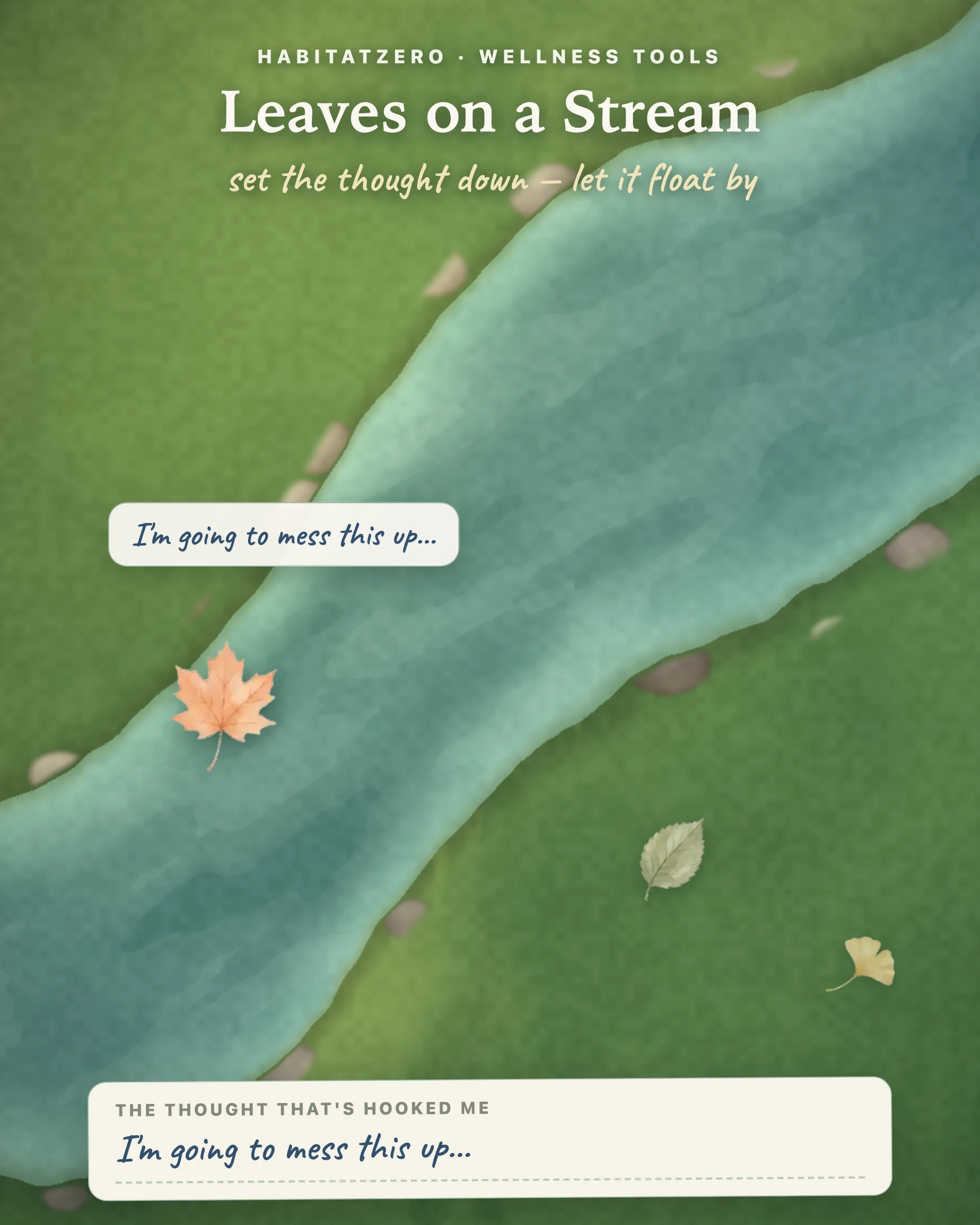
Every entry in the log shares one property: it passed. That is not a slogan; it is the literal record. The breaker on the birthday passed. The ripple at the shed key passed. Rereading the tide is how the page earns its keep — because in the middle of the next wave, the feeling will insist that this one is permanent, and you will hold written evidence, in your own hand, that the feeling has been wrong every single time so far. If letting a thought move through without wrestling it is a skill you want to practice directly, leaves on a stream is the classic exercise for exactly that.
A journal can hold a wave; it cannot hold you through a storm that will not break. If the weight is not lifting month after month, if daily life — sleep, work, people — is not coming back, or if the waves are getting bigger instead of passing, that is not a sign you journaled wrong. It is a sign this page is too small for what you are carrying, and a grief counselor or mental-health professional is the right companion. Many people use one alongside a journal; the two work well together. And if you ever feel unsafe with your own thoughts, call or text 988 (US) or your local emergency number now — the page can wait.
A journal built around how hard feelings actually arrive — in waves. You name the hard thing once at the top, write one anchor line that stays true through everything, and then log each wave as it comes: how big it was, what set it off, and what helped this time. The record that builds up is the point: every entry on it passed.
Two ways this page leans on. First, putting a feeling into words while it is happening tends to loosen its grip a little — research on expressive writing finds modest but real benefits, clearest when the writing is honest rather than polished. Second, the log becomes evidence you cannot argue with: wave after wave, in your own words, each one arrived and each one passed. That is a fact your worst hour will try to make you forget.
No. Nothing here asks the hard thing to shrink or the feelings to hurry. The anchor line exists precisely because some things stay true — the love, the meaning, what you know in your bones — while the waves around them change. Healing on this page means the waves passing through you, not the hard thing being erased.
Then this page is not enough, and saying so is part of being honest with yourself. A journal can hold a wave; it cannot hold you through a storm that will not break. If the weight is not lifting month after month, if daily life is not coming back, or if you feel unsafe, a grief counselor or mental-health professional is the right companion — and using one alongside a journal is common, not a failure. This page will still be here.
Yes. The journal is free to use, and this page shows a working preview filled in with an example so you can see how the anchor line and the wave log fit together. Inside Fabulous your own entries are saved privately to your account, so the tide you are tracking is still there next month — which is exactly when you will want to reread it.
By the team behind Fabulous, the science-based self-care app used by over 30 million people.