Leaves on a StreamEmotional Fitness · ~3 min
About this template · Updated September 2026
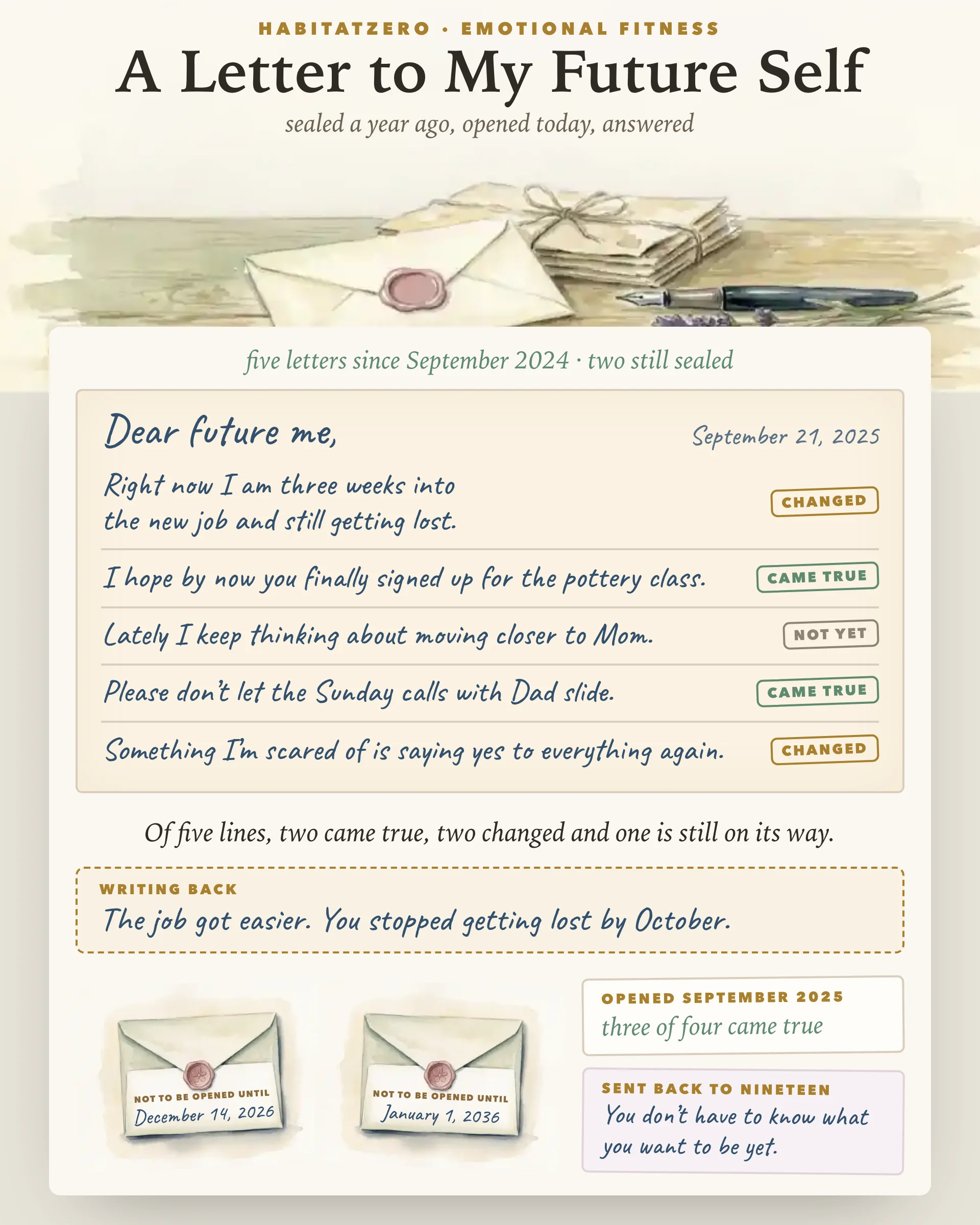
A letter to your future self is a small act of trust. You write to someone who doesn't exist yet, seal it, and let time turn today's worries and hopes into something you can check.
This page helps you write the letter, keeps it shut until the day you pick, then turns the opening into a short reckoning with what came true, what changed and what you would say back.
First choose who the letter is for. Future me is the familiar version, opening in a few months or a couple of years. A time capsule reaches further, five to twenty years out, and its prompts lean toward the texture of now. Younger me turns around and writes to you at an age you pick.
Then write, one line at a time. Each prompt starts a sentence (Right now I am, Please don't forget) and you finish it in your own words, in handwriting on ruled paper. The paper stops at eight lines, because a letter you can read in one sitting is one you will actually read.
Choose when it opens and seal it. From that moment the page shows only the envelope and its date. If you spot a mistake while the wax is still warm, you can unseal it the same day; after that it stays closed. No email arrives on the day: the letter waits in your saved copy of the page, and the opening happens when you come back.
When the day comes, the envelope moves to the top of the page and waits for you to break the seal. Mark each line as came true, changed or not yet, and the page adds your marks into one plain reading, something like two came true, two changed and one is still on its way. Note what the letter never saw coming, write a few lines back to the person who sealed it, and file it with the others. Over the years the bundle becomes a record of what you hoped for and how it went.
The letters worth opening are specific. "I hope you're happy" gives your future self nothing to answer. "I hope you finally signed up for the pottery class" does. A few kinds of lines tend to earn their place:
For a time capsule, lean on the ordinary: the song on repeat, what everyone is arguing about, who sits at your table on a Sunday.
Writing to a future self has a small but real evidence base. In studies with students, Yuta Chishima and Anne Wilson found that a letter exchange with a future self, writing to that self and then replying from its point of view, raised students' sense of continuity with their future selves and their career planning more than sending a letter alone. In their exercise the reply was imagined. Here the reply comes from the real later you once the date arrives, which is a different thing and not what they tested.
People expect to change less than they do: in the end of history illusion studies, adults from eighteen to sixty-eight described more change over the previous ten years than people ten years younger predicted for the decade ahead. A sealed letter catches that illusion in your own handwriting, which is why the page asks what the letter never saw coming.
The ordinary details matter too. In experiments on rediscovery, people underestimated how interesting their everyday records would feel when they found them again, and the mundane moments were the most underrated. That is the case for writing down a normal day, even when it feels too small to bother with.
None of this makes a letter a treatment for anything. It is a reflective exercise, and most of its value is in the reading.
A letter to your younger self runs the other way. It can't be delivered, so the page doesn't pretend: you choose the age, write what you wish you had heard then (you don't have to have it all figured out, be gentler with yourself), and send it back into the bundle as a keepsake. It is a kind way to measure how far you have come.
Any threshold works: a birthday, New Year's Eve, the first week of a job, a graduation, a move. If you want to take stock before a year-end letter, run through a Year in Review first. If the letter turns up a hope you want to plan for properly, map it on The Life Map. And if you would rather hear from your future self every morning than once a year, the Future Self Journal is built for that daily rhythm.
Write it now, seal it, and let the date do the rest.
Things your future self can check. Describe an ordinary day right now, name one or two concrete hopes, admit one worry and say what you want to keep. A line about finally taking the pottery class gives the reader far more to answer than a wish to be happy.
A year is the usual span: long enough for real change, short enough that you still remember the person who wrote it. Three or six months suits a single goal or a hard season, while a time capsule letter can wait five, ten or twenty years.
A letter sealed for years to keep the present safe for a much later reader, usually you. It works best with ordinary details, such as what a normal day looks like, the song on repeat and who sits at your table, because those fade first and are the most fun to find again.
Yes. Switch the letter to younger me, pick the age you are writing to and use the prompts for what you wish you had heard back then. It cannot travel backward, so it goes straight into your bundle as a keepsake to reread.
No. It stays sealed in your saved copy of this page in HabitatZero, which is free, and it opens there on or after the day you chose. The public page only shows a filled-in example; personalize it to write and seal your own.
By the team behind Fabulous, the science-based self-care app used by over 30 million people.