The Overwhelm Recovery ProtocolWellness & Routines · ~5 min
About this template · Updated September 2026
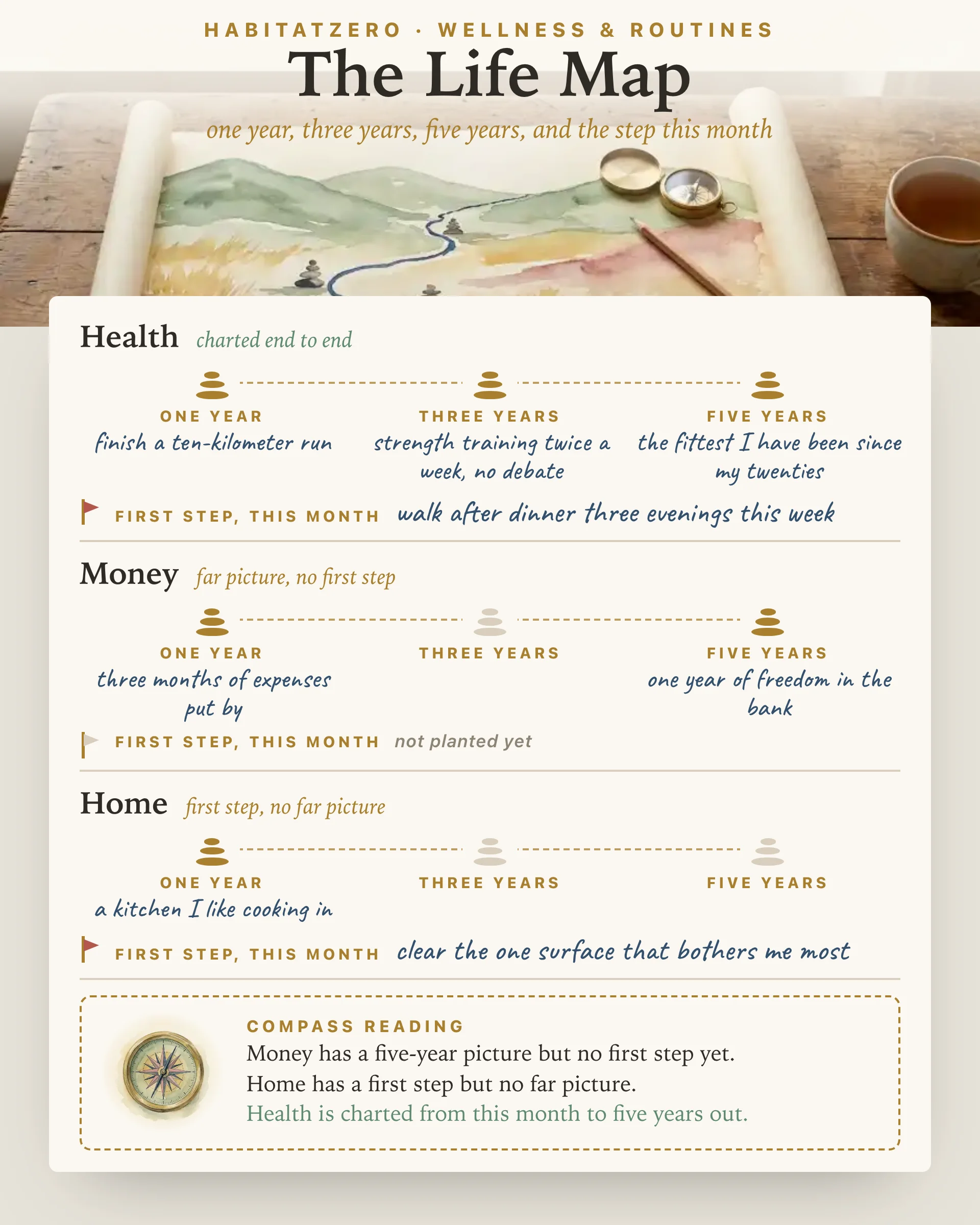
A goal list answers one question: what will I do next? A life plan answers a different one: where is all of this going? This page is built for the second question. You choose a handful of life areas, and for each one you mark three points on a trail: where you want it to be in one year, in three, and in five. Then you write the single step that starts this month. The result reads like a map rather than a to-do list, and the map comes with a compass that tells you where the plan is honest and where it is still only a wish.
Decades of goal-setting studies point the same way: specific, demanding goals pull more effort and persistence out of people than vague intentions to do well, as long as the person is committed and gets feedback along the way. That is the core of Locke and Latham's goal-setting theory, assembled over thirty-five years of experiments. A five-year picture on its own is not specific enough to steer a Tuesday. A one-year milestone is. Putting both on the same trail gives the far picture something to pull on.
The near end matters even more than it looks. In a classic study of children catching up in arithmetic, Bandura and Schunk found that those who set themselves proximal, session-by-session goals worked faster, mastered more and rated their own ability higher than those chasing a single distant target. Distant goals inspire; near goals get done. The first-step line on each trail exists to give every far picture a near end.
There is a reason people find the five-year line easy to fill and the this-month line hard. Construal level theory describes how the mind represents distant events in abstract, high-level terms and near events in concrete detail. Five years out you naturally see the shape of the thing: the fitness, the home, the work that fits. This month is where the detail lives, and detail is more work to write. The compass on this page is looking for exactly that gap.
Start with the regions. Tap the parts of life you want on the map: health, work, money, love, family, friends, home, learning, play, purpose, or name your own. Six regions is the ceiling, because a map you cannot read in one glance is a map you will stop opening.
Each region gets a trail with three cairns at one, three and five years. Tap a cairn and mark it, either by choosing a suggested milestone or writing your own short line. Under the trail sits a flag for the first step: the one thing that starts this month. It should be small enough to finish before the month ends.
As the trails fill, the compass reads the map. It names the regions that have a five-year picture but no first step, the regions that have a step but no far picture, and the regions that are charted end to end. A far picture with no step is a wish. A step with no picture tends to wander. The reading is not a score; it is a pointer to the trail that needs attention next.
Once the step is chosen, decide when and where it happens. A meta-analysis pooling ninety-four independent tests found that implementation intentions, plans in the form of "when situation X arises, I will do Y", had a medium-to-large effect on whether people followed through on goals they already held. "Walk after dinner" becomes "when the dishes are done on Monday, Wednesday and Friday, I put on my shoes." The step line on each trail is short on purpose; the when-and-where can live in your calendar.
No study shows that writing a five-year plan makes the five-year outcome arrive. The research supports something narrower: clear goals with near milestones and feedback change how much effort people put in and how long they keep going. Five years is long enough for jobs, cities and relationships to change, and a map drawn today will be partly wrong by then. That is fine. The far cairns are there to give the near steps a direction, not to hold you to a forecast. Redraw the map once a year, keep whatever still rings true, and let the rest go.
Draw the map at a natural threshold: a birthday, a new year, a move, the week after a job ends. If you are not sure which regions need attention, score them first with The Wheel of Life and bring the lowest two or three here. When one trail deserves a month-by-month route of its own, hand it to the Goal Map. And if a first step feels fuzzy, run it through the SMART Goals Worksheet until it has a number and a date.
Then close the map and walk the nearest step. The compass will still be here when you come back.
It is a one-page frame for the long view: a few life areas, and for each a milestone at one, three and five years plus the first step this month. This version is drawn as a map, with a trail per area and a compass that reads what is missing.
A goal list is a set of things to do; a life plan is a set of directions to travel. The list tells you what to do on Tuesday, the plan tells you which Tuesdays add up to something. This page keeps both, with the far picture and the near step on the same trail.
Pick the ones that would change your days if they changed: health, work, money, love, family, friends, home, learning, play and purpose are the usual regions. Six is the most this map holds, so choose the ones that need a decision this year rather than all ten.
It sorts your regions into three kinds: charted end to end, a five-year picture with no first step, and a first step with no far picture. The first kind is ready to walk. The second is a wish until you add a step. The third needs a destination.
The page shows a filled example you can read through. Drawing your own map and keeping it means personalizing it in HabitatZero, which costs nothing.
By the team behind Fabulous, the science-based self-care app used by over 30 million people.