Leaves on a StreamEmotional Fitness · ~3 min
About this template · Updated September 2026
Credit belongs to two cardiologists, Meyer Friedman and Ray Rosenman. In a 1959 paper in the Journal of the American Medical Association, they described what they called a specific overt behavior pattern and tested whether it went with blood cholesterol, clotting time and coronary artery disease. The pattern became Type A, and its absence became Type B. This quiz is an independent page built on their idea. It has no tie to their work or to any published Type A questionnaire, and no one connected with either has reviewed or endorsed it.
Friedman and Rosenman were describing a way of acting, not a fixed temperament: a chronic sense that time is short, a hard competitive edge, a quick flash of irritation, and the habit of running two or three things at once. The Type B end is simply less of all four. It is not the lazy end. Someone can be ambitious and still wait for the microwave without drumming their fingers.
For decades the letters were used as if everyone belonged in one of two camps, and that assumption has now been tested. In 2019, Michael Wilmot, Nick Haslam, Jingyuan Tian and Deniz Ones repeated the best-known analysis that had claimed a true Type A category, then ran the question again on a second sample, with more than two thousand people each time. The pattern behaved like a dimension, with people spread along it rather than sorted into groups, and the authors recommended retiring the typology. That is why this page hands you a tempo instead of a letter.
Type A became famous as a heart risk, and the full story is more careful than the legend. When Michael Myrtek pooled the prospective studies published through 1998, the overall Type A pattern showed essentially no association with coronary heart disease. Hostility did show one, though so small that he found it of no practical use for prediction or prevention. A later meta-analysis by Yoichi Chida and Andrew Steptoe tied anger and hostility to more coronary events among people who started out healthy, and to poorer outcomes among people who already had heart disease.
So the part of the pattern that later research linked to the heart is hostility, not the pattern as a whole. This page keeps temper as a strand of its own for that reason, but it reads temper the way it reads everything else, as a tempo. Nothing on the page predicts anything about your health. If your heart worries you, take that to a doctor rather than a quiz.
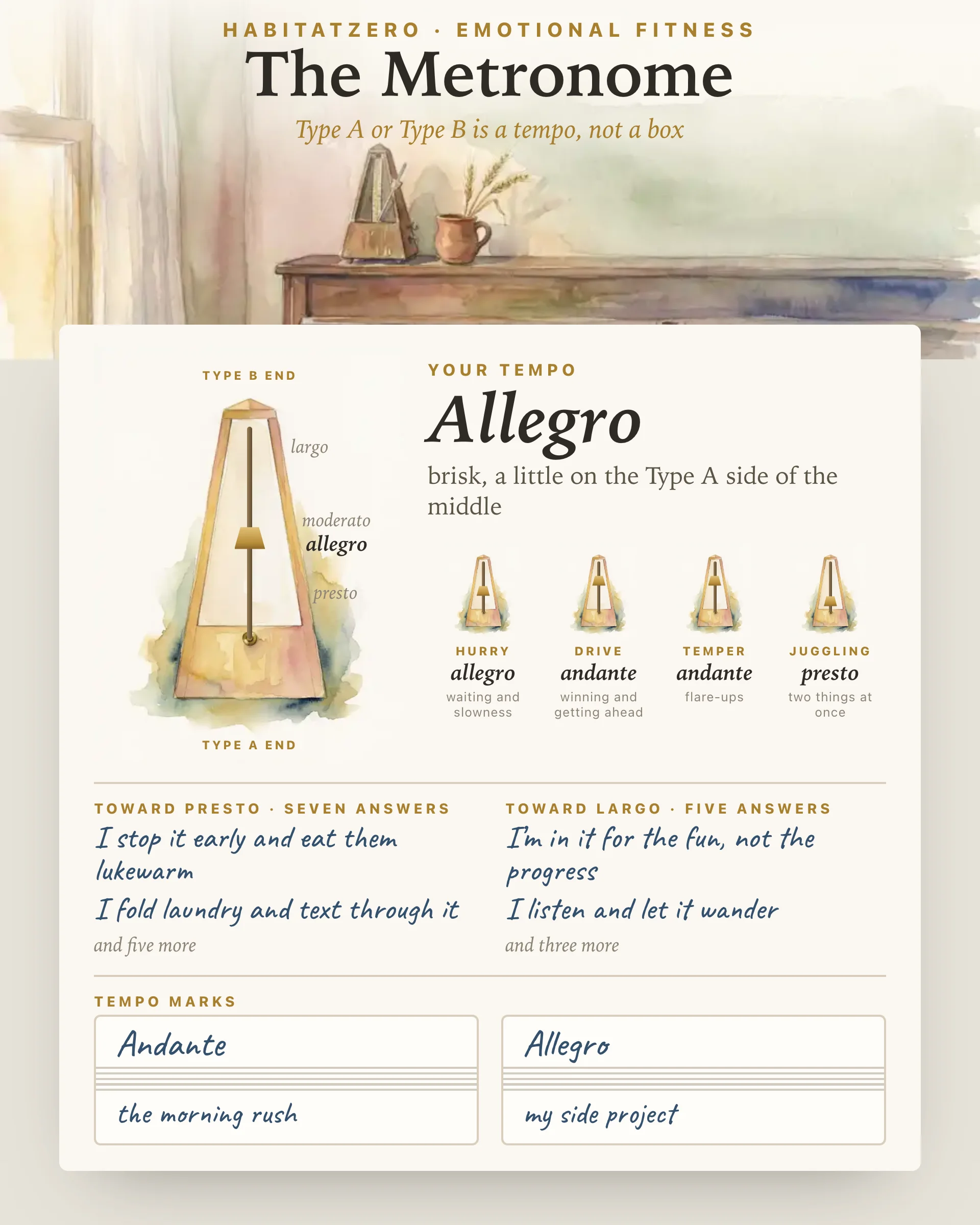
Twelve everyday moments, from a microwave counting down to a friend's long story, each offer four answers in mixed order. Every answer slides the brass weight on the painted metronome: up the rod toward largo, the unhurried Type B end, or down toward presto, the hurried Type A end. A real metronome behaves the same way, since a weight set higher on the pendulum swings more slowly.
The moments come in four strands of three: hurry, drive, temper and juggling. Once all twelve are set, the page names your tempo in words, from largo through adagio, andante, moderato, allegro and vivace to presto. Each strand gets a small metronome of its own, and the answers that pulled you each way are listed underneath, split into the ones that went all the way and the ones that only leaned. Press let it swing to watch the pendulum keep eight beats at your tempo.
Then take the idea off the page. Choose up to three moments from your own week and pencil a tempo onto each, the way a player writes adagio above a passage that keeps running away from them. The morning rush might deserve andante. A side project you keep postponing might deserve allegro. Neither end is the virtuous one; the point is choosing the speed on purpose.
The twelve moments were written for this page. They are not drawn from the Jenkins Activity Survey or any other published scale, and they have not been validated, so treat the tempo as a reflection of how you answered today rather than a measurement. It can move with a hard month or a quiet vacation, and that movement is worth noticing. A presto reading is not a character flaw, and a largo reading is not a lack of drive. The strands often say more than the headline, because one fast strand can carry an otherwise easy tempo.
Take it when a friend calls you Type A and you want to see how much of that is hurry and how much is ambition, or when a rushed season makes you wonder which part of you sped up. If the speed has started to feel like depletion, the burnout quiz looks at that directly. If temper is the strand keeping the quickest time, the emotional maturity quiz looks at what you do in the moments after a sharp word lands. And for a different range entirely, the introvert extrovert quiz asks where your energy comes from.
Nobody plays every passage at the same speed, and nobody needs to.
Most likely somewhere along the line between them. Current evidence treats Type A and Type B as two ends of one range rather than two kinds of people, so this quiz shows where your answers settle on that range and which moments pulled you toward each end.
Type A describes a hurried, competitive way of acting that flares up quickly and keeps several tasks running at once. Type B describes the unhurried end: patient with waiting, easy about winning, slow to boil. Few people sit at either extreme, and the mix shifts with the setting.
The cardiologists Meyer Friedman and Ray Rosenman described the Type A behavior pattern in a 1959 medical paper about heart disease. This metronome is an independent quiz inspired by their idea, with no connection to them or to any published Type A questionnaire.
Not as a whole pattern. Pooled studies that followed people for years found no dependable link between overall Type A behavior and heart disease, while hostility showed a small one on its own. This quiz reads your answers as a tempo and makes no prediction about your health.
This page shows a finished metronome as an example. To set your own weight across the twelve moments and keep your tempo marks, personalize the quiz in HabitatZero, which costs nothing.
By the team behind Fabulous, the science-based self-care app used by over 30 million people.