Leaves on a StreamEmotional Fitness · ~3 min
About this template · Updated September 2026
Credit where it is owed. The three strands this candle is built on come from Christina Maslach's decades of burnout research, which she and Michael Leiter set out in an overview for World Psychiatry: exhaustion, a growing cynicism or distance toward the work, and a shrinking sense of doing the job well. Their Maslach Burnout Inventory is the licensed questionnaire that measures those strands in studies. This page is an independent practice built around the same three-part shape, with lines of its own; it is not that inventory and is neither connected to nor endorsed by Maslach, Leiter, or the inventory's publisher.
Most people who type burnout quiz into a search box want to know whether the tiredness they are carrying has a name. What they usually get is a number, and numbers have a way of sounding like verdicts. This page keeps the useful part of the question, what exactly has worn down, and drops the score.
Burnout is not simply being tired. The description the World Health Organization adopted in ICD-11 calls it an occupational phenomenon rather than a medical condition and names three dimensions: depleted energy, mental distance or negativity toward the job, and reduced professional efficacy. A person can be exhausted and still care fiercely, or still competent while feeling nothing at all. Treating the three as one flame hides that.
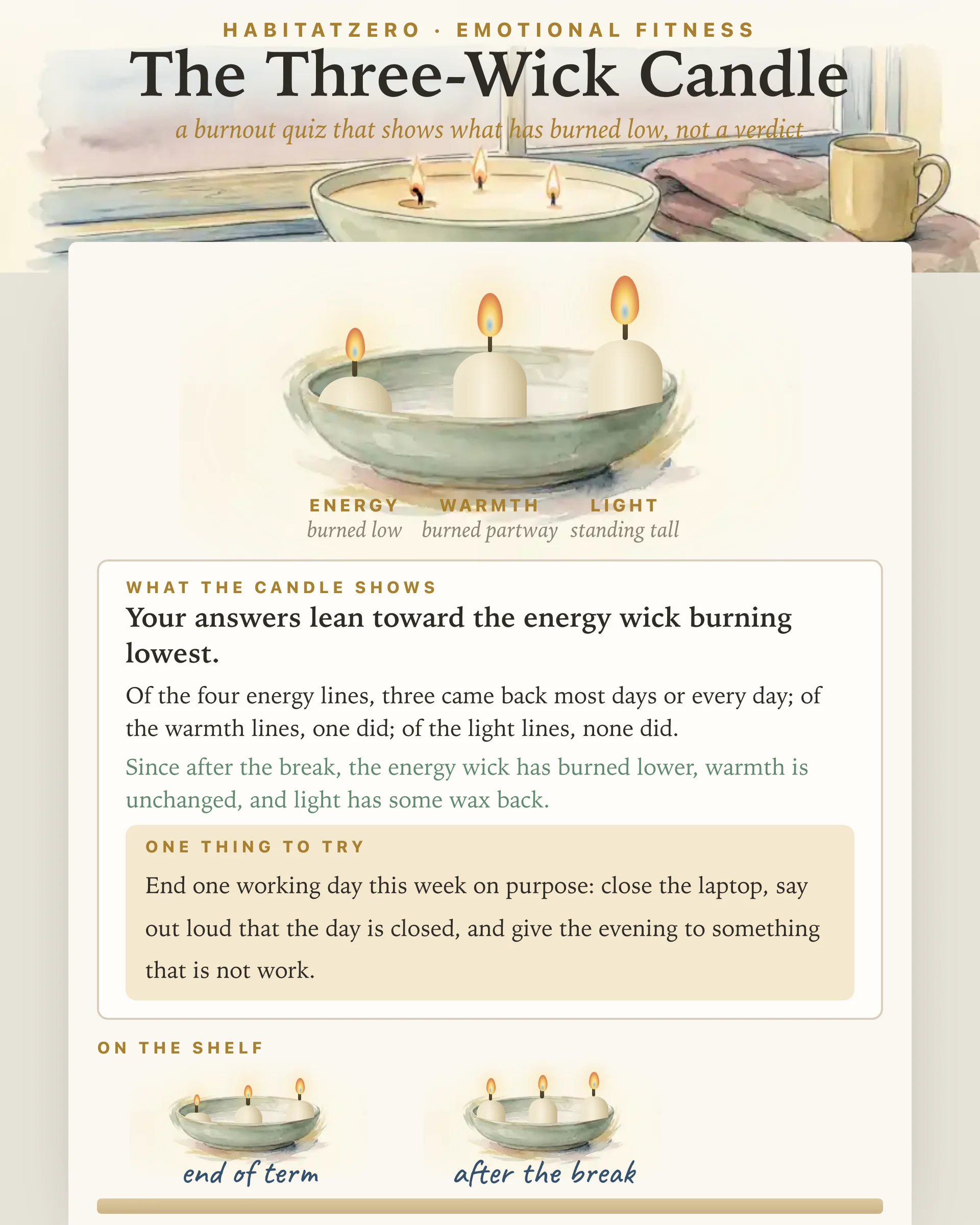
So the candle has three wicks. Energy is the exhaustion strand: waking already tired, an afternoon with nothing left in it. Warmth is the distance strand: catching yourself not caring how something turns out, keeping people at arm's length, a bitterness that surprises you. Light is the efficacy strand: struggling to see that anything you do makes a difference, doubting you are any good at this anymore. Four lines feed each wick, and the height of the wax left on it is the whole readout.
Under the candle sit twelve lines about recent weeks. For each you tap one of four stops, from hardly ever to every day. Finish a group of four and its wick lights, with the wax drawn to the height your answers left it. Tapping an unlit wick on the candle jumps to its four lines.
Once all three are lit, a reading appears. It names the wick that burned lowest, counts how many of each wick's lines came back most days or every day, quotes the single line that burned hardest, and hands you one thing to try for the lowest wick. Then it offers to keep the candle on a shelf under a label such as end of term; three fit. Whenever your current answers differ from the last one kept, the reading adds a line on what has changed: which wick has some wax back, which is unchanged, which has burned lower.
A single reading tells you where you are. Two readings a month apart tell you which way you are moving, and direction is what decides whether a hard stretch is a stretch or a slope.
Each wick comes with one deliberately modest practice. The energy wick's is to close one working day on purpose and give the evening to something that is not work. That comes from recovery research: when Sabine Sonnentag and Charlotte Fritz built their measure of how people recuperate from work, psychological detachment, genuinely switching off in non-work hours, stood out alongside relaxation, mastery and control as what lets energy return. The Workday Shut-Down Ritual is the long form of that closing move.
The warmth wick's practice is to do one small piece of the work slowly, the way you did it in your first month, and notice whether anything warms. The light wick's is to write down, three evenings running, one thing that would not have happened without you. None of these fixes a job that is grinding you down. They are ways of finding out which wick still answers when you tend it.
It cannot tell you that you are burnt out, and you should distrust any page that claims it can. Exhaustion, flatness and self-doubt also belong to poor sleep, low mood, grief, thyroid trouble and a dozen other things, and sorting those apart is work for a clinician who can ask follow-up questions. If all three wicks have burned low and stay that way across several readings, take the shelf with you to a doctor's appointment and describe it in your own words. You will not need a score to be taken seriously.
Light it at the end of a stretch that felt heavier than it looked, and again about a month later. If the weight you are carrying is a person rather than a job, the Caregiver Burnout Quiz is written for that particular week. If what you feel is less a slow burn than a pile of pressures you cannot see the edges of, the Stress Relief Worksheet sorts them first. And if the candle keeps showing you the same low wick, that is not a failure of the practice. It is the candle doing its one job, which is to show you where to look.
Burnout research describes three strands: exhaustion, a growing distance or cynicism toward the work, and a fading sense of doing the job well. This page calls them energy, warmth and light and gives each its own wick. Four everyday lines feed each wick, and the height of the wax is the only readout. There is no number to compare yourself against, because a number would pretend to a precision that twelve taps cannot have.
No. The instrument used in studies is the Maslach Burnout Inventory, a licensed questionnaire scored by people trained to use it. This candle borrows the three strands that research settled on and writes its own plain lines around them. It is not that inventory, does not reproduce its items, and returns a reflection on your answers rather than a score.
It cannot, and neither can any page on the internet. The World Health Organization lists burnout as an occupational phenomenon rather than a medical condition, and telling it apart from poor sleep, low mood or a physical illness is work for a clinician who knows you. What the candle can do is show a pattern across three wicks and hand you one practice to try. If all three have burned low and stay that way for weeks, that pattern is worth taking to your doctor in your own words.
Try the one thing attached to the wick that burned lowest: closing a working day on purpose, doing one piece of the work slowly the way you once did it, or writing down one thing that would not have happened without you. Then keep the reading on the shelf and mark the lines again at the end of the next hard month. Two candles side by side show a direction, which is more useful than either one alone.
The page you are reading shows a finished candle with two readings already on its shelf, so you can see how the wicks and the shelf work together. Marking your own lines and keeping readings from month to month happens inside HabitatZero, where the candle is saved to your account at no cost.
By the team behind Fabulous, the science-based self-care app used by over 30 million people.