Leaves on a StreamEmotional Fitness · ~3 min
About this template · Updated July 2026
Caregiving weeks have a strange accounting. From the outside they look like errands — appointments kept, meals managed, a parent or partner looked after. From the inside, someone is quietly paying for all of it in 2 a.m. wakings, postponed check-ups, and a resentment that arrives with guilt already stapled to it. This quiz is for the person doing the paying. Ten ordinary moments from your week, and at the end no score, no grade, and no verdict — just an honest reading of which loads were heaviest, each with one concrete move to set part of it down.
Most burnout quizzes hand you a number, and numbers feel like diagnoses even when the fine print says otherwise. This page deliberately does neither. Caregiver strain is real and well documented — medicine formally recognizes caregiver burden as a common, serious, and routinely under-noticed condition among family caregivers — but recognizing that reality is a clinician's work, done with a person, not a webpage's work, done with a form. A page's honest job is smaller: noticing. Which is also the useful job, because a caregiver who can say the solo load was the heavy one this week has something to act on by Friday. A caregiver who has been told "moderate burnout, 6.2" has something to worry about, which is the one thing the week did not need more of.
So the quiz reads one week at a time, in moments small enough to answer truthfully: what actually happened at 2 a.m., what happened to your own doctor's appointment, what you said when someone offered to help.
The night load is rest traded away — up for them once or twice or who-counts-anymore, and mornings that pay the invoice. Its relief move is one protected wind-down this week, chosen now, with the listening handed to someone else for those hours.
The own-ground load is your upkeep sliding down a list it never leaves: the postponed check-up, lunch eaten standing over the counter. Its move is putting one appointment of yours on the same calendar that runs theirs — booked this week, not someday.
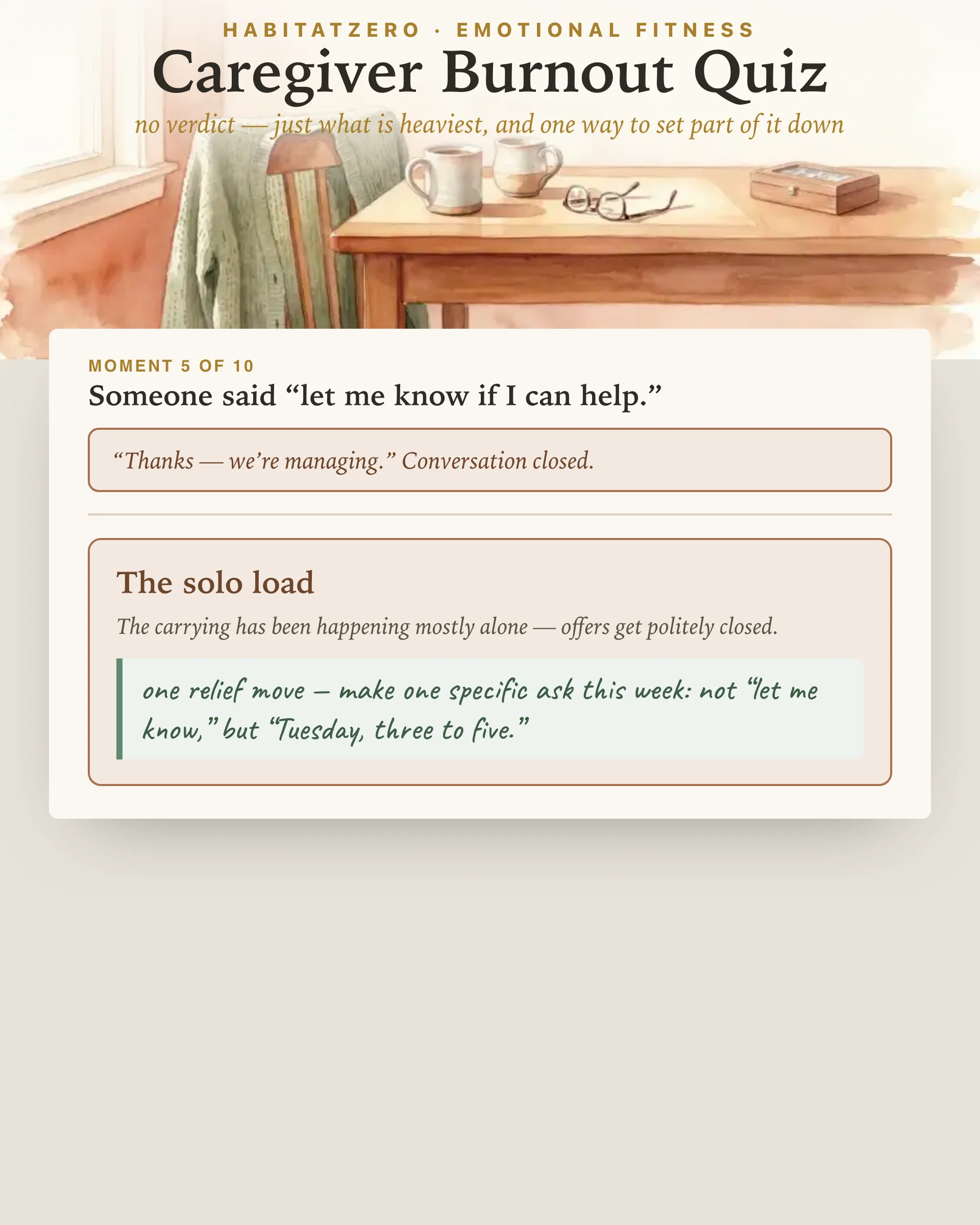
The solo load is carrying alone. Offers get politely closed with "we're managing," and handing over feels harder than doing it yourself. Its move borrows the oldest trick in volunteer coordination: not "let me know if you can help," but "Tuesday, three to five." Specific asks get yeses.
The breather load is the disappearance of minutes that belonged to you — the walk, the choir, the unclaimed half-hour. Its move is thirty unbargained minutes on the schedule like a medication, because that is roughly how it works.
And the undertow is what pulls underneath the doing: resentment, guilt about the resentment, a truth with no safe place to be said. Its move is saying the true sentence out loud once, to one safe person. Naming it is not betrayal; it is maintenance.
Then here is the honest answer this page owes you: no quiz decides that — not this one, not the ones with numbers. The signal worth trusting is your own read of yourself across time. You already know whether the tiredness has stopped sleeping off, whether the dread lifts, whether your body has been flagging warnings you keep overriding. If that read is telling you something, it deserves a doctor's appointment of its own, described in your own words. You do not need a checklist's permission to make that call, and a good doctor will not ask you for one.
Two starting points are worth naming because caregivers rarely have research time. The Family Caregiver Alliance's self-care guide for family caregivers is written by people who understand the guilt economics of respite, and AARP's caregiving resources are a practical index to local support, respite options, and the paperwork side of caring. Closer to home, the self-care checklist on this site is a gentle weekly floor for the own-ground load.
One heavy week is caregiving. A run of them where every load stays heavy — sleep gone, ground gone, no one sharing the weight, the undertow humming — is a situation, and situations deserve people: your doctor first, and the respite services, support groups, and family counselors that exist precisely for this. Caring for them includes you; that is not a slogan, it is logistics — the care they receive is only ever as sustainable as the person providing it. And if the weight ever turns into feeling hopeless or unsafe in your own head, put the page down and call or text 988 (US), or your local emergency number, now.
Which parts of the caregiving load your past week leaned on hardest — sleep, your own health and upkeep, carrying alone, minutes that belong to you, or the unspoken feelings underneath — and one concrete relief move for each. It deliberately does not produce a number, a grade, or a verdict about you. The result is a fact about the week, built entirely from your own answers about ordinary moments.
No, and no online quiz honestly can. What this page can do is help you take one week seriously. The truer signal is your own read of yourself over time — tiredness that has stopped sleeping off, a dread that does not lift, your own health repeatedly slipping down the list. If that read sounds familiar, it deserves a doctor's appointment of its own, said in your own words. You do not need a quiz result to justify making that call.
The night load is rest traded away — the 2 a.m. wakings and the mornings that pay for them. The own-ground load is your upkeep sliding to the bottom of the list: appointments postponed, meals eaten standing. The solo load is carrying alone and politely closing every offer. The breather load is the disappearance of minutes that belong to you. The undertow is what pulls underneath — resentment with guilt stapled to it, or a truth with no safe place to be said.
One thing, this week: the relief move attached to your heaviest load. The moves are deliberately small and specific — a protected wind-down night, one booked appointment of yours, an ask with a day and time attached — because small and done beats comprehensive and postponed. For the longer game, the Family Caregiver Alliance and AARP caregiving resources listed in the article are genuinely useful places to find respite options near you.
Then let the page lose to your own judgment, gladly. A run of weeks where every load is heavy, a body that keeps flagging warnings, a low that stays — that pattern belongs with your doctor, and caregiver strain is something medicine now takes seriously, not a private failing. Respite services, support groups, and family counselors exist precisely for this. Caring for them includes you; that is not a slogan, it is logistics.
Free, in your browser — this public page shows a filled-in example week so you can see how the moments and the result work together. Inside Fabulous your answers save privately to your account, which makes the retake honest: next month you answer the new week fresh and see what shifted, rather than remembering what you said.
By the team behind Fabulous, the science-based self-care app used by over 30 million people.