Leaves on a StreamEmotional Fitness · ~3 min
About this template · Updated July 2026
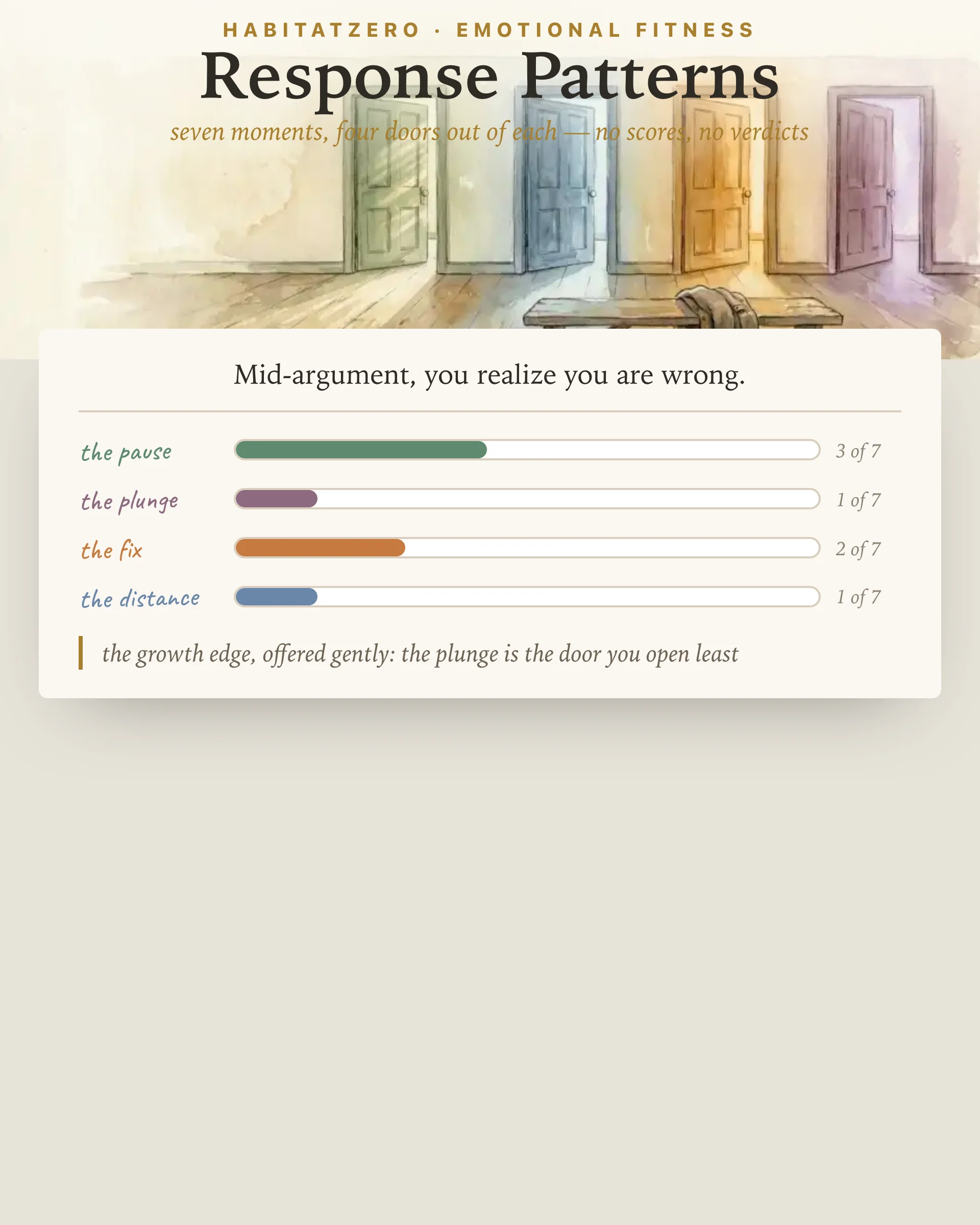
Most quizzes on this topic end with a verdict — a percentage, a level, a "you are 74% emotionally mature" that flatters or stings and changes nothing. This one refuses the premise. Emotional maturity isn't a score; it's a repertoire. So the quiz hands you seven ordinary moments — a plan collapses an hour before, a friend's text lands sharp, you realize mid-argument that you're wrong — and four honest doors out of each. What comes back is not a grade. It's a reading of which doors you actually open, what each one gives you, what each one costs, and which door your hand never reaches for.
The scoring version of this quiz would have to pretend there's a best answer, and the research says there isn't. Work on regulatory flexibility — Bonanno and Burton's Regulatory Flexibility: An Individual Differences Perspective is the clearest statement — argues that healthy responding isn't a single superior strategy but the capacity to match the response to the demands of the moment. Cheng's studies on coping flexibility found the same shape from another angle: people who varied their approach across situations fared better than people loyal to one style, however good that style looked on paper.
Which means the pause that saves you from the bad email is the same habit that lets a decision age on your desk for a week. The fix that has something genuinely better within the hour is the same reflex that solves a crying friend who only wanted witnessing. A score would crown one of these and flatten exactly the thing worth seeing.
Every answer in the quiz maps to one of four response patterns, and each is described twice — gift first, cost second, both true at once.
The pause buys a beat before anything happens. Things rarely get worse in a pauser's hands; they occasionally never happen at all.
The plunge lets the feeling be as big as it is, so it moves through instead of settling in. The people nearby sometimes get the weather report before you know the forecast yourself.
The fix converts discomfort into motion. Something is usually genuinely better within the hour — and some things wanted witnessing before solving.
The distance steps back far enough to see the whole board. You rarely say the thing you regret; from far enough away, every moment also looks skippable.
Most people run a mix with one clear favorite. The result view shows the mix as it actually falls across your seven answers, names your most-practiced door with its gift and its cost, and then offers the part that matters most.
The last line of your reading names the door you opened least — not as a deficiency, but as an invitation. The framing is deliberate: not better, not required, but worth borrowing on purpose once this week, in a low-stakes moment, just to know your hand can reach it. That's what growing a repertoire actually looks like — not converting to a new style, just adding range where a moment might one day want it.
Answer honestly (the quiz only works at the speed of honesty), read your patterns, and retake it whenever you like — after a hard season, the mix often shifts, and watching it shift is its own kind of self-knowledge.
HabitatZero keeps its mirrors deliberately specialized. The self-esteem quiz listens for the inner voices that narrate your everyday moments — how you talk to yourself. This quiz watches your hands instead — what you do when a moment lands. And when you find a pattern you'd like to practice rather than just see, the emotional regulation worksheet is the practice room: the same hot moments, taken one at a time, with a pause built in.
Seven moments. Four doors. No verdict — just a clear look at which ones you open, and one worth trying with your own hand on the handle.
Not maturity as a level — nobody can score that in seven questions, and this quiz refuses to pretend. It reads which of four response patterns you reach for when a moment lands: pausing before acting, feeling it fully first, moving straight to a solution, or stepping back for distance. The result is a picture of your practiced habits, with the gift and the cost of each named plainly.
Because the honest version of this topic is not a ladder. Every pattern here is the right move in some rooms and the wrong move in others: the pause that prevents a bad email is the same habit that lets a decision age on your desk. Research on regulatory flexibility points the same direction — what serves people is not one superior style but the range to match the response to the moment. A score would flatten exactly the thing worth seeing.
The pause buys a beat before anything happens. The plunge lets the feeling be as big as it is so it can move through. The fix converts discomfort into motion. The distance steps back far enough to see the whole board. None is the mature one — each carries a real gift and a real cost, and most people run a mix with one clear favorite.
The door you open least. The quiz offers it gently: not as a deficiency, but as a response your hand does not reach for by habit — which means the moments that want that response are the ones you handle least well. Borrowing it once, deliberately, in a low-stakes moment is how a repertoire grows.
No. It is a self-reflection exercise — seven moments, honestly answered, read back as patterns. It does not diagnose, measure, or rank anything, and it is not a substitute for talking to a licensed professional if how you respond to hard moments is genuinely worrying you. It is a mirror with good lighting, nothing more.
By the team behind Fabulous, the science-based self-care app used by over 30 million people.