Leaves on a StreamEmotional Fitness · ~3 min
About this template · Updated August 2026
Search for a quiz on self esteem and most results promise a measurement: answer honestly, get a score, discover whether your self-esteem is high, low, or worryingly medium. This page declines that job on purpose. A number attached to your sense of worth is a strange gift — it changes nothing on Tuesday morning, and it hands your inner critic a citation.
What can be usefully noticed is a habit: which voice answers first when an ordinary moment goes slightly wrong. That's what these eight questions listen for.
Psychologists call the running commentary self-talk — the internal dialogue through which we appraise ourselves and regulate what we do next (APA Dictionary of Psychology: self-talk). It feels like a fixed personality feature. It behaves like a skill: whichever style of commentary runs most often gets stronger, the way any rehearsed phrase gets easier to say.
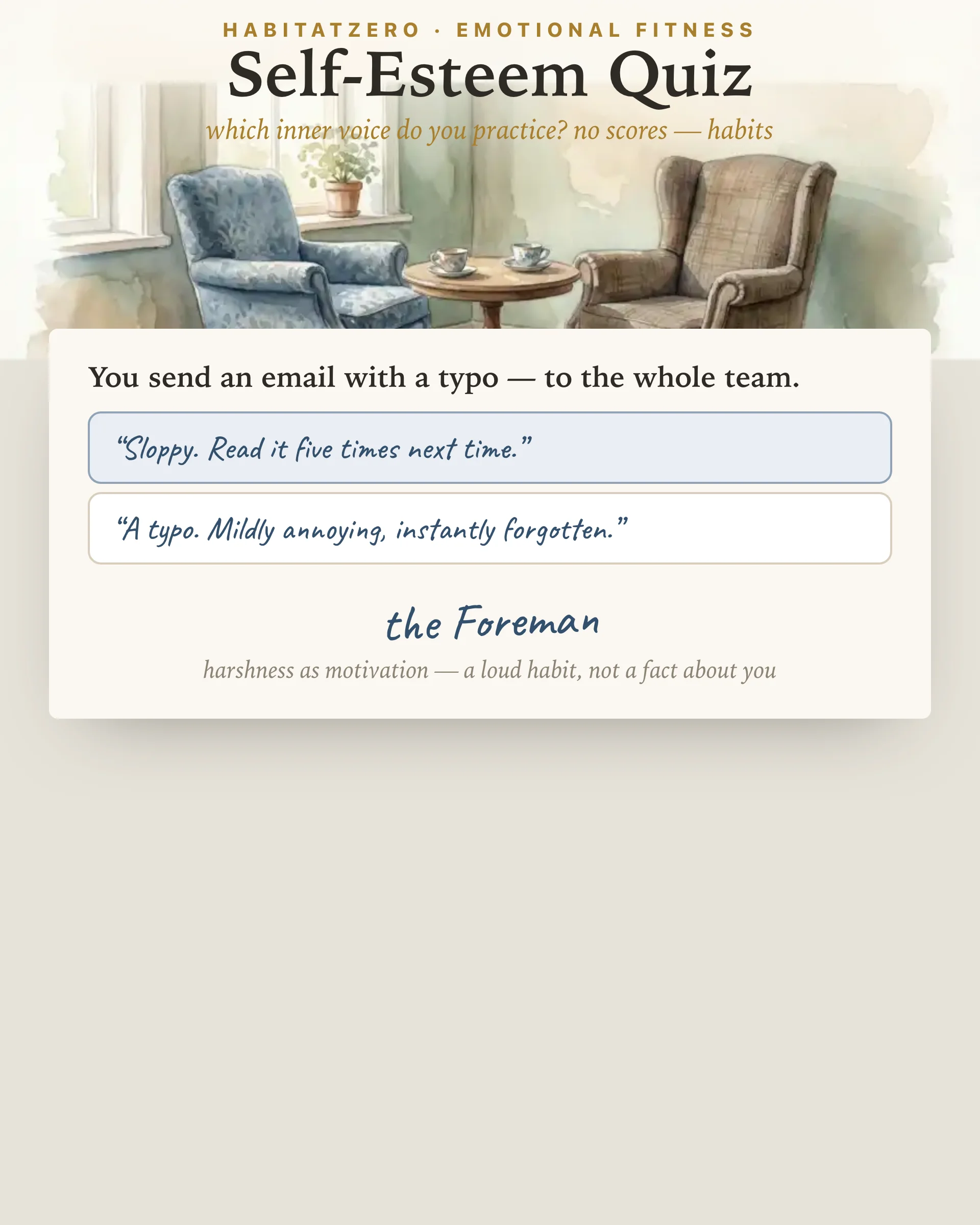
The quiz presents eight ordinary moments — the typo email, the friend's big win, the text that goes unanswered, the project that lands merely fine — each with four replies. Your instruction is to pick the voice you actually hear first, not the one you endorse. The four replies belong to four recognizable speakers:
The Foreman motivates by barking. Every slip gets a supervisor's correction, on the theory that kindness breeds laziness. The theory is wrong on its own terms — barked-at people start later and quit sooner — but the Foreman never audits itself.
The Comparer runs every moment against someone else's highlight reel. Its arithmetic is quick and always incomplete: you never see the other person's Tuesday afternoons.
The Mind-Reader delivers other people's thoughts about you with total confidence and zero access. The silence after your comment, the short reply — all converted into verdicts you never actually received.
The Fair Witness names what happened, includes what went fine, and speaks to you like someone it respects. Not a cheerleader — a witness. Most people hear it sometimes; the question is whether it holds the chair under pressure.
When all eight are answered, the quiz names your most-practiced voice — as a pattern, with a description and one matched habit to retrain it. The Foreman pairs with answering harsh lines the way you'd answer a friend. The Comparer pairs with keeping a record of your own handled moments, so it has something real to read. The Mind-Reader pairs with writing the guess down beside two alternative explanations. The Fair Witness pairs with staying fed on hard days, when the other voices audition loudest.
No severity bands, no percentile, no your self-esteem is… sentence anywhere. That's not squeamishness; it's the design working. A verdict invites you to agree or argue. A named habit invites a rep — and reps are the only thing that ever changed a voice.
Retake it in a month. The pattern drifts toward whichever voice gets practiced, which is the entire encouraging point.
Two of them, stated plainly. This is a reflection exercise for adults — it diagnoses nothing, screens for nothing, and measures no clinical anything; read the result as a direction for practice, full stop. And if your inner voice is relentless, or the low feeling doesn't lift, trust that signal over any page: a mental-health professional is the right listener for that conversation, and this quiz will still be here for the ordinary Tuesdays afterward.
A habit of speech: which inner voice answers first when an ordinary moment goes slightly wrong. It does not measure, score, or rank your self-esteem itself — there is no number, no severity band, and no grade on your worth anywhere in the result.
The Foreman motivates by barking; the Comparer measures you against everyone else's highlight reel; the Mind-Reader reports other people's thoughts as if it had access; the Fair Witness names what happened, includes what went fine, and speaks to you like someone it respects. Most people hear all four — the quiz finds the one with the most practice hours.
Because a score turns a habit into an identity, and identities resist change while habits invite it. Being told your self-esteem is a five does nothing on Tuesday morning; noticing that the Foreman answered six of eight moments hands you something to practice against by Tuesday afternoon.
No. It is a self-reflection exercise for adults, built for noticing patterns in self-talk — closer to a well-aimed journaling prompt than to any assessment. Nothing here diagnoses, screens, or measures a clinical construct, and the result should be read as a direction for practice, nothing more.
Each voice ends with one matched practice: the Foreman pairs with answering harsh lines the way you would answer a friend, the Comparer with keeping a record of your own handled moments, the Mind-Reader with writing the guess down next to two other explanations. Pick the one rep, run it for a few weeks, then retake — the pattern moves.
Then trust that instinct over any result on this page. A relentless inner voice, or a low feeling that never lifts, is a signal to bring in a mental-health professional — this quiz is a mirror for everyday habits, and some conversations deserve a person, not a page.
By the team behind Fabulous, the science-based self-care app used by over 30 million people.