Leaves on a StreamEmotional Fitness · ~3 min
About this template · Updated September 2026
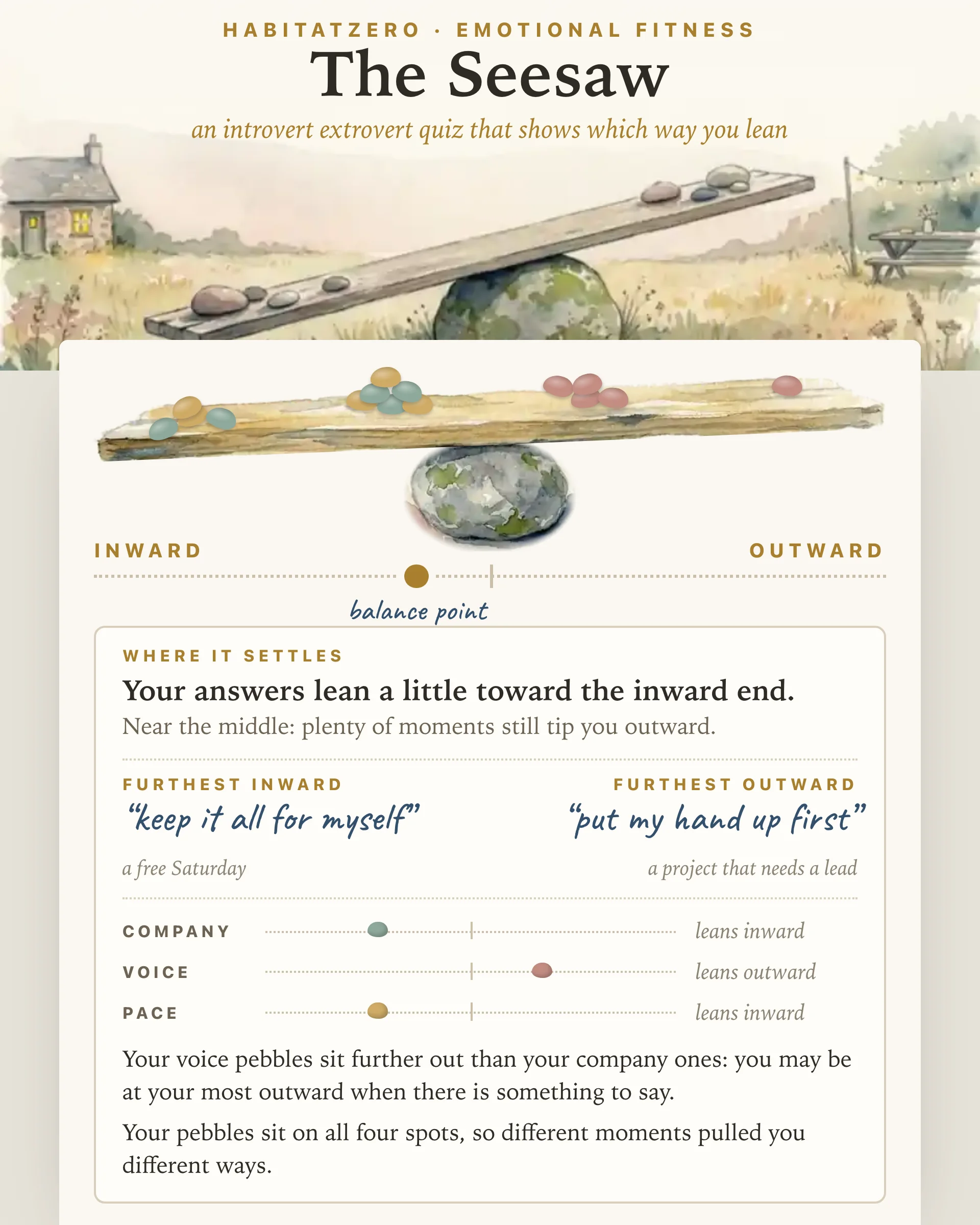
Most people who look for an introvert extrovert quiz want one word back. The trouble is that personality research stopped handing out that word a long time ago. Psychologists measure extraversion as a scale with two ends, and far more people land somewhere along it than at either end. So this page does not sort you into a box. It sets fifteen pebbles on a plank and shows you which way it tips.
Carl Jung made the words introvert and extravert famous about a century ago, and he described them as types, with one attitude leading in each person. Psychologists still tend to spell the second one extravert; most people outside the field write extrovert. Modern research kept the idea and dropped the boxes. In the Big Five model, extraversion is a single continuous dimension, and your standing on it can fall anywhere from one end to the other.
The clearest evidence against the two-box picture comes from the test that made types popular. When researchers rescored roughly twelve thousand Myers-Briggs results with a finer method, the apparent split into two humps turned out to be a scoring artifact, and the scores came out strongly center-weighted. The middle of the range is its busiest stretch. Ambivert is simply the everyday name for that stretch, and landing there is the ordinary result, not a way of dodging the question.
Extraversion is about more than parties. When Christopher Soto and Oliver John rebuilt the Big Five Inventory, they divided the trait into three facets: sociability, assertiveness and energy level. This page borrows that structure and calls the strands company, voice and pace.
Five moments come from each strand, fifteen in all. Plenty of people lean one way on company and the other on voice, which is why the reading draws all three.
Each moment offers four answers, running from furthest inward on the left to furthest outward on the right. Tap one and a pebble drops onto the plank directly beneath it, mild answers near the middle and strong ones near the ends. The plank tips toward wherever your pebbles gather, and a gold dot on the line below the stone marks your balance point: the average of everything you have set down so far.
Once all fifteen are down, the reading puts the balance point into words, quotes back the answer that reached furthest toward each end, and gives each strand its own small track, so a voice that leans outward can show up inside a life that mostly leans inward. Tap any answer in the list to change it, and the plank moves with you.
Look at a finished plank and you will almost certainly find pebbles on both sides. That is not inconsistency. In a set of studies that asked people to report what they were doing several times a day for two to three weeks, the typical person showed nearly every level of extraversion in ordinary behavior, while their average stayed almost perfectly stable. Everyone acts reserved at some hours and outgoing at others. Your pebbles are those hours. The balance point is the part that holds.
These fifteen moments were written for this page. Nobody has tested them for reliability or validity, and one sitting on one day is a narrow sample, so take the result as a reflection rather than a measurement. If you want a scored, published scale, the International Personality Item Pool offers free, public-domain extraversion items that researchers rely on.
Leaning inward is also not the same thing as shyness, which is about worry over how you come across. Some people who lean inward feel none of that worry, and some outgoing people feel a great deal of it. Neither end of the plank is the better seat.
Take it when the question comes up, when a crowded season has you wondering how much company really suits you, or when someone has told you what you are and you would like to check for yourself. If your pebbles gather inward and your calendar is full, The Social Battery lays the week's plans against your energy so you can see where a quiet evening belongs. If you wonder whether other people see you the way you see yourself, The Johari Window lets someone who knows you add their words beside yours.
Come back in a few months and set the pebbles down again. Some will land in new places. The balance point will probably stay close to where it was.
Probably some of each. Research measures introversion and extraversion as the two ends of a single scale, and far more people land in its middle stretch than at either end. The seesaw above shows where your own answers balance and which moments pulled you furthest each way.
It is the everyday word for someone whose answers settle near the middle of the introversion to extraversion range. It is not a third personality type. On measured scales the middle is the most crowded part of the range, which is why so many people recognize themselves in both descriptions.
In daily life, yes. Studies that check in on people several times a day find the same person quiet and reserved at some hours and talkative and bold at others. What separates people is where their behavior usually centers, and that center is the balance point this quiz draws.
Treat any online quiz as a prompt for reflection rather than a measurement. The fifteen moments on this page were written for it and have not been validated. For a scored, published scale, the International Personality Item Pool offers free, public-domain extraversion items that researchers use.
You can look through a finished example right here. Setting down your own fifteen pebbles, keeping the reading and coming back later to change an answer all happen in HabitatZero, and that costs nothing.
By the team behind Fabulous, the science-based self-care app used by over 30 million people.