The Overwhelm Recovery ProtocolWellness & Routines · ~5 min
About this template · Updated September 2026
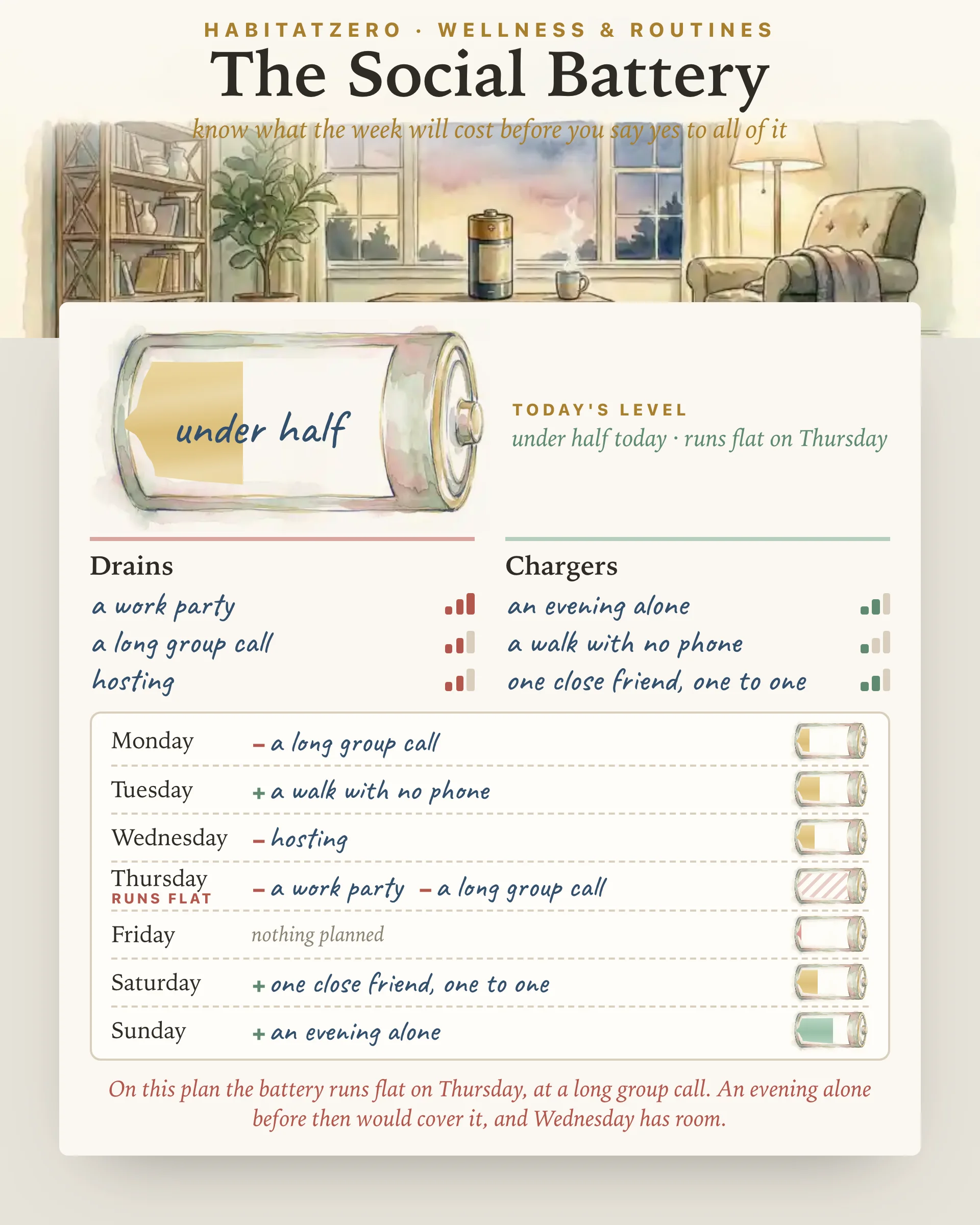
Nobody measured a social battery in a lab. It is a figure of speech that stuck because it describes something most people recognize: an evening with others spends something down, and a night alone or a good sleep tops it back up. What the metaphor leaves out is that the rate is personal, that it changes with the kind of company, and that the same dinner can lift you while it is happening and cost you the next morning.
This page takes the metaphor literally enough to be useful. It puts a painted battery on the sheet, lets you set where the charge is today, and then does the arithmetic on the week ahead so you can see the trouble spot before you are standing in it.
The clearest finding is about timing. A twelve-day experience-sampling study that measured behavior, mood and fatigue five times a day found that acting outgoing came with better mood and less fatigue in the moment, but with more fatigue three hours later. The lag effect did not depend on whether the person scored as introverted or extraverted, and it was largely explained by how many people they had met. Both halves of the metaphor are in that result: the lift is real, and so is the bill.
The second finding is about individual difference. In a randomised trial, people were asked to behave in a bold, talkative way for a week of ordinary life. On average their positive mood went up. But the more introverted participants gained less, felt more tired and reported more negative feelings than the rest. Sustained sociability has a price, and the price is not the same for everyone.
The third is about the recharge. A series of studies on being alone found that solitude reliably brings high-arousal feelings down, pleasant and unpleasant alike, and turns into relaxation and lower stress when the person has chosen it. Chosen quiet does something that enforced quiet does not, which is why the chargers on this page are ones you name yourself.
Introversion and extraversion are a spectrum, not two boxes, and knowing where you sit tells you less than a few honest readings from your own week. Some people run flat after a party; some run flat after a weekend with nobody in it. The page treats both as ordinary.
Start by dragging along the battery until it shows how much you have in you today. It reads back in plain words, from flat to full.
Next come two lists. Drains are the things that leave you flatter than they found you; chargers give the charge back. Tap a suggestion or write your own, then tap the bars beside each one to say how much it costs or gives: a little, a fair bit or a lot.
The week strip is where it earns its place. Add each day's plans from your own lists, and a small battery beside every day shows where the charge would end up, allowing for whatever a night's sleep gives you back. When a day would go past empty, that day is marked, and the verdict beneath the strip names the plan that tips it and picks a charger from your list that would cover the gap, along with an earlier day that has room for it.
The last section is the readings. Back from something, tap what it was and slide the battery to where it is now. Three readings in, the page starts saying which of your plans has cost the most and which charger has given the most back. If a drain turns out to have lifted you, or a charger to have cost you, it says so, because that is exactly the kind of thing the research above predicts.
The bars under each item are a first guess, and the number behind them is a rough one. The projection is a sketch of a budget, not a forecast. Its job is to make a heavy Thursday visible on Sunday evening, not to be right to the decimal. The readings are how the guesses get corrected, so treat the first week as calibration.
The page does not diagnose anything. Running flat after people is not a condition, and neither is needing a lot of them. If your readings show the battery going down almost regardless of what you do, the trouble may not be social at all, and The Three-Wick Candle is a better place to look.
Sunday evening or Monday morning is the natural moment, while the week's plans are visible but still movable. Set the level, lay the plans out, and let the strip tell you where a recharge needs to go before you agree to one more thing. If the hard part is the agreeing, the Boundaries Worksheet works through the sentence you need to say. Once you know which evening to protect, block it on the Weekly Planner so nothing else lands there.
Then come back after the big evenings and log what they cost. A month of readings will tell you more about your own battery than any quiz, and it will be true of you rather than of a type.
It is a figure of speech, not a medical term. It describes the sense that time with people spends something down that time alone or asleep tops back up. Everyone's runs on a different schedule, and the same person can be lifted by company one night and drained by it the next.
Diary research on daily behavior found that acting outgoing tends to lift mood in the moment while predicting more fatigue a few hours later, with the number of people encountered doing much of the work. Enjoying the evening and paying for it afterwards are not in conflict.
Start with what has worked for you before rather than a generic list. Solitude that you choose for yourself tends to settle high-arousal feelings, which is why a quiet morning or a walk with no phone earns a place on many people's charger list. The readings on this page show which of yours actually gives the most back.
No. A trial that asked people to behave in an outgoing way for a week found more introverted participants gained less from it and felt more tired, but nobody was immune to the cost. The page avoids labels on purpose and lets your own readings describe how you run.
You can explore the filled example here without signing in. Setting your own level, keeping your lists and having your readings remembered from week to week happens inside HabitatZero, which is free to use.
By the team behind Fabulous, the science-based self-care app used by over 30 million people.