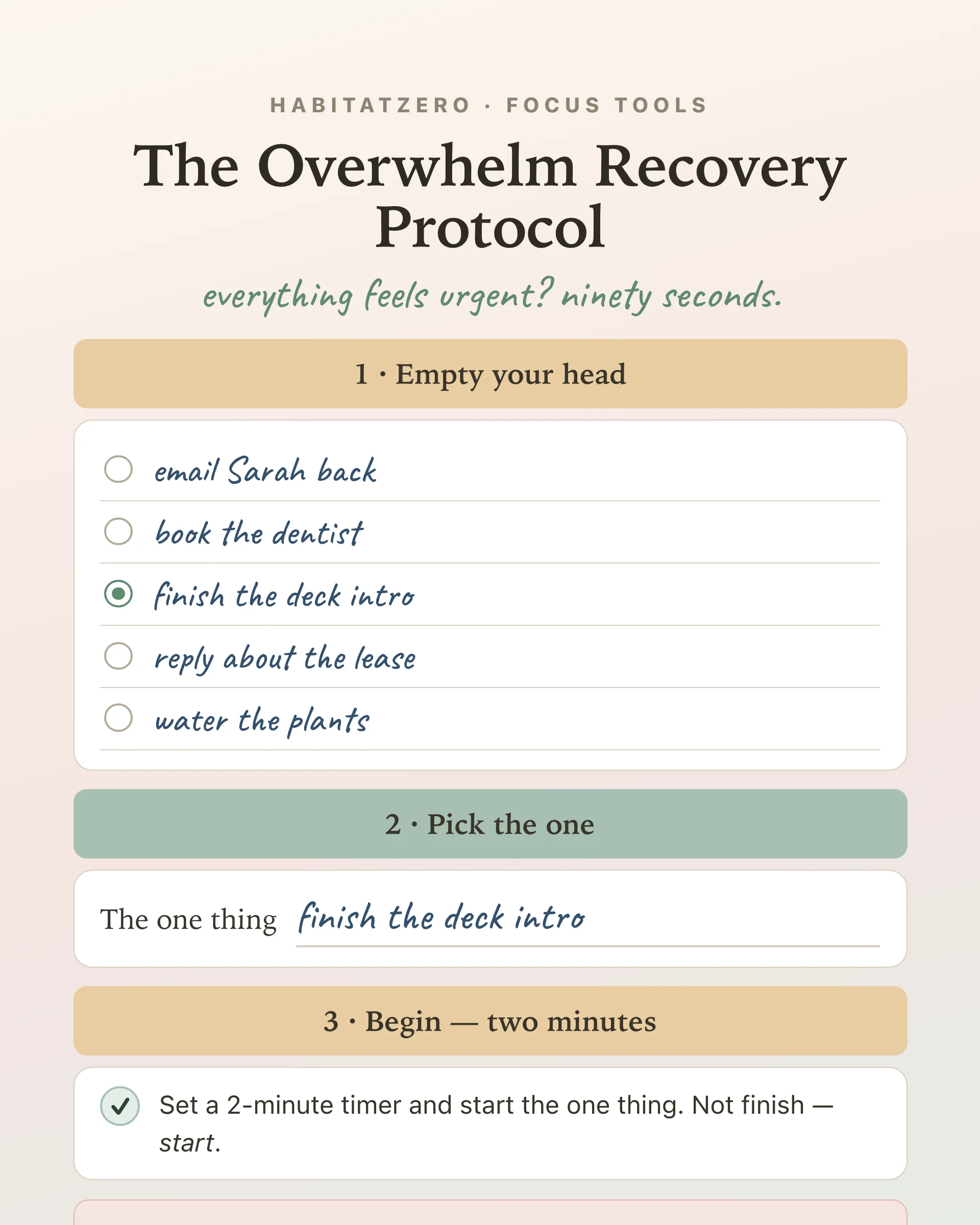
The Overwhelm Recovery ProtocolWellness & Routines · ~5 min
About this template · Updated July 2026
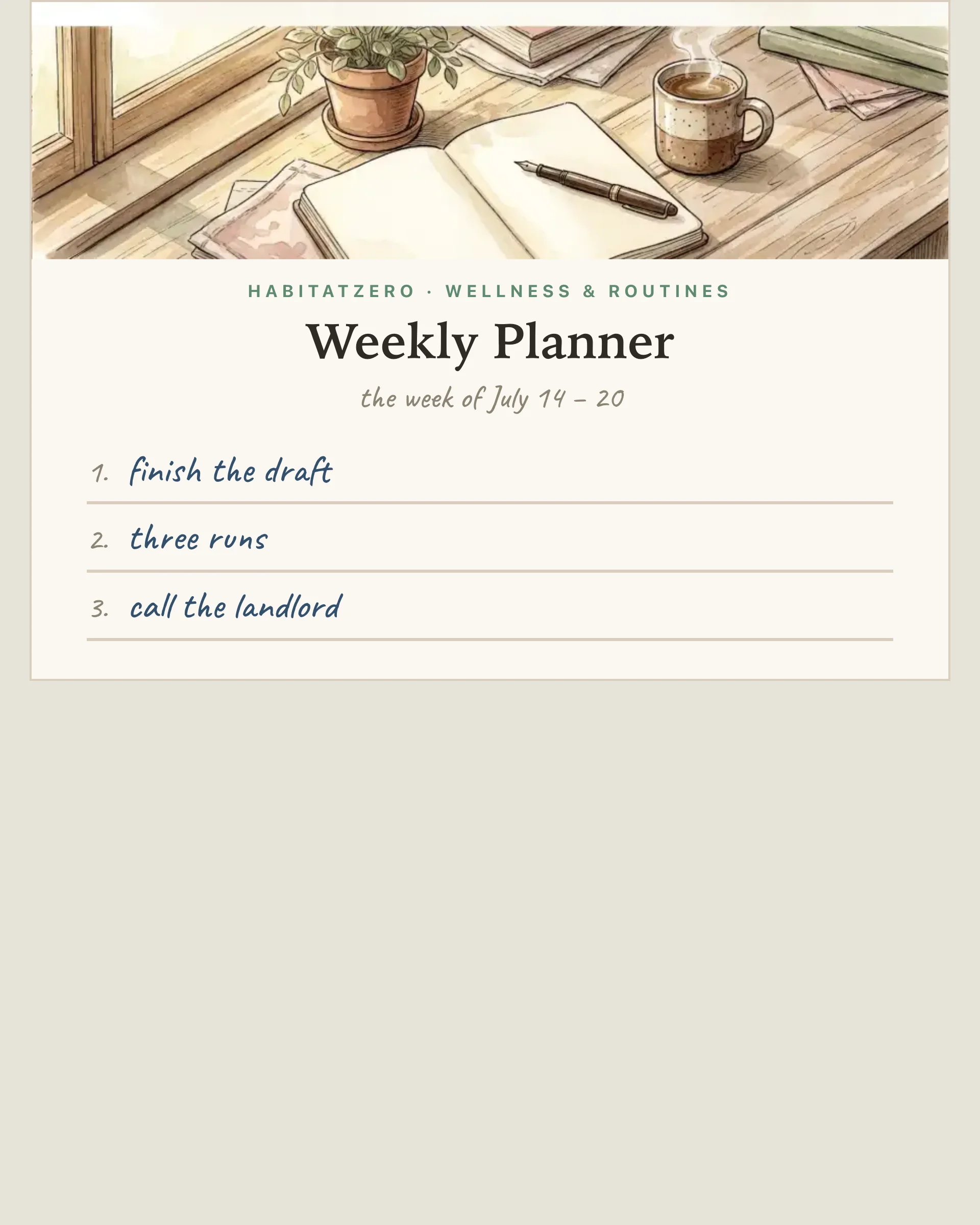
A week is the largest unit of time a person can actually steer. Days are too small — they get eaten by whatever arrives. Years are weather. But a week fits on one page, and one page on the desk beats an app in a pocket for one stubborn reason: it stays visible after you stop looking at it. This planner prints that page — with a twist the usual PDF can't offer: you type on it first.
The box at the top holds three lines, and it's deliberately not five or ten. Ask what would make this a good week — not a perfect one — and three answers is what an honest week has room for. The research here is old and unbudging: specific, few commitments outperform sprawling, vague ones, and every priority you add quietly taxes the others. Named at the top of the page, the three survive to Wednesday; buried in a list of fourteen, they drown by Tuesday lunch. There's a planning-realism bonus too: people systematically underestimate how long things take — the planning fallacy — and a page with visible, finite room per day is a quiet corrective. If it doesn't fit on three lines, it doesn't fit in the day.
Monday through Sunday each carry three ruled lines, and you type directly onto them: the dentist, the deadline, the run. What you type prints exactly where you typed it; what you leave empty prints as a clean ruled line for the pen. That makes the one page work three ways — fully typed for the organized weeks, fully blank for the paper purists, and half-and-half for real life, where the fixed appointments are known on Sunday and the rest of the week is negotiated live in ink.
It's undated on purpose. Type "July 14–20" or "the week everything is due" — the page never expires, and a Sunday-evening reprint is the whole setup ritual.
The planner is the week's map; two neighbors handle the terrain. If your days dissolve on contact with the calendar, the time blocking daily planner zooms one day into blocks. And the honest Sunday companion is the weekly review — ten minutes on what actually happened, before this page decides what happens next. For the habits that repeat regardless of the week's shape, the printable habit tracker keeps its own grid.
Print it, put it where the coffee happens, and give the week its three words before Monday gives you its opinion.
Yes — free, in your browser, no signup and nothing gated. Type on it and print as many copies as you like; the free page keeps nothing after you leave, which is rather the point of paper. In the Fabulous app the same planner saves as you go and syncs across devices.
Yes — the page you see is the page that prints. Type the week label, the top three, and anything on any day's lines; the printed sheet comes out with your words already on it. Or print it fully blank and keep the pen ritual.
Because a week has less room than a list believes. Three named priorities survive contact with a real Tuesday; twelve become a guilt document by Thursday. Goal-setting research consistently favors few, specific commitments over sprawling ones — the box sizes the ambition to the container.
Undated, on purpose — you type whatever week label you like, so the page works for any week of any year and never expires. Print a fresh one each Sunday, or a small stack at once.
Yes — tap print and choose Save as PDF in the dialog. The layout is a single letter or A4 portrait page with light ruled lines, so it prints quickly and reads cleanly in black and white.
By the team behind Fabulous, the science-based self-care app used by over 30 million people.