Leaves on a StreamEmotional Fitness · ~3 min
About this template · Updated September 2026
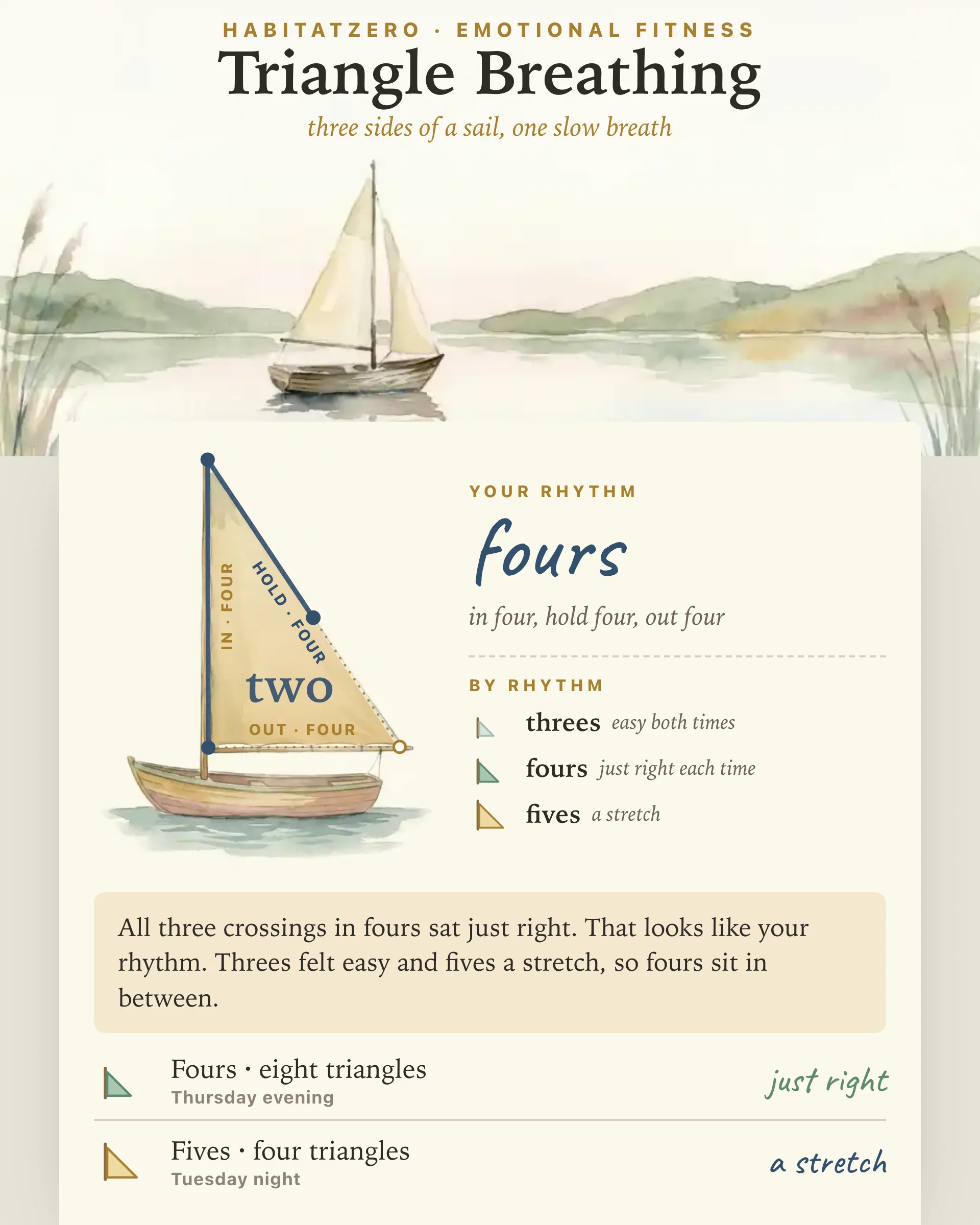
Triangle breathing is slow breathing with three parts and a shape to hold them. You breathe in, you hold, you breathe out, and each part gets one side of a triangle. A one-page NHS handout from St George's in London puts it plainly: start at the bottom left corner, breathe in for three counts up the first side, hold for three down the second, breathe out for three along the base, and you have finished one deep breath.
The shape does more work than it seems to. Counting in your head drifts, especially when you are keyed up, and a triangle gives the count somewhere to travel and a corner where each part ends. Many versions ask you to trace it with a finger for the same reason. And because a triangle has three sides instead of four, there is no second hold with empty lungs, the pause that box breathing adds after the out-breath. Each out-breath rolls straight into the next in-breath.
Three counts a side is where the NHS handouts start. From there people stretch it, and this page offers the four versions you will meet most often:
All four sit inside what researchers mean by slow breathing. A 2018 systematic review drew that line at fewer than ten breaths a minute, and every rhythm here stays under seven.
The sail is the triangle. Its mast is the first side, its back edge the second, the boom the third. Press set sail and a line of ink climbs the mast while the cloth fills with color: breathe in. The ink runs down the back edge while the sail stays full: hold, with your throat open and your shoulders loose. Then it comes home along the boom as the color drains away: breathe out. The count sits in the middle of the sail in words, so you never have to keep it yourself.
Four triangles make a crossing, which takes under a minute in threes. Add four more as many times as you like, up to forty, or stop at any corner; the triangles you finished still count.
When a crossing ends, the page asks one question: how did that rhythm sit? Easy, just right, a stretch, or light-headed. That tap goes into the logbook with the rhythm and the number of triangles. After a couple of crossings the logbook starts reading them back to you: which rhythm keeps landing just right, which one felt like a stretch, and when the next size up might be worth a try. Slower is not a score. The rhythm you can keep without strain is the one to use.
We could not find a trial that tests triangle breathing on its own, so any claim about this exact shape would be a guess. What exists is research on slow, paced breathing in general. The 2018 review linked slow breathing with higher heart rate variability and with people reporting more comfort and relaxation and less anxiety and anger, while calling that evidence interesting but limited. A 2023 meta-analysis of randomized trials found breathwork was associated with a small-to-medium reduction in self-reported stress compared with control conditions, and its authors warned against hype, since most of the studies carried a moderate risk of bias.
Read together, that makes triangle breathing a reasonable tool for the minute you are in, with modest evidence behind it. It is not a treatment for an anxiety disorder, and it is no reason to put off care you need.
The hold should feel like a pause in conversation, not a dive underwater. If you feel light-headed, dizzy or short of air, let the breath get smaller and smoother, go back to ordinary breathing for a while, and pick a shorter rhythm next time. That is what the light-headed tap is for: the logbook will steer you back to threes. If you live with a heart or lung condition, ask your clinician which breathing exercises suit you before practicing holds.
Use it in the minute before you speak, in a waiting room, before a hard call, or when your breathing has gone quick and high. Save the long out-breath for winding down at night.
If three sides start to feel easy and you want the fourth, Box Breathing adds the hold after the out-breath. When you need something quicker than a full crossing, The Physiological Sigh resets one breath at a time. And if you are teaching a child, Star Breathing gives a small finger five points to trace.
A slow breathing pattern in three equal parts: breathe in, hold, breathe out, often for three counts each. You trace or picture a triangle as you go, one side per part, so a full lap of the shape is one slow breath.
Close, but not the same. Box breathing has four sides and adds a second hold after you breathe out. Triangle breathing leaves that fourth side off, so each out-breath runs straight into the next in-breath and there is only one hold to manage.
Begin with three counts a side, the version NHS hospital handouts teach. Move up to four or five if three feels easy, and come back down if a count leaves you short of air. Every one of these rhythms keeps you under seven breaths a minute.
No trial has tested triangle breathing on its own. A 2018 review of slow breathing studies linked it with more relaxation and less anxiety in the moment, and a 2023 meta-analysis of breathwork trials found a small to medium drop in self-reported stress. Treat it as a practice for the minute you are in, not a treatment.
Reading the method and trying a few triangles on your own needs nothing at all. The painted sail that paces each crossing and the logbook that learns your rhythm live in HabitatZero, which is free to use.
By the team behind Fabulous, the science-based self-care app used by over 30 million people.