Leaves on a StreamEmotional Fitness · ~3 min
About this template · Updated September 2026
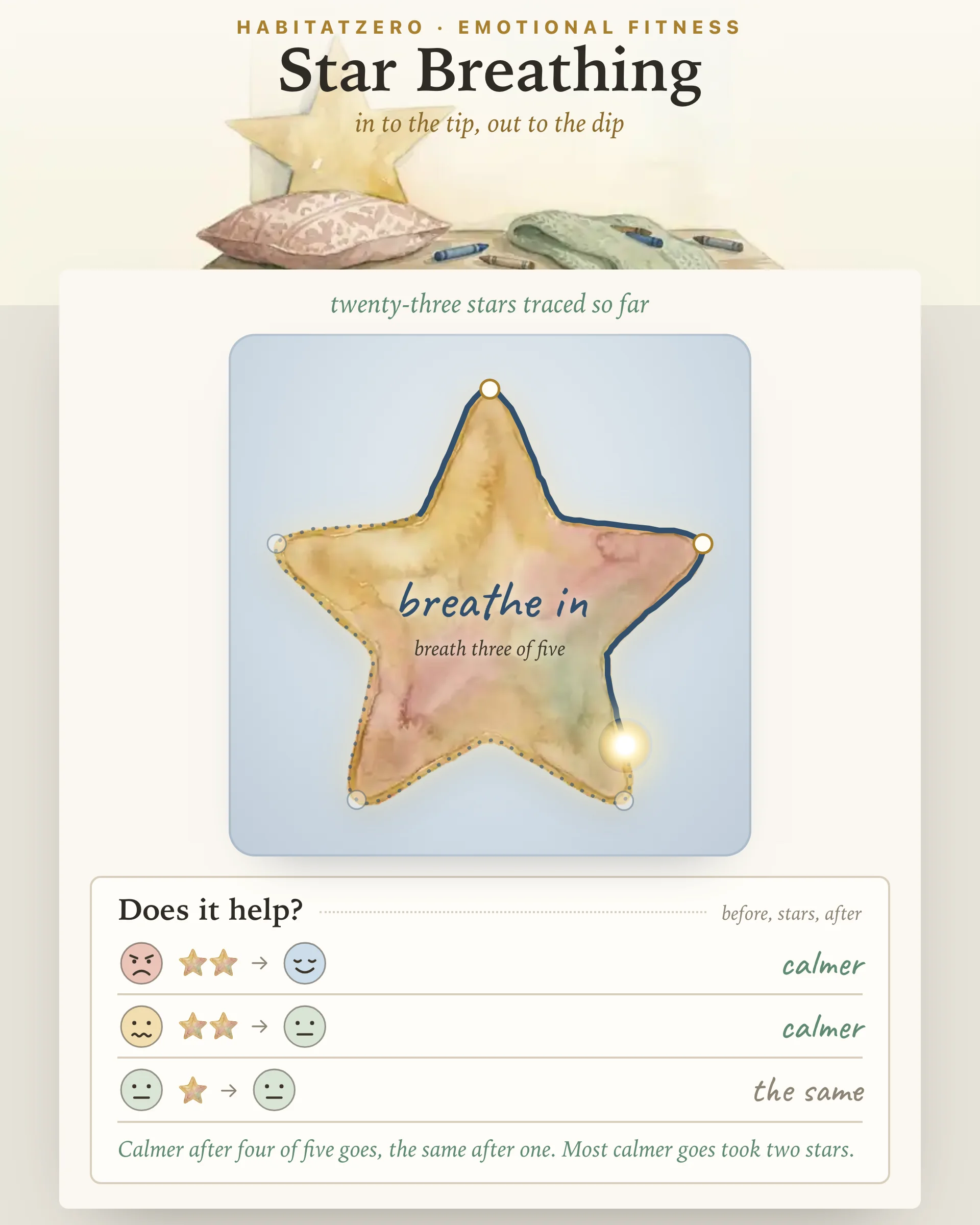
Star breathing turns a slow breath into something a child can see and touch. Put a finger in one of the dips between two points of a five-pointed star. Breathe in while the finger climbs out to the tip, breathe out while it slides down into the next dip, and carry on around. Five points make five slow breaths, and the star has a clear finish, which small children like. This page is written for you, the adult; the star is for your child.
If you came looking for S.T.A.R., that is a different exercise with a similar name. S.T.A.R. (Smile, Take a deep breath, And Relax) is one of the breathing routines in Conscious Discipline, the classroom program founded by Dr. Becky Bailey. It is a smile, a deep breath in through the nose, a pause and a long breath out, with no shape to trace. The traced star here is a separate, widely shared exercise, and this page is an independent tool that Conscious Discipline has neither made nor approved.
Its dotted line follows the painted gold edge. On screen there are two ways to use it, and printed it becomes a paper star with a marked start.
Follow the glow. Press start and a small point of light travels the outline at the pace you choose. It swells a little as it climbs to a tip and softens on the way back down, while the middle of the star says breathe in or breathe out and which breath you are on. Each tip lights up as the glow reaches it, and once the glow is home after the fifth, the star joins the count.
Trace with a finger. Switch modes and your child drags along the line from the glowing dot instead. The line forgives a wobbly finger but not a shortcut across the middle. If a side is rushed, the center asks for a finger as slow as a snail. On a keyboard, the space bar moves the point one side at a time.
The pace buttons may run the opposite way to what you expect: the setting for little ones is the quickest. Children breathe faster at rest than adults do, and a large review of normal vital signs found breathing rates falling steadily from birth into early adolescence. For a preschooler, two seconds in and three out is already a slow breath. Stretching a small child's breath much further invites gulping or breath-holding, which works against the whole exercise. So little ones get two seconds in and three out, most kids get three and four, and older children and adults get four and six. Every setting gives the out-breath a little longer than the in-breath.
Under the star sit four simple faces: upset, wobbly, okay and calm. They are optional. To learn whether star breathing helps this particular child, let them tap one face before they start and another when they finish. The go lands on a small chart as two faces with its stars in between. Once there are a few goes, the page tells you in plain words how often the second face was calmer and how many stars that usually took.
None of that measures anything clinical. It is a way of noticing, over a week or two, whether your child reaches for this tool or resents it. The chart holds ten goes, so it reflects the last few weeks rather than last spring.
We could not find a trial of star tracing itself. What has been studied is the core move, a few slow breaths. In a preregistered field experiment with more than three hundred children averaging about seven and a half years old, a one-minute animated video that walked them through a few slow, deep breaths lowered their heart rate and raised respiratory sinus arrhythmia, a heartbeat rhythm tied to the body's resting state, compared with a similar video without the breathing. In another study, fifth-year primary pupils in Singapore who took deep breaths before a timed math test reported less anxiety and scored better than classmates who did not.
Both effects were measured in the moment: slow breathing can take the edge off quickly, which is not the same as treating anxiety. If your child's worries or outbursts are frequent and hard to shift, raise it with their doctor; star breathing can sit alongside whatever help follows.
Practice on an easy day first. A star learned in a calm moment is far more likely to get used in a stormy one. After that, it fits the small gaps in a day: the minute before lights out, the car outside school, the pause after a squabble.
If your child already knows Rainbow Breathing, the star is a good partner. The rainbow is one long arc per breath, while the star offers five short climbs and a finish line. Both belong in a Calm Corner, and The Feelings Thermometer helps a child show how big a feeling is before you decide which tool to offer.
Keep it an invitation rather than an instruction. If a slow breath ever leaves your child dizzy, stop, let them breathe normally, and choose a quicker star next time.
It is a calming exercise for children that uses the outline of a five-pointed star as a breathing guide. A finger climbs out to each tip on a breath in and slides back into the dip on a breath out, so one lap of the star is five slow breaths with a clear finish.
Start together on a calm day. Put your finger next to theirs in the dip beside the top point, breathe in through your nose as you both climb to the tip, then breathe out slowly on the way down. Say it as you go: in to the tip, out to the dip. After a few stars most children can lead it themselves.
No. S.T.A.R. comes from Conscious Discipline, the program founded by Dr. Becky Bailey, and stands for Smile, Take a deep breath, And Relax, with no shape to trace. Star breathing follows the edges of a drawn star. This page is an independent tool with no link to Conscious Discipline.
Any child who can follow a line with a finger, usually from about three, and it still works for older kids and adults. What should change with age is the pace. Resting breathing slows across childhood, so a slow breath for a preschooler is shorter than a slow breath for a ten-year-old, and the pace buttons here follow that.
We could not find a study of star tracing itself. Studies of a few slow breaths in school-age children found lower heart rates and less reported worry in the moment, a short-term effect rather than a treatment. The face check on this page lets you see whether it helps your own child.
By the team behind Fabulous, the science-based self-care app used by over 30 million people.