Leaves on a StreamEmotional Fitness · ~3 min
About this template · Updated July 2026
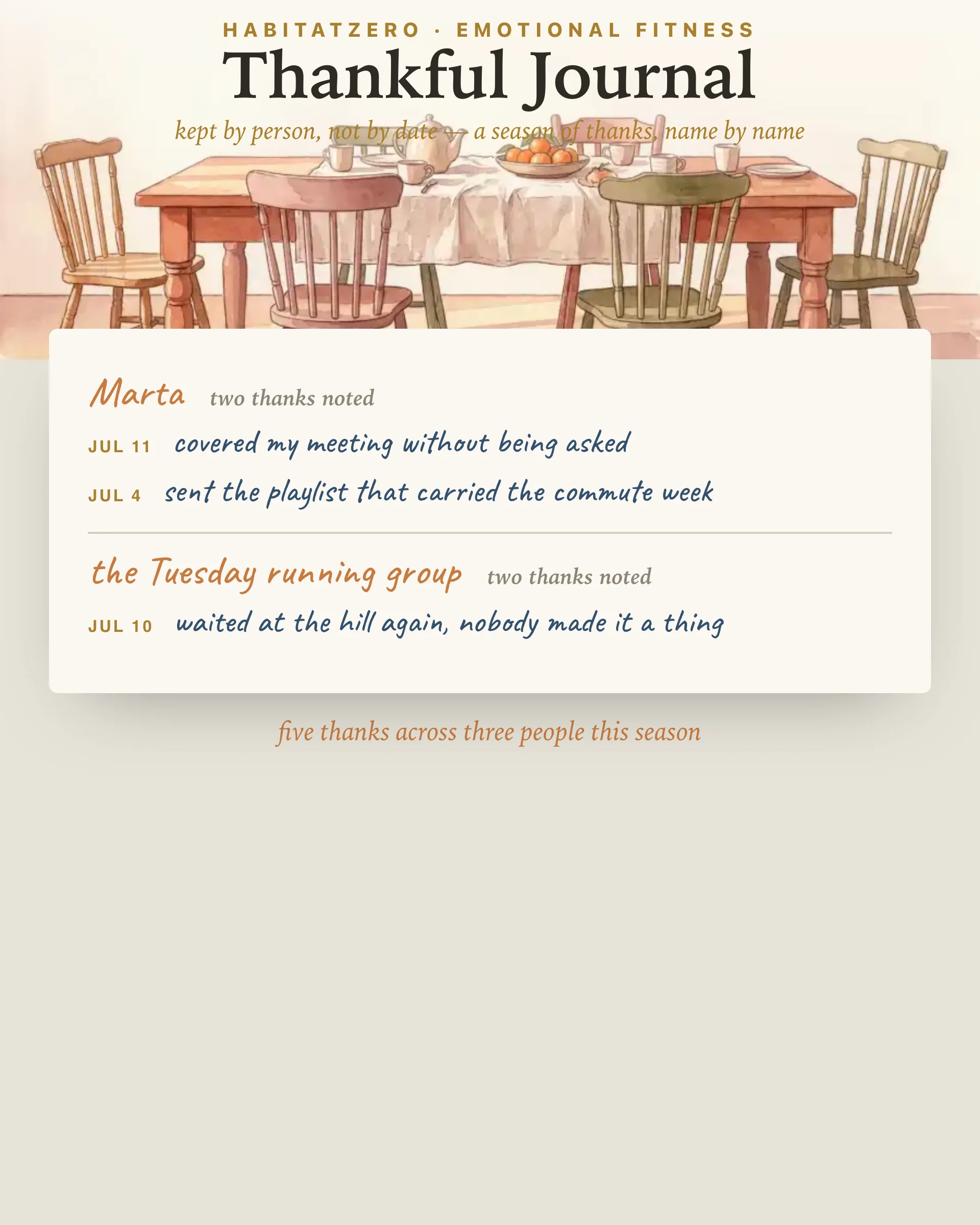
Open any thankful journal from last year and read it back. The entries are fine — but the pattern is invisible, because diaries file everything under dates, and dates are not what gratitude is made of. Read the same year sorted by person and something else appears: Marta shows up eleven times. Your dad, nine. The Tuesday running group, again and again, all winter. This journal files it that way from the start. Names first. Dates second. The tallies do the talking.
When researchers looked at what gratitude actually does in daily life, the strongest story was relational. The find-remind-bind account puts it plainly: moments of thankfulness flag responsive people (find), refresh our attention to the ones already beside us (remind), and tighten those bonds over time (bind). A journal sorted by person is that theory turned into stationery — every entry lands under a name, so the reminding happens mechanically, every time you open the page.
The broader review literature on gratitude and well-being keeps circling the same ingredient: appreciation woven into how you see your life, not performed as a separate chore. Filing thanks under the people who caused them is about as woven-in as it gets.
Add a name when someone belongs on the page — a person, or a whole crew under one banner. Twelve names is the deliberate ceiling; a season genuinely runs on fewer people than we assume, and a roster with edges means something a contact list never will. Then, when the small good thing happens, open their name and note it in a single line with the date: covered my meeting without being asked. Waited at the hill again, nobody made it a thing. Ten seconds, while the memory is still warm.
Each name carries its running tally — four thanks noted — and the status line totals the season. That arithmetic is quietly the point. By midsummer the page has drawn a map of your support system in your own handwriting, and the top of that map is a shortlist of conversations worth having.
The family divides by direction. The grateful journal looks at your days — one dated page, one rotating question. The thankfulness journal looks at your debts — full notes of thanks, written to be delivered. The gratitude jar hoards moments for a December rereading. This one looks at your people, and does its best work over a whole season: not what happened, not what you owe, but who keeps being there.
Somebody's tally is about to embarrass every gift you've ever bought them. Start the page and find out whose.
A dated diary answers what happened today; this ledger answers who keeps showing up. Sorting thanks under names instead of dates surfaces a pattern single entries hide — by week six, the tallies have quietly drawn a map of your support system.
Anyone whose presence made the season lighter: family, one particular colleague, the barista who remembers your order, a whole running group under one name. The twelve-name cap is a feature — it forces the roster to mean something.
The concrete act, in one line, close to when it happened — waited at the hill again, talked me off the ledge before the review. Small and specific beats grand and vague, and the line takes ten seconds while the memory is warm.
Read a name's column top to bottom and you are holding a ready-made thank-you speech. Many people close a season by telling their top name what the page says — the tallies make plain who has more than earned the conversation.
By the team behind Fabulous, the science-based self-care app used by over 30 million people.