Leaves on a StreamEmotional Fitness · ~3 min
About this template · Updated September 2026
Your heart speeds up in the hallway, your palms go damp around the pencil, and the first question slides right off your mind. You have probably met a list of test anxiety strategies already: sleep well, breathe, think positive, show up early. A list never tells you which of those things works for you, and a plan you only half believe is the first thing to go when your pulse climbs.
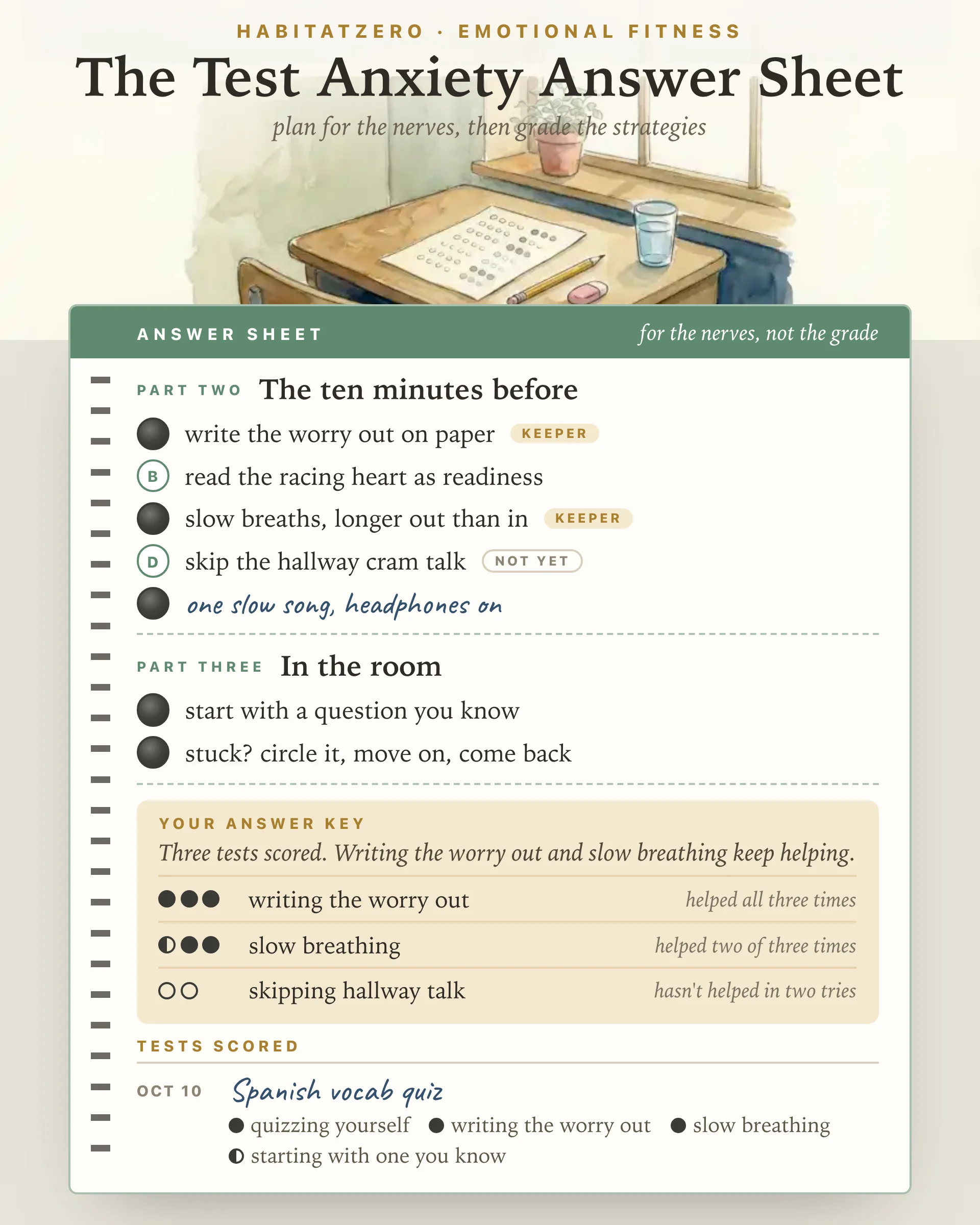
This page gives you an answer sheet to fill in before the test and a place to grade the strategies afterward, never yourself. After a few tests, it adds up your scores and shows which strategies keep earning their place.
Practice testing in the weeks before. Quizzing yourself with your notes closed, or sitting one timed practice test, rehearses the situation you are nervous about. Psychologists call this retrieval practice: pulling what you know out of memory instead of reading it again. When Pooja Agarwal and colleagues surveyed 1,408 middle and high school students about a classroom program built on it, 72 percent said it made them less nervous for unit tests and exams.
Writing the worry out just before. In experiments by Gerardo Ramirez and Sian Beilock, students spent ten minutes right before a test writing about their thoughts and feelings on that test. The writing raised exam scores, most of all for students who were usually anxious about tests, both on a pressured math test in the lab and on a ninth-grade biology final. Writing about the test itself seemed to matter, not writing in general, so put this particular test's worries on paper, then fold the page away.
Reading the racing heart as readiness. Jeremy Jamieson and colleagues told one group of people preparing for the GRE that feeling keyed up can improve performance. That group outscored the comparison group on the math section of a practice exam, and the gap showed up again on their real GRE, one to three months later. Your body does the same thing either way; what changes is the story you tell yourself about it.
Slow breathing. In an experiment with 122 primary school students, taking deep breaths before a timed math test lowered the anxiety they reported and raised their scores. A long, slow out-breath fits in a hallway, at your desk, or at the top of each new page.
Parts one to three of the answer sheet cover the weeks before, the ten minutes before, and the room itself. Tap a bubble to fill it in, and a one-line instruction appears under that strategy, so the plan tells you how and not just what. Each part holds three bubbles at most, because the plan has to fit in your head while your heart is pounding. Each part also takes two strategies of your own, written in your hand.
Part four is for afterward. Name the test, then mark each strategy you used: helped, not sure, or didn't. There is no box for your grade, and that is deliberate. A rough score on a hard test says little about whether slow breathing steadied your hands.
File the test and the answer key updates. Every strategy gets a row of marks, one per test, and a plain reading such as "helped two of three times." A strategy that helped on at least two tests, and on most of the tests where you used it, earns a keeper tag on the key and on the sheet. One you have tried at least twice without it helping gets a not yet tag, a quiet nudge to swap it out. The log holds eight tests; to file a ninth, erase an old row.
Each finding comes from a particular group: college students and ninth graders, people studying for the GRE, primary school children, and middle and high school students answering a survey. They describe averages, not promises for every student on every test. The practice testing figure is what students reported about their own nerves, not a measurement of anxiety. A few of the moves for the room, like starting with a question you know or circling a stuck one and coming back to it, are everyday test-taking advice rather than tested interventions. They cost nothing to try, and your scores will show whether they help you.
None of this replaces knowing the material.
This is practice, not treatment. If test anxiety is severe, keeps you away from tests altogether, or has spread past tests into your school days or your life at home, talk with a school counselor or a doctor. You do not have to sort that out alone.
Fill in the plan a week or two before a test you dread, while there is still time for practice tests. Reread it in the ten minutes before you walk in. Score it the same day, while you still remember how the hallway felt.
For the weeks before, the Exam Planner breaks the material into passes you can count down, and The Study Techniques Cabinet helps you choose a way to quiz yourself. If you want to rehearse the slow breath until it runs on its own, Box Breathing paces it for you.
Four have the clearest research behind them: practice testing in the weeks before, ten minutes of writing about your worries right before, telling yourself a racing heart means your body is getting ready, and slow breathing. Which of them works for you is personal, so the sheet has you score each one after every test and keeps a running tally.
Slow breathing with a longer out-breath is the easiest to use in a hallway or at your desk, for instance in for four counts and out for six, for a couple of minutes. Once the test has started, dropping your shoulders and loosening your grip on the pencil can take some tension out. Relaxation works best on top of real practice, not in place of it.
In one experiment, primary school students who took deep breaths before a timed math test reported less anxiety and did better on the test than a comparison group. That is a single study with children, so treat breathing as a strategy worth trying and scoring on your own tests rather than a sure thing.
The sheet is made to be used rather than printed blank, because it remembers your plan, logs each test and adds up which strategies helped. Personalize it in HabitatZero, fill in your plan, and the print button gives you a paper copy to reread in the minutes before a test, when phones often have to go away.
Talk with a school counselor or a doctor if the fear is severe, if it keeps you from taking tests at all, or if it has spread past tests into the rest of your school day or your life. This sheet is practice for ordinary pre-test nerves, not a treatment.
By the team behind Fabulous, the science-based self-care app used by over 30 million people.