Reading JournalStudy & Learning · ~4 min
About this template · Updated September 2026
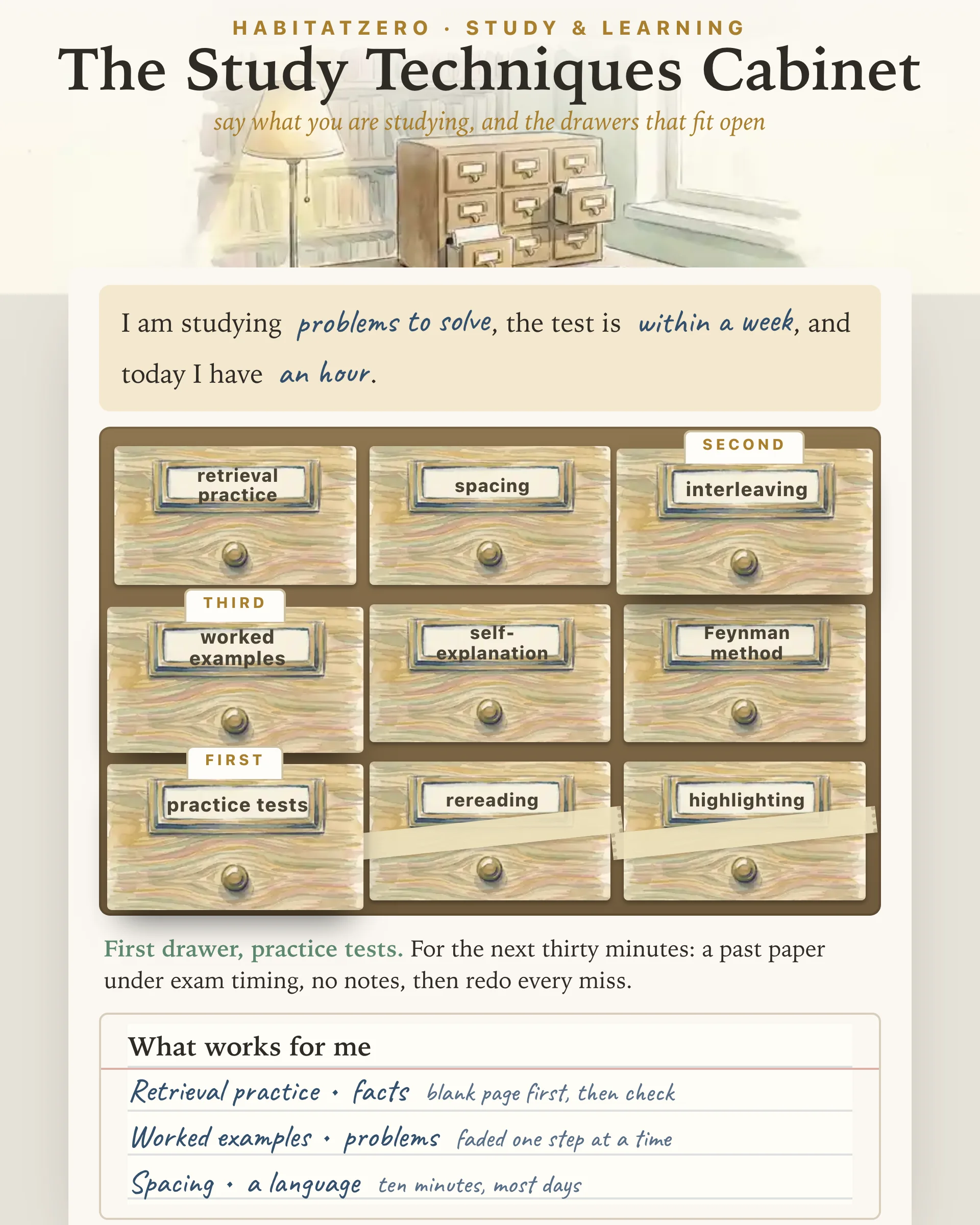
Most lists of study techniques fail at the same moment: nine o'clock on a Tuesday, textbook open, test on Friday, and no idea which of the twelve methods applies to this chapter with this much time. The list was never the problem. The choosing was, and this cabinet does the choosing.
The slip asks what you are studying, in five kinds: facts to memorize, problems to solve, essays and arguments, a language, or a practical skill. It asks how far away the test is, from tomorrow to no date at all. And it asks how much time you have right now, from fifteen minutes to a free afternoon.
From those answers the cabinet scores its seven technique drawers and opens the two or three that fit best. Each open drawer holds a card: one line on why that technique suits your slip, and one plain instruction that starts for the next thirty minutes. Fifteen minutes opens only two drawers, because a quarter of an hour is one technique, not a syllabus.
Tap a drawer that stayed shut and it tells you why. Practice tests stay closed when you have half an hour, because a real paper wants an hour in one sitting. Spacing stays closed when the test is tomorrow, because there are no days left to spread across. You learn the rules by watching them applied to your own evening.
If a dealt drawer is wrong for you, swap it and the next best one opens. When a technique clearly worked, file it on the catalog card at the bottom with a note on what made it work. Eight lines is the limit, so the card records what earned its place, not a wish list.
The scoring leans on a few well-tested findings rather than on study folklore.
The largest single review is Dunlosky and colleagues' 2013 assessment of ten learning techniques. It rated practice testing and spreading study over time as high utility, because they help learners of different ages and abilities across many materials. Interleaving, self-explanation and elaborative interrogation came out as moderate: promising, but with thinner evidence in real classrooms. Five techniques rated low, and two of them are the ones students say they use most: rereading and highlighting. That is why those two drawers are taped shut here.
Testing yourself is more than checking. In Roediger and Karpicke's experiments, students who read a passage and then recalled it from memory remembered more a week later than students who reread it, even though the rereaders were more confident. Confidence from rereading is the fluency trap: the second pass feels easy, and easy feels like known.
Spacing is one of the oldest results in memory research. Cepeda and colleagues' meta-analysis pooled hundreds of experiments and found that separated study sessions beat a single massed session, and that the best gap between sessions grows as the test moves further away. That is why the spacing card on this page changes its advice with your deadline, from a pass now, another before bed to once a week and stretch it.
Interleaving is the newest of the four. Rohrer and Taylor had students practice several types of math problem either grouped by type or shuffled together, and the shuffled group did far better on a test a week later. The lesson is specific: mixing pays when there are methods to confuse, which is why the cabinet opens that drawer for problem sets and practical skills and keeps it shut for a vocabulary list.
Two drawers rest on adjacent evidence rather than on those four papers. Worked examples with faded steps come from research on cognitive load in problem solving, and they suit beginners with a procedure to learn. The Feynman method is a popular name for explaining an idea plainly to a beginner; it has not been tested under that name, and the cabinet says so on its card. It borrows what is known about self-explanation and learning by teaching.
The cabinet cannot tell how well you know the material; it only knows what you told it. Its rankings are a reasonable reading of the research applied to five broad kinds of material, not a prescription tuned to your course. If your teacher says the exam is all essays, believe the teacher over the drawers. And the thirty-minute instructions are deliberately plain: if one reads as too simple, that is usually a sign it will work.
Open it at the start of a session, before the highlighter comes out, and fill the slip honestly, especially the time you have. Come back when anything changes: a new subject, a moved deadline, a shorter evening.
For the sessions it points at, the site has tools ready. The Active Recall Deck turns your notes into cards you answer from memory, which is the retrieval drawer made physical. The Revision Timetable Builder spreads your subjects across the days you have left, which is the spacing drawer as a calendar. And the Exam Planner walks a single exam down to zero with passes rather than hours, so the practice-test drawer has a date to aim at.
Pick a drawer, set a timer, and stop when it rings. That is the whole method.
The two with the strongest track record are testing yourself from memory and spreading study over several days. Behind them sit interleaving, self-explanation and worked examples, each of which shines for particular kinds of material. The right answer depends on what you are learning and how much time is left, which is exactly what this cabinet sorts out.
It depends on three things: whether the material is facts, problems, arguments, a language or a hands-on skill; how close the test is; and how long you have. Facts the night before call for closed-book recall. Problem sets with a week to go call for a timed mixed set. A language with a month to go calls for short daily visits. Fill the slip and the drawers do the sorting.
Both feel productive and both rank at the bottom of the evidence. A second reading feels fluent, and fluency is mistaken for knowing; a highlighter marks the page rather than the memory. Swap rereading for a closed-book recall, then reread only what you could not produce, and swap highlighting for one question written per page.
Yes, when the fun is made of the same ingredients. Quizzing a friend, teaching a topic to a younger sibling on one page, or racing a timer through a shuffled problem set are all retrieval, explanation or interleaving in a friendlier coat. What does not work is fun that removes the effort, like rewatching a lecture or coloring notes.
The page shows the cabinet already filled in so you can see how it deals. To fill your own slip, swap drawers and keep a card of what worked, personalize it in HabitatZero at no cost.
By the team behind Fabulous, the science-based self-care app used by over 30 million people.