Reading JournalStudy & Learning · ~4 min
About this template · Updated September 2026
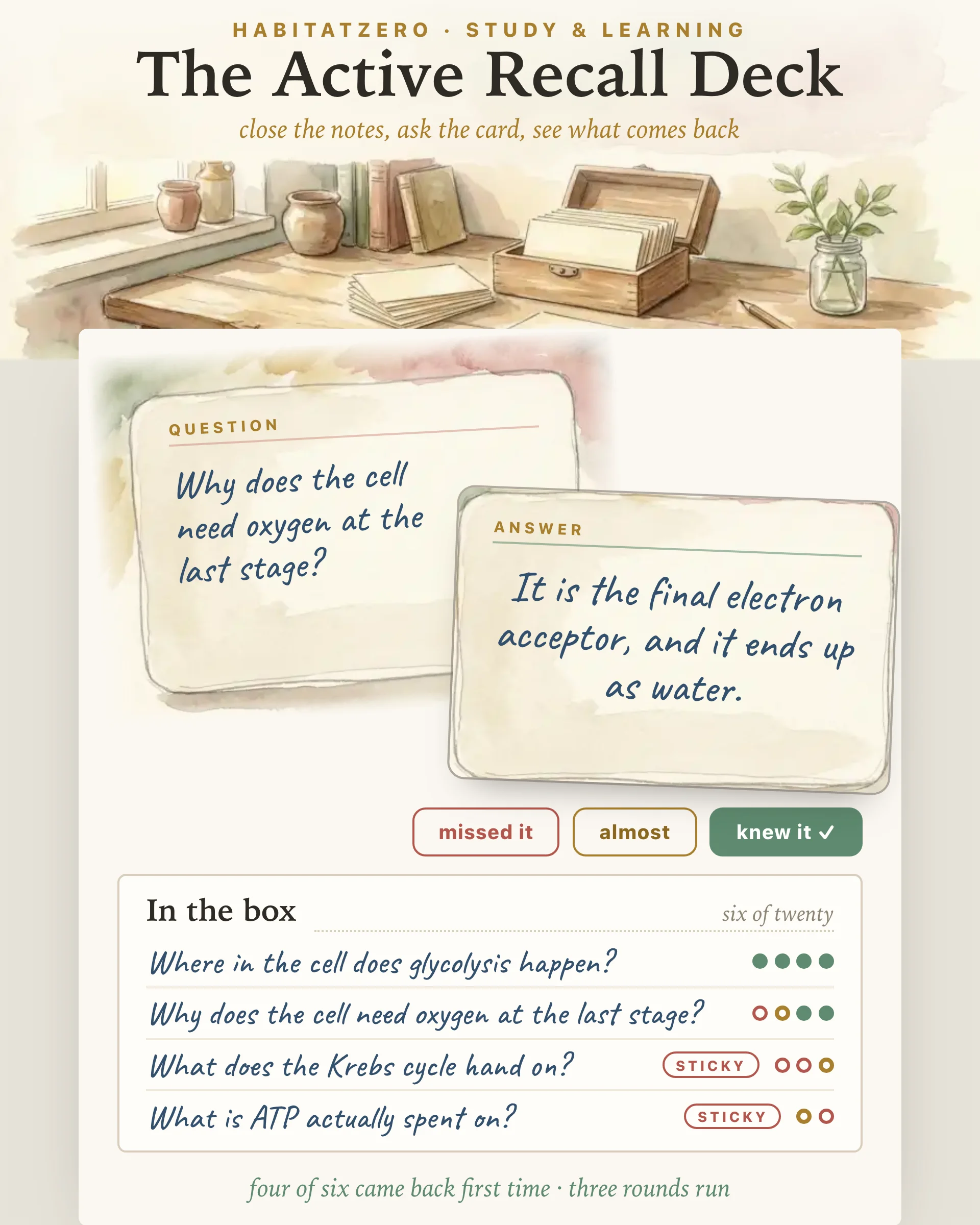
Active recall is the plain act of answering a question from memory before you look at the answer. Psychologists file it under retrieval practice or the testing effect; students have been doing it with index cards for generations. What earns it a page of its own is how reliably it beats the way most people actually study.
When you reread a chapter the words feel familiar, and familiarity is easy to mistake for knowledge; the mistake only shows once the book is shut. In a well-known pair of experiments, students read a prose passage and then either studied it again or tried to write down everything they could remember, with no feedback. Tested five minutes later, the group that studied again did better. Tested two days or a week later, the students who had practiced recalling it remembered substantially more, even though restudying had left people feeling more confident.
When 177 college students were asked how they study, most said they reread their notes or textbook and relatively few said they tested themselves. Retrieval takes effort and shows you exactly what you don't know, which is unpleasant and also the point.
This page is an index card box: a question on the front of each card and, if you want one, a short answer on the back.
Write a card. Turn one line of your notes into a question, or tap an opening such as Why does… or What is the difference between… and finish the sentence. The back is optional: for anything long, leave it blank and check your notes instead. The box holds twenty cards, roughly a chapter's worth of questions that matter, and asks you to retire one before it accepts a twenty-first.
Run a round. The deck is shuffled and the top card shows its question. Answer it out loud or on scrap paper before you turn it over; a vague sense of knowing doesn't count, you need an answer you could be wrong about. Then grade yourself: missed it, almost, or knew it.
Let the misses come round. A paper stack only does this if you are disciplined. A card you knew is set aside, a card you almost had goes to the bottom of the deck, and a card you missed slides back in three cards deep: near enough that the answer you just read is still within reach, far enough that you have to retrieve it rather than echo it. The round cannot end until every card has been answered correctly once, and three small piles under the card show where everything sits.
Read the trail. When the round closes, the card reports how many came back on the first try. In the box, each card grows a trail of dots, one per round, and any card that needed a second pass last time is tagged sticky, ready for a short round of its own.
No notes to hand? Deal the sample deck: five cards about active recall itself, so you learn the method by being quizzed on it. You will probably miss one or two, and then watch what happens when they come round again.
Two findings shaped the rules of this deck. First, getting a card right once is not the finish line. In a vocabulary-learning study, items that were dropped from testing after the first correct answer were recalled far worse on a delayed test than items that kept being tested, while extra study of those same items added nothing. That is why the sheet nags you to ask again tomorrow, and why the trail exists: one green dot is a start, a row of them is knowledge.
Second, gaps help. In experiments with flashcards, one large stack beat several small stacks studied separately, because a larger stack puts more distance between two meetings with the same card, yet after the first session most participants believed the small stacks had worked better. So don't split your twenty cards into tidy groups of five, and leave a day between rounds when you can.
Now the limits. These studies mostly measure memory for facts, word pairs and passages. Active recall does not replace understanding: a card can't ask a question you never thought to write, and reciting a definition is not the same as using it in a problem. Self-grading is only as honest as you are, and nothing here promises a grade, only a better use of the study time you were already going to spend.
The best moment is the day after you first meet the material, when some forgetting has set in and retrieval takes real effort. Write cards as you work through a chapter, run the first round the next day, and return to the sticky ones later in the week.
Use the Study Guide Builder to boil a unit down to the ideas that deserve cards, give your rounds a fixed slot in the Revision Timetable Builder, and once an exam date is on the calendar, let the Exam Planner decide which subject gets a round on which day.
Twenty honest questions, asked until you can answer them and asked again after a gap. That is the whole method.
Active recall means producing an answer from memory before you check it, instead of looking at the material again. Flashcards, practice questions, closed-book summaries and explaining a topic aloud are all versions of the same move: the notes are shut and your memory does the work.
Turn your notes into questions, put the notes away, answer each question from memory, check yourself, and send every miss back for another attempt in the same sitting. Then repeat the whole round after a gap of a day or more. This page runs those steps for you with a box of up to twenty cards.
Blurting, where you fill a blank page with everything you remember about a topic and then check it against the book. Past papers and end-of-chapter questions done with the book shut. Teaching the idea aloud to a friend or an empty room. Covering a diagram and redrawing it from nothing.
For remembering things days later, experiments keep finding that it is. Rereading can look better on a test taken within minutes, which is part of why it feels productive, but students who practiced retrieving a passage held on to more of it a week on. Rereading still earns its place when a topic is so new that you cannot yet answer questions about it.
You can look over the deck and a filled example on this page without an account. Writing your own cards and keeping each card's trail from one round to the next happens inside HabitatZero, which is free to join.
By the team behind Fabulous, the science-based self-care app used by over 30 million people.