Reading JournalStudy & Learning · ~4 min
About this template · Updated September 2026
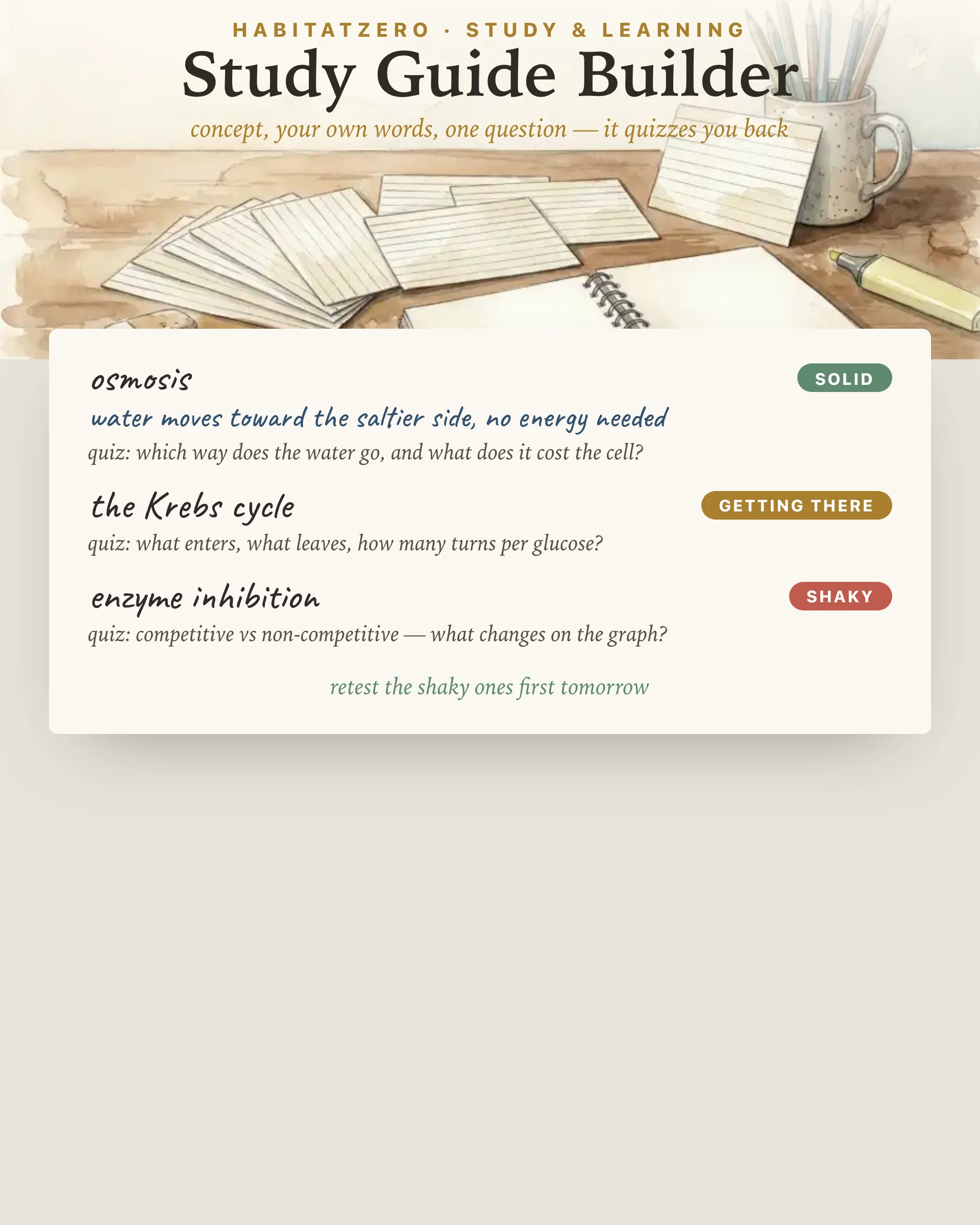
Most study guides are beautifully formatted rereading. Highlighted headings, tidy summaries, the textbook's sentences arranged like furniture — and then the exam asks you to produce knowledge the guide only ever asked you to recognize. This builder makes the other kind of study guide: one that quizzes you back.
The guide holds up to eight cards, and each card asks for exactly three things:
The concept. Osmosis. The Krebs cycle. Enzyme inhibition.
The idea in your own words. As you'd explain it to a friend — water moves toward the saltier side, no energy needed. This line is where the guide earns its keep, because translation is diagnosis: when the own-words line won't come, that card has just told you precisely where tonight goes. Copying the textbook's phrasing teaches the textbook, not you.
One question a fair examiner would ask. Which way does the water go, and what does it cost the cell? Writing the question is half the studying; it forces you to see the concept from the side the exam will approach it.
Eight cards is the cap, and it's a feature: a guide that fits one page gets reread, retested, and finished. When a ninth concept insists, that's the next chapter's guide introducing itself.
One tap on cover the answers and every own-words line disappears under ink, leaving your questions staring back. Answer from memory, reveal, mark your confidence — shaky, getting there, solid — and let the readout schedule you: retest the shaky ones first tomorrow.
This isn't a gimmick; it's the best-attested move in learning science operationalized. Roediger and Karpicke's testing-effect experiments showed that retrieving material from memory strengthens retention well beyond restudying it — and when Dunlosky's team graded ten study techniques across the literature, practice testing took a top utility rating while the summarizing-and-highlighting that fills most study guides landed at the bottom. The builder simply makes the high-utility loop — question, retrieve, check, mark — the guide's default posture instead of an extra effort.
The builder covers one exam's concepts; the rest of the term has its own tools. The Study Style Quiz is the fifteen-question diagnosis of how you study across all five habit dimensions — this page is effectively its self-testing dimension turned into a working tool. The Revision Timetable decides when each guide gets its covered-mode sessions as the exam walks closer, and the Semester Goal Worksheet holds the term-level goal these sessions serve.
Eight cards. Three lines each. Cover, retrieve, mark — the guide that studies you back.
Three things per concept, and this builder enforces exactly those: the concept's name, the idea restated in your own words, and one self-test question. Page limits matter too - the eight-card cap exists because guides that sprawl become archives, and archives do not get reread the night before.
Build it as questions, not summaries. Decades of testing-effect research show that retrieving an answer from memory strengthens it far more than rereading it - so this guide's covered mode hides your answers and makes you produce them. The building itself is the first study session; covered mode is every session after.
Because the textbook's sentence is the author's understanding, not yours. Restating the idea as you would explain it to a friend forces the translation that reveals whether you actually hold it - and when the own-words line refuses to come, the card has diagnosed tonight's work for you.
After each covered-mode pass, cycle every card through shaky, getting there, or solid. The marks drive the readout's advice - retest the shaky cards first tomorrow - which is spaced, prioritized review with none of the scheduling homework.
It does a different job. A document template formats notes; this builder rehearses them - the cover-and-retrieve cycle cannot happen on paper without a second person or an index-card system. If you want paper anyway, the sheet prints cleanly with your cards on it.
Eight at most, one guide per exam or chapter cluster. When a ninth concept demands a card, that is the next chapter's guide announcing itself - smaller guides get finished, and finished guides get retested.
By the team behind Fabulous, the science-based self-care app used by over 30 million people.