Reading JournalStudy & Learning · ~4 min
About this template · Updated July 2026
Ask a struggling student how they study and you'll usually hear the same two words: reread and highlight. Ask learning scientists what works and you get a different list entirely — one where the most popular techniques rank last and two unglamorous habits carry most of the weight. The gap between those lists is where this quiz lives. Fifteen honest statements, five dimensions, a 0–100 score, and two fixes chosen from your weakest answers.
Most "study style" quizzes sort you into a sensory type — visual, auditory, kinesthetic — and tell you to match your studying to it. The research is unusually blunt about this: when Pashler, McDaniel, Rohrer, and Bjork reviewed the evidence in 2008, they found no adequate support for the matching idea at all. People do have preferences; the preferences just don't predict what helps them learn.
So this quiz measures something else: the five habit dimensions that do move results.
Spacing. The same minutes spread across days beat the same minutes in one sitting — one of the oldest and most replicated effects in psychology, quantified across hundreds of studies in Cepeda and colleagues' meta-analysis. Cramming feels productive because recognition feels like knowing; the forgetting curve collects the difference during the exam.
Self-testing. Closed-notes recall — flashcards, practice questions, the blank-page brain dump — strengthens memory more than restudying the same material, an effect Roediger and Karpicke demonstrated directly with students and prose passages. When Dunlosky's team graded ten popular techniques for utility, practice testing and distributed practice took the only two high-utility grades; rereading and highlighting sat at the bottom.
Focus, planning, and rest round out the five: a phone within reach taxes every session, a session that starts undecided starts slowly, and the all-nighter quietly steals the consolidation that sleep would have done for free.
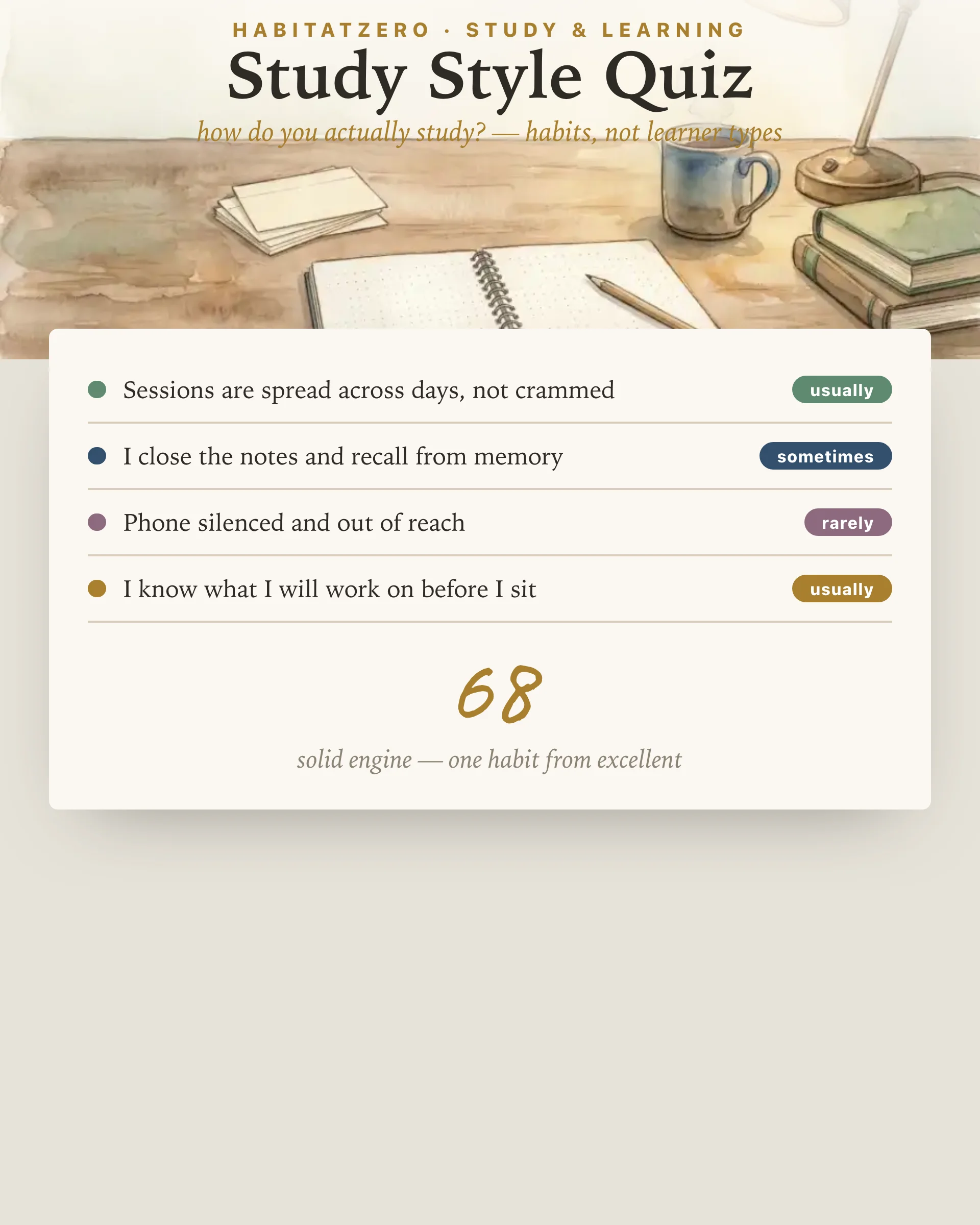
Each statement — sessions are spread across days; I close the notes and recall from memory; my phone is silenced and out of reach — gets one of three taps: rarely, sometimes, usually. Answer for the term you actually had, not the one you intended. Fifteen answers produce your score, your strongest suit, your biggest lever, and a two-item plan whose fixes are deliberately small: book half of tonight's session for two days from now; turn one rereading hour into a self-quiz hour.
The plan surfaces your two weakest answers, not a generic list — a chronic crammer and a chronic grinder get different marching orders from the same page.
The score is a diagnosis, not a grade — and the two fixes are the treatment. Give them two or three weeks, retake, and log the run; the page keeps your recent scores so the trend is visible. When the fixes need somewhere to live, the Revision Timetable turns spacing into an actual calendar, the Pomodoro Planning Worksheet gives sessions a shape with breaks built in, and the Distraction Log catches what keeps pulling your focus sideways.
Three minutes to a score. Two habits to fix. One term to feel the difference.
On this page, a study style is the pattern of habits you actually study with: whether you space sessions or cram, self-test or reread, protect focus or study next to your phone, plan sessions or improvise, and rest or grind. Those five dimensions are measurable and changeable, which makes them more useful than a fixed label.
No, on purpose. Reviews of the learning-styles idea, including Pashler and colleagues in 2008, found no solid evidence that matching teaching to a sensory type improves learning. This quiz measures habits with real evidence behind them instead: spaced practice, self-testing, focus, planning, and rest.
Each of the fifteen statements scores 0 for rarely, 1 for sometimes, and 2 for usually, and the total converts to a 0-100 scale. Every statement weighs the same, and each five-dimension subscore decides your strongest suit and your biggest lever.
Two stand above the rest in the research: spreading practice across days, and closed-book self-testing. Dunlosky and colleagues rated both as high-utility in their 2013 review, while rereading and highlighting - the two most popular techniques - rated low. The quiz gives each its own dimension.
Bands run from a well-tended system at 85 and above down to lots of easy headroom under 40. A low score is genuinely good news: it means your results can improve by changing methods rather than adding hours.
After two or three weeks of working on your two fixes, then at the start of each term. The log keeps your recent runs so you can watch the trend rather than a single number.
By the team behind Fabulous, the science-based self-care app used by over 30 million people.