Assignment TrackerStudy & Learning · ~3 min
About this template · Updated July 2026
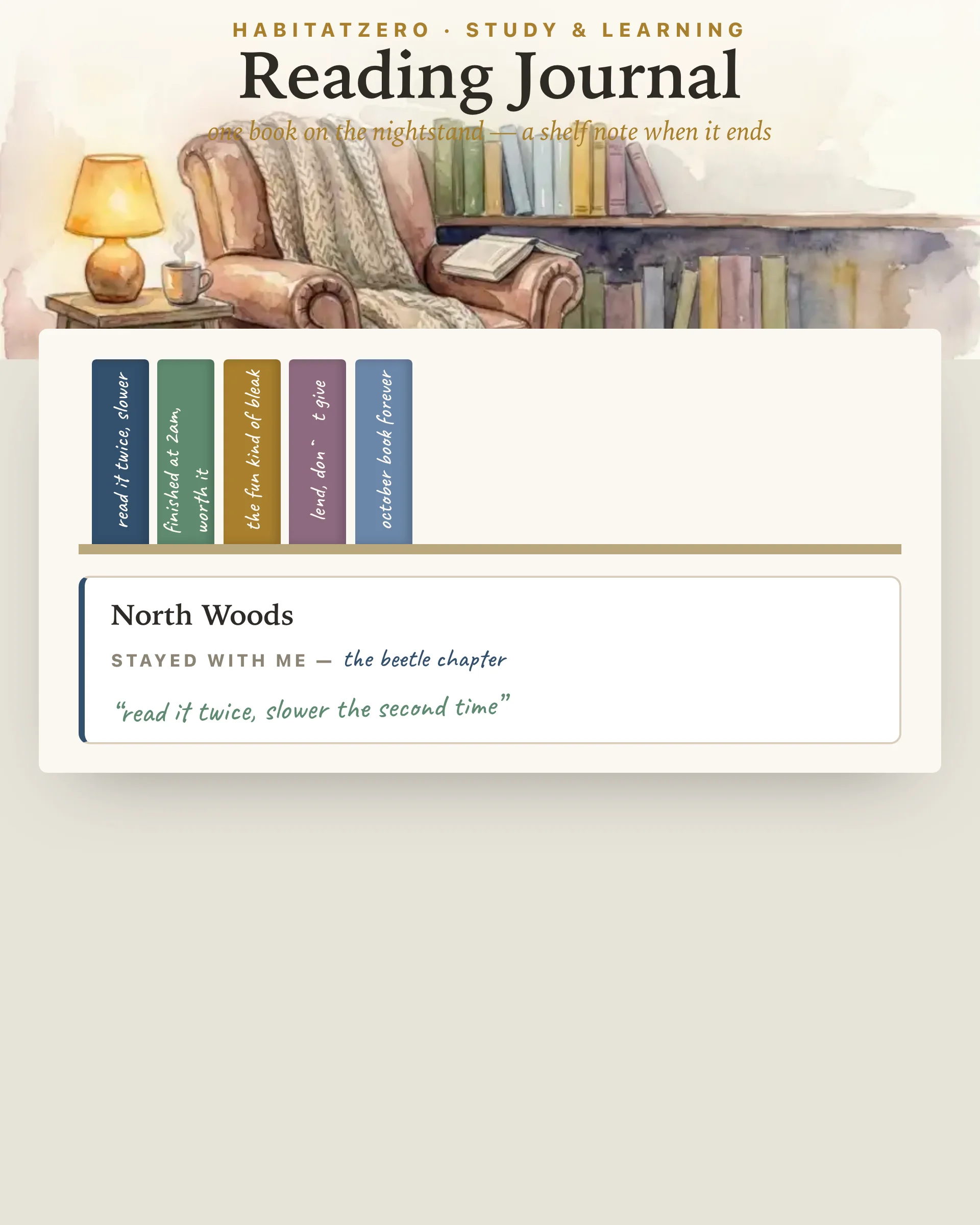
A finished book deserves better than a checkmark. Somewhere between the reading log that counts your books and the review site that grades them for strangers, there's a quieter artifact: a book reading journal, written for an audience of one, that keeps what each book actually left behind. This one is built around a small ritual — one book on the nightstand, and when it ends, a shelf note: four short lines and a verdict, written while the ending is still warm.
The whole method fits in four lines, and each line earns its place.
What it was about, in one line. Not the blurb — your line. Compressing four hundred pages into a sentence forces you to find the spine of the thing, and that act of compression is where much of the remembering happens.
What stayed with me. A scene, a sentence, a minor character, an argument you keep chewing on. This is the line you'll be gladdest to have in five years, because it's the one no one else could have written about the same book.
Who I would hand it to. The fastest honest review ever devised. "Dad." "Anyone tired." "Nobody — it was for me." Naming the reader tells you what the book was, sideways.
The verdict. One line, your words, and it gets written on the spine: finished at 2am, worth it. The fun kind of bleak. Lend, don't give. No stars — stars flatten. Three stars for a flawed book that will haunt you and three stars for a competent book you forgot by Friday is the number hiding exactly what you'd want to remember.
Then you shelve it, and the book becomes a colored spine on your shelf with the verdict as its label. Tap any spine to reread its note. The shelf that grows out of this is a different creature from a book count: it's a row of one-line verdicts in your own hand, which is to say, a memoir of your reading year written three minutes at a time.
The memory claim here isn't folklore. Research on retrieval practice — Roediger and Karpicke's Test-Enhanced Learning is the classic — found that actively recalling material beats rereading it for long-term retention, and by a wide margin. A shelf note is retrieval practice wearing casual clothes: you can't write "what it was about in one line" without pulling the whole book back through your head once more, and that pull is what sets it.
And the habit the journal quietly protects — regular book reading itself — keeps surprisingly good company in the research: a large cohort study, A chapter a day, found book readers had a survival advantage over non-readers across a twelve-year follow-up. It's an association, not a prescription — but as habits worth journaling go, this one's file is thick.
The nightstand holds a single title, and that's the journal having an opinion. A single book on the nightstand is a commitment; five is a mood board. If a book isn't earning its place, you can put it away unfinished — no spine, no ceremony, no guilt, the nightstand simply clears. Abandoning a book cleanly is a reader's skill, and the journal makes it a two-tap act instead of a lingering reproach.
HabitatZero keeps its reading tools deliberately specialized. The reading log is the census — which books, what happened to them, the whole flow of your reading life in one tracked view. This journal is the letters — slower, fewer words per book than you'd expect, but the words that keep. And for the smallest readers in the house, the printable reading log puts ruled rows on the fridge where they belong.
One book on the nightstand. Four lines when it ends. A spine with your verdict on it — and a shelf that remembers your reading year better than you will.
Less than you think, sooner than you think. This journal asks for four lines per book, written the day you finish: what it was about (one line — writing it forces you to find the spine of the thing), what stayed with you (a scene, a sentence, an argument), who you would hand it to (the fastest honest review there is), and a one-line verdict. Four lines catch what a rating never does, and they take three minutes while the ending is still warm.
A log tracks; a journal keeps. A reading log answers which books and when — titles, dates, finished or not. A reading journal answers what happened to you while reading them. Both are useful and they pair well: the log is the census, the journal is the letters. This page is the journal — if what you want is the tracking artifact, the reading log is the right tool.
Because stars flatten. Three stars for a flawed book you'll think about for years, and three stars for a competent book you forgot by Friday — the number hides exactly what you'd want to remember. One line in your own words — 'the fun kind of bleak', 'lend, don't give' — is both the rating and the reason, and it's what gets written on the spine.
Yes, and the mechanism is well studied: recalling material and putting it in your own words strengthens memory far more than rereading or highlighting does — the retrieval itself does the work. A shelf note is retrieval practice wearing casual clothes: summarizing the book in one line and naming what stayed forces exactly the kind of recall that makes a book stick.
Yes, with one adjustment: for assigned reading, the 'what stayed with me' line works best pointed at the argument rather than the experience — the claim you'd cite, the counterexample you'd raise in seminar. The one-line verdict is surprisingly useful at essay time, when you're deciding which of nine readings deserves a reread. For pleasure reading alongside a course load, use it exactly as designed.
It tracks the part most trackers miss. A classic reading tracker is about throughput — titles, dates, a status per book — and if that census view is what you want, the reading log is built exactly for it. This journal tracks what each book left behind: the one-line summary, what stayed, the verdict on the spine. Run it as your only tracker if what you care about is memory rather than count; run both if you want the census and the letters. Either way, the shelf still shows your reading year at a glance — just measured in verdicts instead of checkmarks.
By the team behind Fabulous, the science-based self-care app used by over 30 million people.