Reading JournalStudy & Learning · ~4 min
About this template · Updated July 2026
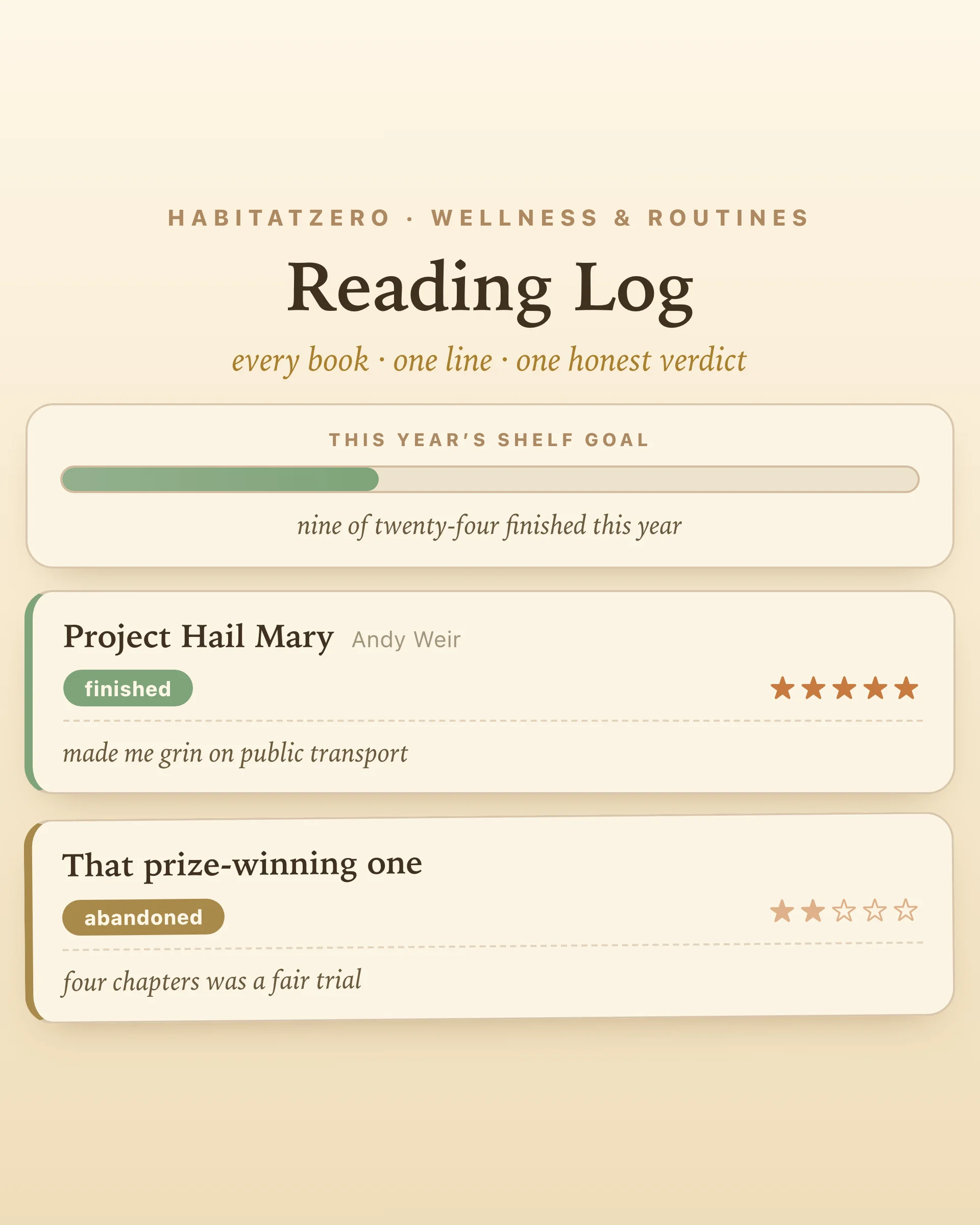
Ask a reader what they read last year and you'll get a shrug and four titles — the two they loved, the one they hated, and the one everyone else was reading. The other dozen dissolve. A reading log fixes the dissolving: every book gets a line the moment you start it, a verdict when it ends, and one sentence about what it left behind. Thirty seconds per book, and December-you gets a shelf instead of a shrug.
The instinct to track reading feels suspiciously like a book report, which is why most logs die in week two. But the mechanism underneath is sturdier than nostalgia: a meta-analysis of 138 studies found that monitoring progress toward a goal reliably increases the chance of reaching it — and the effect gets stronger when the progress is physically recorded rather than just noticed. The log isn't the memory of your reading year; it's part of the engine. And the reading itself is worth engineering: decades of research consolidate into a simple finding — print exposure compounds, feeding vocabulary, comprehension, and general knowledge in a spiral that starts wherever you are.
So the log asks for almost nothing. Title, author, tap. It's a shelf that keeps itself.
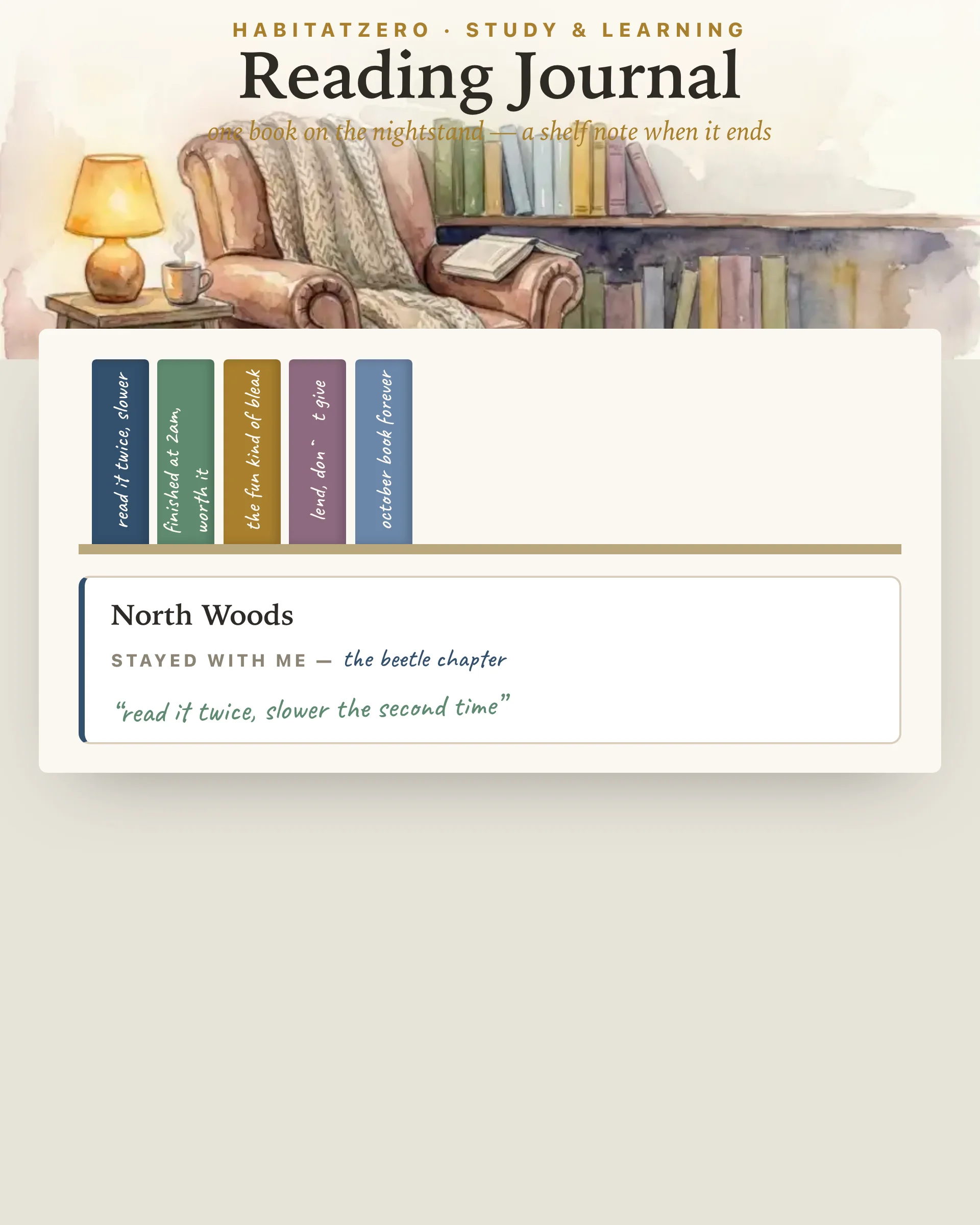
Every book on the shelf is reading, finished, or abandoned — and the third one is the load-bearing wall. Finishing books you stopped enjoying is a habit left over from school; out here, every evening spent slogging through chapter nine of a book you resent is an evening taken from one you'd inhale. Logging a book as abandoned keeps it on the record — you did give it four chapters — without letting it squat in your currently-reading pile radiating guilt. The stats count it separately. Your finished number stays true.
When a book does end, give it two things: stars, and one line. Not a review — the sentence you'd say to a friend across a table. "Slow start, perfect ending." "Made me call my sister." One line is small enough to actually get written, and a year of one-liners reads back like a diary you didn't know you were keeping.
Set a books-for-the-year goal — six or sixty, the meter doesn't judge — and it fills with every finish. That thin bar does quiet work: a goal you can see is a goal that survives March. If you're a student staring down a syllabus, the same shelf swallows required reading too; pair it with the study planner for the when, and the semester deadline tracker for the due dates, and the log becomes the record of what all that planning actually produced.
Start with the book on your nightstand. It takes one line — and it's the first line of the best answer you've ever had to "read anything good lately?"
A running list of the books you read: what you started, what you finished, what you thought, and when. This one tracks each book through three honest states — reading, finished, or abandoned — with a star rating and a one-line note, plus a meter that fills toward your books-for-the-year goal. Research on goal monitoring finds that the simple act of recording progress measurably increases the odds of reaching the goal.
Yes — abandoning is a reading skill, not a failure. Every hour spent finishing a book you stopped enjoying is an hour taken from one you would love. The abandoned shelf keeps those books on the record without letting them nag you, and the stats card counts them separately so your finished total stays honest.
Whatever number makes you reach for a book instead of your phone — the meter works the same at six books or sixty. Set it with the stepper and the bar fills as books hit finished this year. A modest goal you beat builds more reading than an ambitious one you quietly stop looking at.
The sentence you would say to a friend who asks about the book — not a report, just the trace it left. One line is deliberately small: it takes fifteen seconds, so it actually gets written, and a shelf of one-liners reads back like a diary of your year.
Yes — free, in your browser, no signup. Your shelf, ratings, notes, goal, and stats save as you go, and the log holds a whole year and beyond. In the Fabulous app the same worksheet syncs across devices.
By the team behind Fabulous, the science-based self-care app used by over 30 million people.