Leaves on a StreamEmotional Fitness · ~3 min
About this template · Updated September 2026
The four temperaments are roughly two thousand years old. Physicians in the Hippocratic tradition taught that health rested on a balance of four body fluids: blood, yellow bile, black bile and phlegm. In the second century AD the physician Galen used that theory to explain why people differ in character, and the four types he described are the ones people still quiz themselves on today: sanguine, choleric, melancholic and phlegmatic. Stelmack and Stalikas give a clear account of Galen and the humour theory of temperament, including how his descriptions found their way into modern personality research.
The word itself carries the idea this page is built on. Temperament comes from the Latin temperamentum, a mixing in due proportion. Nobody was supposed to be one pure fluid. A person was a blend, and the proportions made the character. The glass keeps that part and leaves the medicine behind.
The quiz is twelve moments, four from each of three settings: at work, at rest, and in a disagreement. Every moment has four answers, one per temperament, arranged so that no temperament always sits in the same spot on the list. Tap the answer closest to what you actually do, not what you wish you did. If two are honestly true, tap both, and that moment's measure splits between them. A third tap is refused, because a moment only holds one measure.
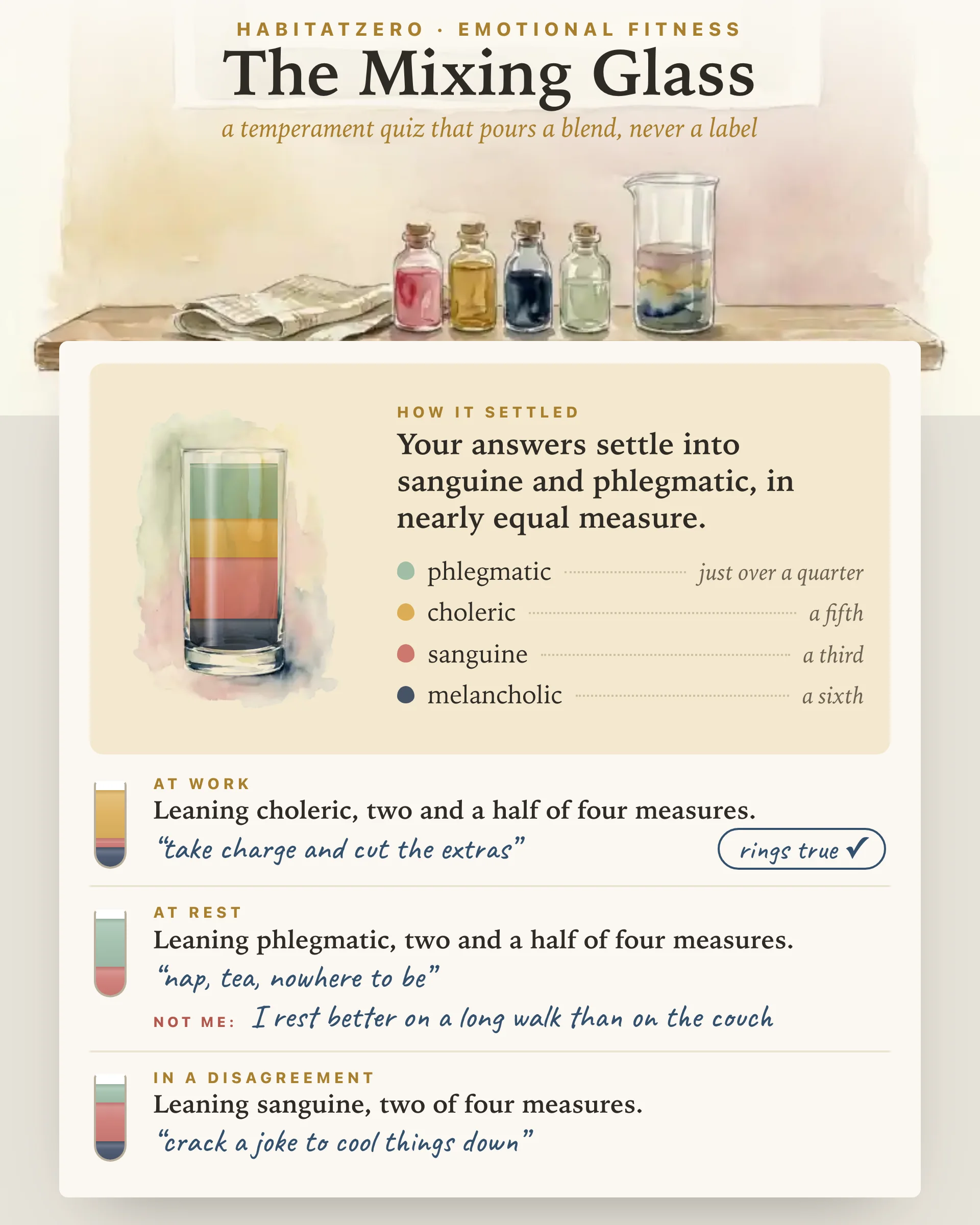
Each answer pours color into a painted glass: rose for sanguine, gold for choleric, ink for melancholic and sage for phlegmatic. While you answer, the colors stack up in the order you poured them, so the glass looks like striped sand art. Once the twelfth moment is in, you let it settle, and the stripes sort themselves into four layers. The reading names each layer's share the way you would say it out loud, a third or a sixth, and puts a headline on the whole blend.
Then comes the part a printed quiz can't do. The glass reads each setting separately, because plenty of people are choleric at their desk and phlegmatic on the couch. For every setting it quotes back the answers that filled it and offers one thought about what that might mean for how you work, rest or argue. You can mark each reading as ringing true, or tap not me and write a few words about what fits better. If you change an old answer, the glass settles again and retires any verdict whose reading moved.
Be clear about what you are holding. The four temperaments are a historical idea, not a validated measure, and the fluids behind them have nothing to do with how mood actually works. The trait map that personality researchers rely on instead is the five-factor model, often called the Big Five: extraversion, agreeableness, conscientiousness, neuroticism and openness to experience, dimensions that have held up across different questionnaires, observers and cultures. Those traits run along a scale, and everyone has some amount of each, which is a long way from four boxes.
The old types are not pure fantasy, though. Galen's four descriptions line up loosely with the four corners formed by two of those modern traits, extraversion and neuroticism. Sanguine sits near outgoing and steady, choleric near outgoing and easily stirred, melancholic near reserved and easily stirred, and phlegmatic near reserved and steady. That overlap is why the four portraits still feel familiar, and it is also why a single four-way label is too coarse to take literally.
The word temperament has a modern life of its own, too. In developmental psychology it names early individual differences that feed into later personality, including the Big Five, studied through dimensions such as how strongly a child reacts and how well they manage their own attention. The glass borrows the older meaning of the word and makes no claim on that newer science.
Pour the glass on an ordinary week rather than in the middle of a crisis, since a hard stretch tilts every answer toward whatever you are bracing against. Answer quickly. The first honest pull is usually more useful than the answer you talk yourself into.
It works best as a conversation. Read your three settings with a partner, a roommate or a coworker and ask which lines they would argue with. When their picture of you differs from yours, The Johari Window is built for exactly that gap between how you see yourself and how others see you. If the outgoing-or-reserved thread is what caught your attention, The Seesaw is an introvert extrovert quiz that looks at that one trait on its own. And if the disagreement setting landed a little too close, Our Fair Fighting Rules turns what you noticed into agreements a household can keep.
Hold the result lightly. It is a picture of twelve answers on one day, drawn in four very old colors, and the most useful thing you can do with it is argue back.
Sanguine, choleric, melancholic and phlegmatic are character types from ancient Greek medicine, which tied mood to four body fluids: blood, yellow bile, black bile and phlegm. In popular descriptions the sanguine type is warm and sociable, the choleric driven and direct, the melancholic deep and careful, and the phlegmatic calm and steady.
Most people are. The word temperament comes from the Latin for a mixing in due proportion, and the old physicians pictured character as a blend of fluids rather than one pure type. This quiz keeps that idea and shows your answers as layers sharing one glass.
No. The four types are a historical idea, not a validated measure, and the body fluids behind them are not how mood works. Personality researchers describe people with continuous traits, most often the Big Five, though two of those traits, extraversion and neuroticism, loosely echo the old four-way split.
In developmental psychology, temperament now means early individual differences, such as how strongly a child reacts or how well they can steer their own attention, that later feed into adult personality. The four temperaments on this page are a far older and looser version of the same hunch.
The page shows a settled glass so you can see how the reading comes out. To pour your own twelve answers and keep the result, personalize the template in HabitatZero, which costs nothing.
By the team behind Fabulous, the science-based self-care app used by over 30 million people.