
The Overwhelm Recovery ProtocolWellness & Routines · ~5 min
About this template · Updated November 2026
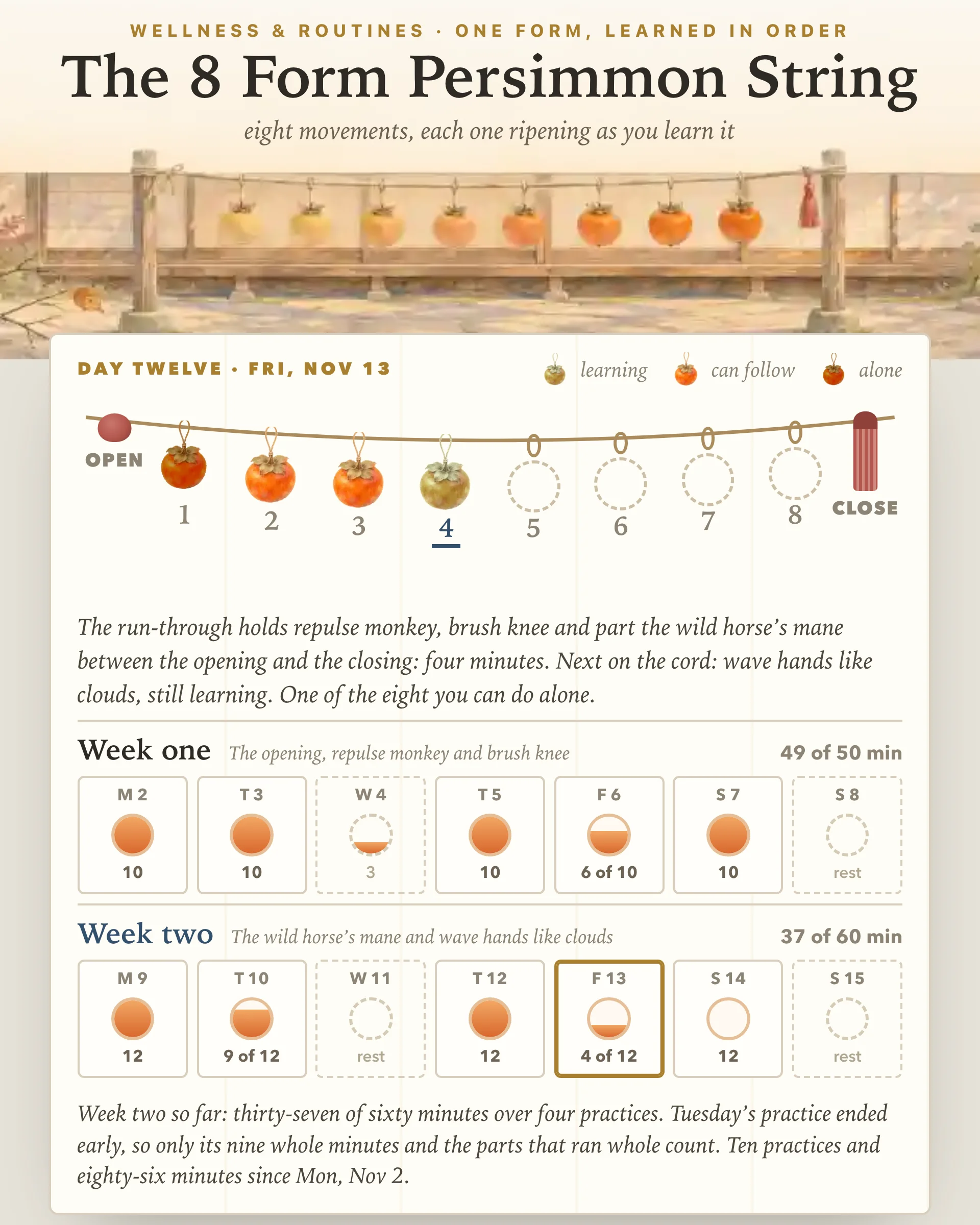
The 8 form is a short Yang-style tai chi sequence: eight movements framed by an opening and a closing, most done to the left, then the right. It is a simplified form from China, and the practice standard it is taught from is issued by China's national sports administration, as a nursing team that built a program around it explains. All eight also appear in the longer 24 form, so what you learn here carries forward.
This page teaches it in order, two movements a week, each strung onto the ones you already know.
The opening comes first: feet apart, the arms float up to shoulder height and sink as the knees soften. Then:
The closing ends it: the palms turn down, the hands sink, and you stand still for a breath.
Translations differ: in the two studies cited below, repulse monkey also goes by reverse reeling forearm, and the bird is a sparrow in one and a peacock in the other. Both list these eight in this order, with the opening and closing outside the count. The name tai chi 10 form also covers other short Yang-style sequences, such as the ten forms in a 2010 fibromyalgia trial, so if a class says 10 form, ask which ten.
The cord holds the form: the opening knot, a persimmon for each movement, the closing tassel. Tap one to read it, standing or seated, and keep your own words for it. Mark it learning and it hangs pale, can follow and it ripens, can do alone and it deepens to the amber of a dried persimmon. The run-through plays the opening, every movement you can follow in order, then the closing, and stops at the first one you cannot follow yet, because the form is learned from the front.
Each day's practice is the week's two new movements alone, fifteen seconds a side with a cue for each part, then the run-through: ten minutes on five days in week one, fifteen by week four. On day one that is four and a half minutes each of repulse monkey and brush knee, then a minute for the opening and closing. The clock keeps real time through a locked phone, a pause stops it, a movement counts only when its whole time runs, and an early end keeps only whole minutes.
Trials of this exact form are small. In a ten-week study of 30 adults aged 60 to 78, two 8 form classes a week lowered perceived stress compared with a control group. In a 2026 trial of 96 adults aged 65 to 85 with knee osteoarthritis and low muscle mass, twelve weeks of the 8 form improved a timed walking test more than health education and home exercise, though the average gain fell just short of the researchers' own bar for a meaningful change.
More broadly, the Cochrane review of exercise for preventing falls in older people living in the community pooled eight tai chi trials with about 2,700 people and found roughly a fifth fewer people falling, evidence its authors rated high certainty. None of it shows that four weeks of the 8 form will prevent a fall. Treat it as slow practice in shifting weight and stepping with control.
If you have fallen, get dizzy, have a replaced joint, a heart or blood pressure condition, or pain, ask a doctor or physical therapist before your first week. Keep a counter or sturdy chair back within reach for every step and every move on one leg, and take the chair version whenever standing feels unsure. Stop if anything hurts.
The Tai Chi Starter Scroll introduces one general move a week. Tai Chi Move Cards builds a session from the moves you pick. The 7-Minute Tai Chi Kite fits a short session to the time you have. This page teaches one named form, in order, until you can do it alone from opening to closing.
Use it when you want a whole short form within four weeks, when a class teaches the 8 form and you want practice between sessions, or when you keep losing the order. Find the first pale persimmon and begin there.
Between an opening and a closing come eight movements: repulse monkey, brush knee, part the wild horse's mane, yun shou (the hands drifting past your face and belly like clouds), golden rooster stands on one leg, kick with the heel, grasp the bird's tail and cross hands. Most are done to the left and then to the right.
It is a short, simplified Yang-style sequence from China, and China's national sports administration issues the practice standard it is taught from. All eight movements also appear in the longer 24 form, so what you learn here carries over if you go on.
Not always. Counted with its opening and closing, the 8 form has ten parts, which is how this page lays it out. The name 10 form is also used for other short Yang-style sequences, such as the ten forms taught in a 2010 fibromyalgia trial, so ask a teacher which movements their class means.
This plan spreads it over four weeks: two new movements a week, ten to fifteen minutes a day on five days. Once you can follow all eight, the whole form runs about nine minutes here, with each movement done on both sides. Doing it smoothly on your own is a longer road, and that is fine.
Yes. Every movement on this page has a chair version: the arms and the turn of the waist stay the same, and the steps, kicks and one-leg stand become small slides and knee raises from the seat. Standing, keep a counter within reach for the steps and anything on one leg.
By the team behind Fabulous, the science-based self-care app used by over 30 million people.


