
The Overwhelm Recovery ProtocolWellness & Routines · ~5 min
About this template · Updated September 2026
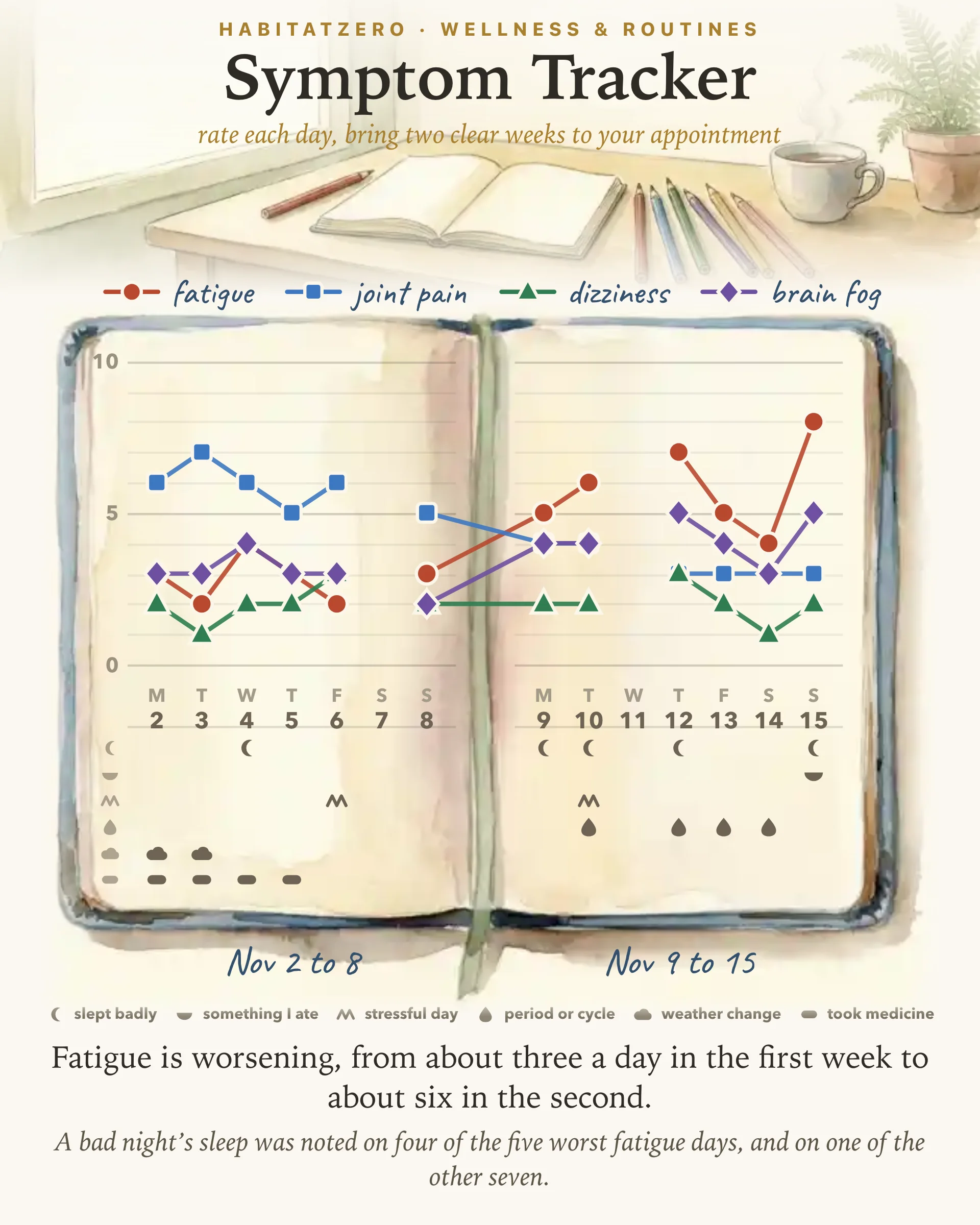
By the time you sit down with a clinician, the last two weeks have usually shrunk to one sentence: it has been bad lately. That sentence drops what helps most, like which days were worse, what else was going on, and whether things are drifting up or settling down. A symptom tracker keeps that part. You rate each symptom once a day, tap a few notes, and the notebook does the remembering.
Memory is a poor recorder of symptoms. When 287 patients rated their pain as it happened during a colonoscopy or a kidney stone treatment, the pain they remembered afterward followed the worst moment and the last few minutes, while the length of the procedure barely registered. Two weeks of symptoms get squeezed the same way, into the worst day and yesterday.
Start by naming up to six symptoms to watch, tapping a suggestion or writing your own. Each one gets a colored pencil and a marker shape of its own, so the lines stay readable in print and for anyone who has trouble telling colors apart.
Once a day, rate each symptom on a row of numbers from zero, for none, to ten, for as bad as it gets. Below them sit six notes you can tap: slept badly, something I ate, stressful day, period or cycle, weather change and took medicine. A short line holds anything else worth keeping.
The ratings land on two facing pages, the earlier week on the left and the latest on the right, with your notes marked under each day. Tap any day to open it. You can still correct a day that has passed, and the sheet says so when you do, because a record filled in from memory is weaker than one kept on the day. The notebook holds eight weeks, and you can turn back a week at a time.
Once each page holds at least three ratings for a symptom, the reading compares its two weekly averages. A rise of two points or more counts as worsening, a fall of two points or more as easing, and anything smaller as holding steady.
The two-point line comes from pain research. Across ten clinical trials with 2,724 participants who kept daily pain diaries, a drop of about two points on a zero to ten scale lined up with patients rating themselves much improved. Your symptom may not be pain, and a change that matters to you may be larger or smaller, but the line keeps ordinary day-to-day wobble from reading as a trend.
For the symptom that moved most, or the one rated highest when nothing has moved, the reading also looks at its worst days, roughly the top third, and checks which of your notes turns up on them more often than on the others. It reports plain counts: a bad night's sleep on four of the five worst fatigue days, for example, and on one of the other seven.
Treat that as a question to bring, not an answer. People are quick to find patterns that are not there. When researchers followed 18 people with arthritis for more than a year, their pain showed no reliable link to the weather conditions each of them blamed, and in the same paper college students saw connections in sequences that were random. A note can also ride along for the opposite reason: you take medicine because a day is bad, so medicine piles up on bad days even when it helps. Two weeks of counts can suggest what is worth testing; your clinician can help you decide how.
Some symptoms should never go into a log first. MedlinePlus lists warning signs from the American College of Emergency Physicians that call for emergency care, among them chest pain or discomfort lasting two minutes or more, trouble breathing, fainting, sudden dizziness, weakness or a change in vision, and sudden severe pain anywhere in the body. If you have any of these, call 911 or go to an emergency room. For something new, worsening or worrying you between visits, call your clinician instead of waiting for the second page to fill.
The summary at the bottom of the sheet is written for the visit: each symptom with its weekly averages, worst day and trend, then how often each note came up and the words you wrote, by date. Print it or bring the page, begin with whatever changed most, and ask what the pattern might mean. The tracker cannot diagnose anything or tell you why a symptom is changing. It gives you and your clinician the same two weeks to look at.
Start when a symptom keeps coming back, when a new one appears and does not settle, or when an appointment is a few weeks away. Rating takes a minute or two in the evening. If headaches are the main thing you follow, the Headache and Migraine Diary gives each one its own page. If your symptoms tend to follow meals, the IBS Food and Symptom Journal records what you ate and when. And The Doctor Visit Card puts your most important questions in order before you walk in.
No. A symptom checker asks about your symptoms and suggests conditions that might explain them. This tracker never guesses at a cause or names a condition. It keeps a daily record in your own ratings, so you and your clinician can look at the same two weeks. If a symptom is severe or came on suddenly, get care now rather than tracking it.
Keep it light enough to manage every day: the symptoms you are watching, a zero to ten rating for each, what was going on that day, such as sleep, food, stress, your cycle, the weather or medicine, and a few words about anything unusual. A rating for every day, the good ones included, tells a clinician more than long entries written only on bad days.
Two weeks is usually enough to show whether a symptom is steady, easing or getting worse, which is why the notebook opens to fourteen days. For symptoms that follow your cycle, keep going through at least one full cycle. Never put off care for a new, severe or sudden symptom because the log is not finished.
Use the summary at the bottom of the page. It lists each symptom with its weekly averages, its worst day and its trend, then how often each note came up and the words you wrote, by date. Print it or bring the page, and open the visit with the symptom that changed most.
The filled-in notebook on this page is an example anyone can read. Rating your own days, keeping eight weeks of them and printing the summary happen once you personalize the tracker in HabitatZero, which is free.
By the team behind Fabulous, the science-based self-care app used by over 30 million people.


