The Overwhelm Recovery ProtocolWellness & Routines · ~5 min
About this template · Updated September 2026
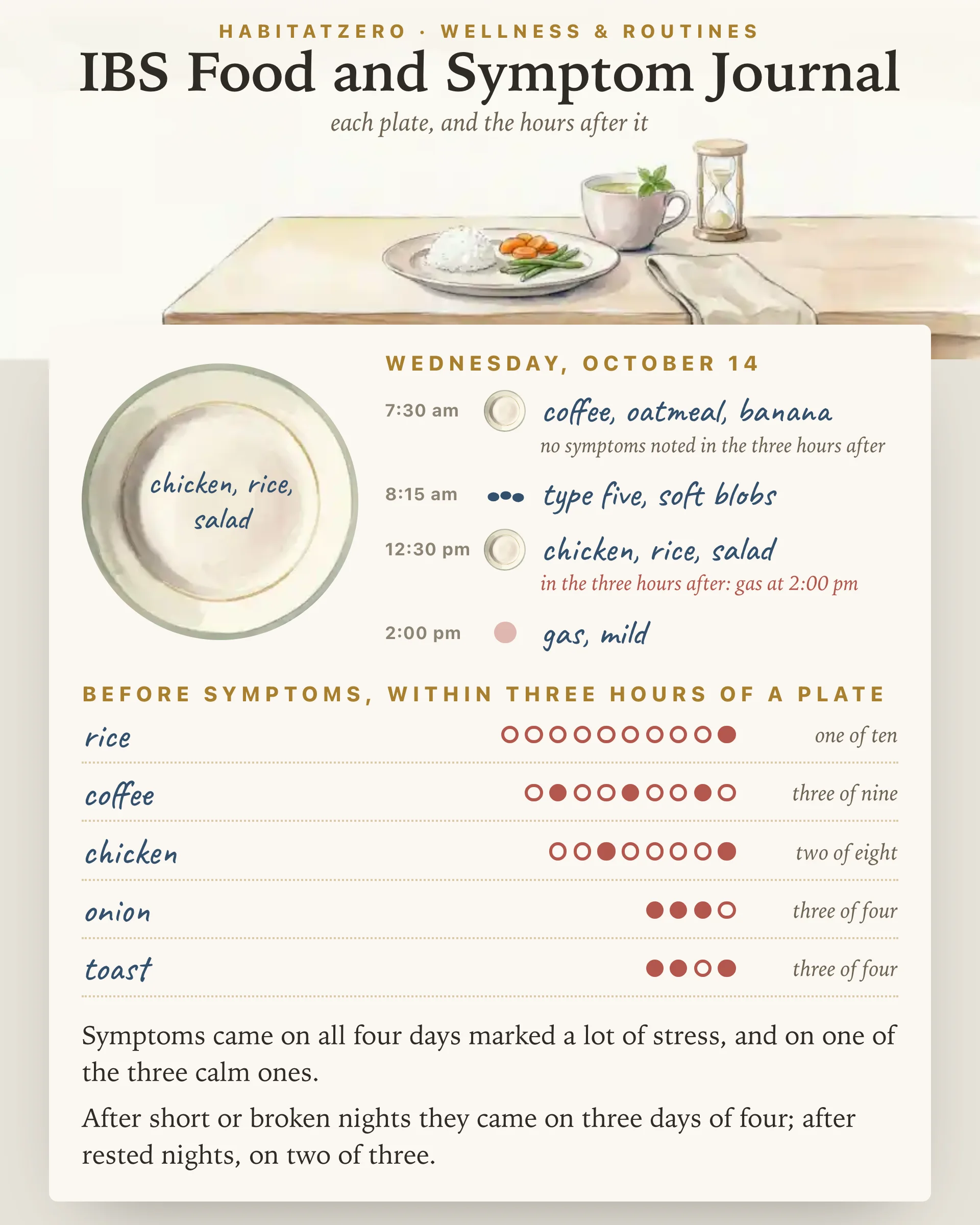
If your gut has good days and bad days and you cannot say why, memory is the first thing to stop trusting. By the time you sit down with a doctor, last Tuesday's lunch has blurred into every other lunch, and the bloating that followed it has no time attached at all. This journal holds on to the one detail recall loses first: when. You set each plate down at the hour you ate it, note symptoms at the hour they arrived, and let a few weeks of pages line the two up.
The stool types on the page come from the Bristol Stool Form Scale, which Stephen Lewis and Ken Heaton published in 1997 as a guide to how quickly food moves through the gut. This page is independent, made without the involvement or endorsement of the scale's authors or of the researchers and organizations cited below.
Most food diaries are lists of what you ate. An IBS journal needs two clocks side by side, one for your plate and one for your gut, because the real question is what tends to come after what. When researchers in New Zealand tested a timed diary of exactly this kind, the Food and Symptom Times diary, with fifty-one adults who have IBS, it recorded symptoms as they happened and tied them to what people had eaten. The team counted a symptom as following a meal when it began within three hours, and a little over half of the meals in the study were followed by one. They also noted that some foods may act over a longer stretch, since the time food takes to pass through the gut varies.
That is where this page's default comes from: it looks three hours past each plate, and one tap widens the view to six.
Each day opens on a painted plate. Tap what was on it, write in anything the suggestions miss, slide to the time you ate, and set it down. Symptoms go on the same page with their own time: bloating, belly pain, gas, urgency or nausea, marked mild, moderate or strong. A bathroom trip gets a type from one to seven, drawn as small shapes so you can match what you saw without studying a chart. Once a day, two taps record how you slept the night before and how much stress the day carried, and a short note line holds the rest, like a period, travel or a new medicine.
Under every plate, a line says what the next three hours held, or that nothing was noted. From your third day of entries, a reading starts counting. Every food you have eaten at least three times gets a row of dots, filled when symptoms followed and hollow when they did not. The same reading sets your calm days against your stressful ones and your rested nights against your broken ones, and it tallies your stool types. A four-week board draws each day as a strip of hours, so a run of evening symptoms is hard to miss, and the whole journal prints for an appointment.
A count is a record, not a verdict. Foods that share a plate share its hours, so the onion and garlic in one dinner will always rise and fall together. A few weeks is a small sample, one hard week can color everything in it, and some patterns are simply coincidence. When a row keeps filling in, treat it as a question for your doctor or a registered dietitian.
That matters most if you are tempted to start cutting foods out. The low-FODMAP diet, which researchers at Monash University developed and tested, is meant for people whose IBS a doctor has diagnosed, and Monash recommends following it with a qualified dietitian. It runs in three steps, and the middle one brings foods back a group at a time to see which ones you tolerate. A journal like this one helps during that process, but it does not replace the person guiding it.
Some symptoms are not patterns to track but reasons to get checked. A worldwide IBS guideline written by an international team of doctors lists warning signs that call for further tests, among them rectal bleeding, weight loss you did not intend, fever, symptoms at night and symptoms that first began after age fifty. If any of those fit, call your doctor now rather than logging another week. That is why the page has "I saw blood" and "it woke me from sleep" taps: log either one and the note at the bottom says plainly that it is time to call.
Start two to four weeks before an appointment, or at the beginning of a trial your dietitian has planned, and log in the moment rather than at bedtime. A minute after each meal is enough. If short nights keep showing up beside your worst days, the Sleep Log adds bedtimes and wake times, and if stress runs through the bad weeks, try the Stress Relief Worksheet next. Either way, the pages you carry into that appointment will say more than your memory can.
Log every meal, snack and drink with the time you had it, then log symptoms and bowel movements with their own times as they happen, not at the end of the day. Add a word on stress and sleep, keep going for two to four weeks, and bring the pages to your doctor or dietitian rather than dropping foods on your own.
Often within a few hours. Researchers who tested a timed food and symptom diary in adults with IBS counted symptoms that began within three hours of a meal, and noted that some foods may act over a longer stretch because gut transit varies. That is why this journal counts three hours by default and lets you widen it to six.
It is a chart of seven stool forms published by Stephen Lewis and Ken Heaton in 1997, running from separate hard lumps at type one to watery with no solid pieces at type seven. Doctors use it so that everyone describes a bowel movement the same way.
Right away, without waiting for a pattern, if you see blood in your stool or black, tarry stools, lose weight without trying, run a fever, have severe pain that won't ease, get symptoms that wake you at night, or notice new bowel symptoms that began after age fifty.
A filled-in sample journal sits right on this page for you to look through. Keeping your own plates and symptoms from one day to the next happens in HabitatZero, where personalizing the journal costs nothing.
By the team behind Fabulous, the science-based self-care app used by over 30 million people.