
The Overwhelm Recovery ProtocolWellness & Routines · ~5 min
About this template · Updated November 2026
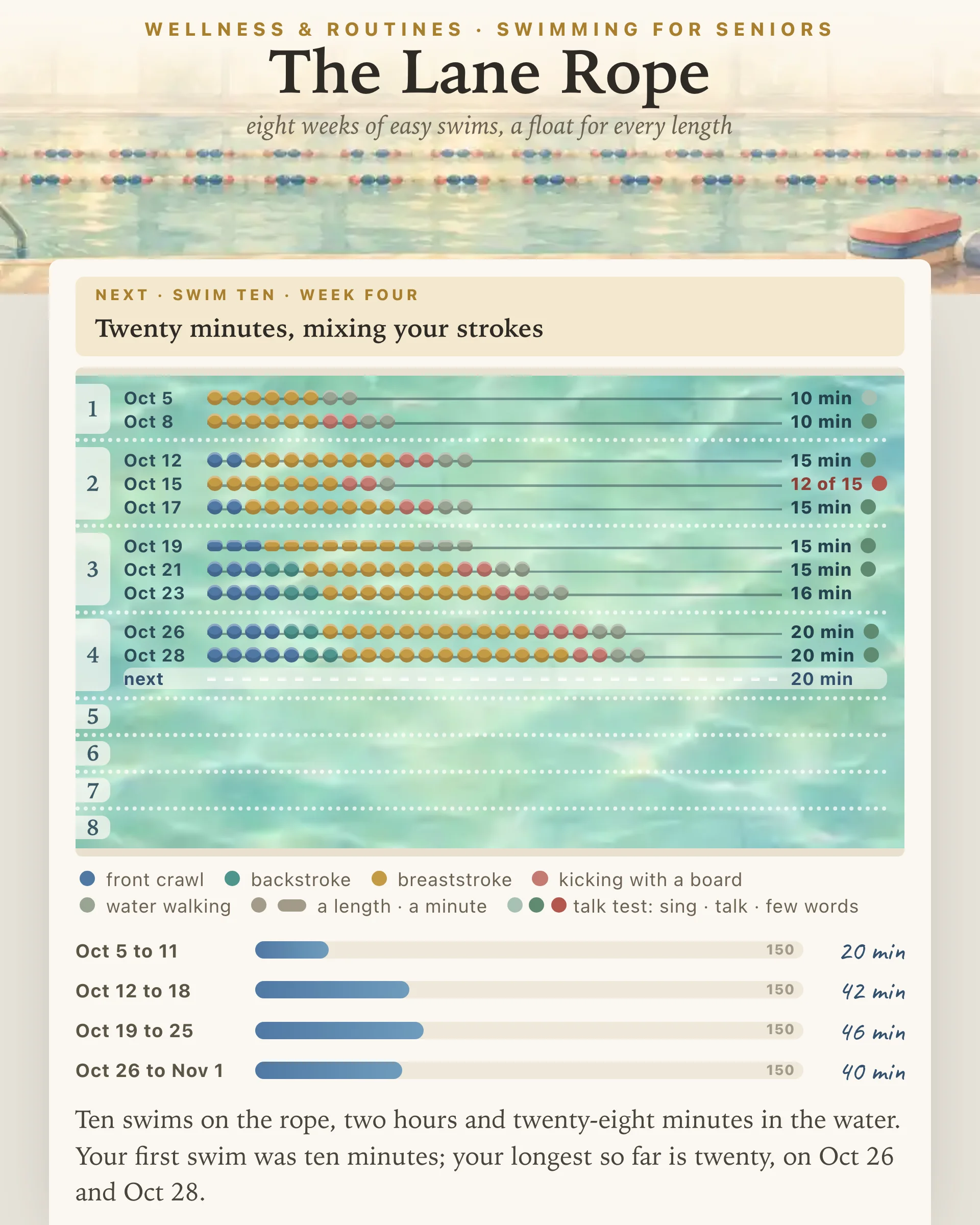
Swimming for seniors works best as a plain, steady habit: a couple of easy swims a week, built up slowly, in strokes you already know. This eight-week plan starts at ten minutes a swim, two swims a week, and grows to thirty minutes, three times a week. After every swim you fill in a short card, and the swim strings a lane rope across that week's lane, one float for every length.
It is meant for people who can already swim a few lengths and want the pool back in their week. If you never learned to swim, start with lessons from a qualified instructor. This page is a plan for swimmers, not a lesson.
Swim only when a lifeguard is on duty, or with a partner who swims well, and never on your own. Check with your doctor or a physical therapist before you begin if you have a heart or blood pressure condition, have had recent surgery, have an open wound or a seizure disorder, have had a fall, dizzy spells or a joint replacement, or live with pain. Stop the moment anything hurts.
Get out for chest pain or pressure, dizziness, breathlessness that does not settle while you hold the wall, a racing or uneven heartbeat, sudden weakness, or a cramp that will not let go, and tell the lifeguard if it lingers. After a break of a couple of weeks or more, ease back in: swim slower and rest longer until the old pace feels easy again.
Every swim has three parts that add up to its length: two easy minutes of water walking or slow lengths, a main stretch mixing whatever strokes you swim comfortably (front crawl, backstroke, breaststroke, lengths of kicking while holding a board), then two easy minutes to finish. In week one that is two, six and two minutes; by week eight, two, twenty-six and two.
Rest at the wall as long as you need. Judge effort with the talk test: halfway through, you should be able to talk but not sing; with only a few words, slow down. If a stroke pinches your neck, shoulders or knees, swap it for another.
The poolside clock is optional: lay the phone on your towel and it shows which part you are in and how long is left, keeping true time even when the screen locks. Stop it early and only the whole minutes you swam go on the card. The card works just as well filled in at home.
The swim card takes your minutes in the water, then each stroke in lengths or in minutes, whichever you kept track of, plus the talk test and how you felt afterward, and turns lengths into a distance.
Each card becomes a rope in its week's lane. A swim that reached the planned minutes moves the plan on. One that fell short stays on the rope, marked short, and the same swim comes up again. A swim where something hurt holds the plan in place and reminds you to get it checked if it lingers.
Your weeks are drawn as bars against the 150 minutes of moderate activity a week that adults are advised to get. The bar holds only your pool minutes; brisk walks, cycling and dancing count toward the 150 too. Every reading compares you only with your own earlier swims.
The 150-minute figure comes from the US Physical Activity Guidelines, summarized by the federal health staff behind them in a 2018 paper. The same guidelines ask older adults for muscle-strengthening work on two or more days a week and for balance training, not aerobic minutes alone.
A 2018 meta-analysis by exercise researchers in England pooled 29 controlled trials of pool swim training in people who were not competitive swimmers. Swimming clearly raised aerobic fitness, including in healthy adults. Its trials mixed children, people with asthma, healthy adults and adults with high blood pressure, rather than older swimmers in particular.
A 2016 trial by a university aging lab in Texas gave 48 inactive middle-aged and older adults with osteoarthritis twelve weeks of supervised swimming or cycling, 45 minutes three times a week. Pain and stiffness eased and strength improved about equally in both groups. With no group that skipped exercise, and sessions longer than this plan's, it shows swimming did as well as cycling, not how much a gentler plan will do.
Bone is where swimming falls short. A 2013 systematic review of 64 studies by an exercise and growth research group in Spain found swimmers' bone density mostly about the same as people who did no sport, and below athletes in high-impact sports. A few studies of swimmers over forty hinted at slower bone loss, but those scored lower on quality and did not account for other exercise.
If you would rather not swim lengths, The Poolside Card lays out standing water exercises in rounds, and The Water Walking Mosaic is a walking plan for the shallow end. This page is for lengths of strokes you already swim. Because swimming does little for bone, pair it with strength work on land, such as The Whole-House Strength Routine, two days a week.
For many older adults it is. The water carries much of your weight, so sore knees and hips take less of a pounding than on a walk or a run, and steady laps count as aerobic exercise. The one thing it does poorly is load your bones, so pair it with strength work on land.
Two or three swims a week is a sensible place to start, growing from about ten minutes to thirty across two months. Adults are advised to get 150 minutes of moderate activity each week, and brisk walks or cycling can cover whatever the pool leaves over.
Whichever one you can keep up comfortably while breathing evenly. Plenty of older swimmers mix breaststroke or backstroke with some front crawl, kick lengths holding a board, and walk widths in the shallow end as a rest. If a stroke pinches your neck, shoulders or knees, trade it for another one.
Anyone with a heart or blood pressure condition, recent surgery, an open wound or a seizure disorder, and anyone who has had a fall, dizzy spells, a joint replacement or ongoing pain. Whoever you are, swim only while a lifeguard is on duty or beside a partner who swims well.
Climb out and rest straight away for chest pain or pressure, dizziness, breathlessness that will not ease at the wall, a racing or uneven heartbeat, sudden weakness, or a cramp that holds on. Tell the lifeguard if it has not passed within a minute or two.
By the team behind Fabulous, the science-based self-care app used by over 30 million people.


