
The Overwhelm Recovery ProtocolWellness & Routines · ~5 min
About this template · Updated November 2026
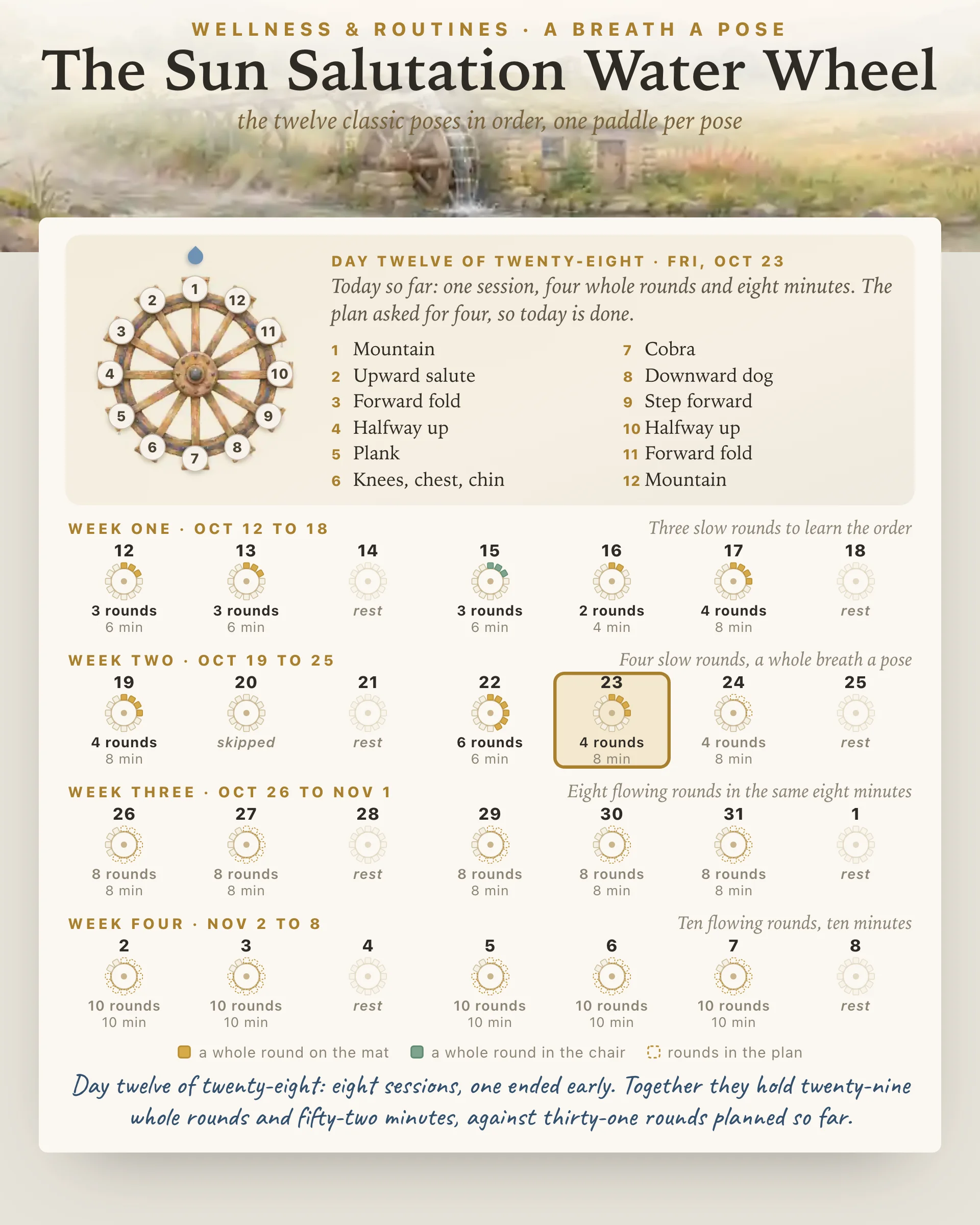
A sun salutation is twelve poses strung into one movement: you reach up, fold, step back, lower, open your chest, push your hips high, then retrace the path to standing. This page teaches the twelve steps one at a time, then runs them with you at the pace of your breath while a painted water wheel turns one paddle for every pose.
Sun salutation is the English name for surya namaskar, Sanskrit for a greeting to the sun, and the practice comes from India, where wrestlers among others used similar exercises before it was counted as yoga. In the 1920s the ruler of Aundh, a small state in western India, promoted the sequence as a daily health routine and wrote a book about it, while calling it a Marathi custom that was already common. A 2022 review of its history and research traces how it spread from there. Some traditions pair each position with a chant; this page teaches the movements as exercise.
The order here is mountain, upward salute, a forward fold with bent knees, halfway up with a long back, plank, knees-chest-chin or a lowered plank, cobra, downward dog, a step forward, halfway up, the fold again and mountain. Many versions step one foot back into a low lunge where this one walks both feet to plank. Every pose on the mat has an easier version written under it: hands on your thighs in the folds, knees down for plank, a low cobra on your forearms.
Pick three to twelve rounds and a pace. Slow gives each pose a ten-second breath, so a round takes two minutes; flowing gives each a five-second breath, a minute a round. Press begin and the wheel brings each numbered paddle under the spout in turn while the cue says when to breathe in and out.
The classic practice moves on every half breath; a whole breath in each pose is slower, which helps while the order is new.
The clock reads real time, so a phone that locks mid-round still knows where you are. A round counts only when all twelve poses are done, and stopping early keeps whole rounds and whole minutes, nothing more: stop three and a half minutes into a slow session and the log takes one round and three minutes.
The chair version keeps the same twelve steps seated: a small hinge for the folds, arms reaching ahead for plank, knee raises for the step forward. Take it if your back hurts, if you have osteoporosis, if you have high blood pressure or glaucoma (the folds and downward dog bring your head below your heart), or if your wrists complain under your weight. These are common cautions rather than trial findings, so ask a doctor or physical therapist about your own case, and come out of anything that pinches.
Practice five days a week. Week one is three slow rounds, six minutes; week two adds a round for eight. Week three keeps eight minutes but switches to the flowing pace, so the same time holds eight rounds, and week four is ten flowing rounds. Each day gets a small wheel, a paddle filled for every whole round, gold on the mat and green in the chair.
Research on sun salutations is real but young. A 2026 systematic review found fourteen studies, thirteen of them in India and one in Thailand. Most enrolled students or athletes in their teens and twenties; the only older group was thirty men aged fifty to sixty living in a home for older people. Most reported better fitness, flexibility, stress scores or body measures, but the designs differed so much that the authors could only describe them, flagged concerns about bias in every randomized trial, and asked for larger, better ones.
Pace changes the effort. In a small laboratory study, ten inactive adults with obesity and little yoga experience averaged just over three METs at six seconds a pose, near the lower edge of moderate exercise, and clearly more at four and three seconds; a treadmill walk at their own pace used more energy than the slower tempos. In a longer trial, forty-two schoolchildren aged twelve to sixteen practiced a slow or a fast version for six months: the slow group's diastolic blood pressure fell, the fast group's systolic pressure rose, and the authors likened the fast version to aerobic exercise.
None of this shows what sun salutations do for people over sixty, for bones or for balance, and none of it compares them with brisk walking over weeks. Treat the practice as honest movement, not a treatment.
If you want a whole morning routine, The Morning Yoga Sundial folds a short six-step salutation in among cat-cow, a lunge and a side bend. If the shapes themselves are new, The Yoga Mannequin teaches twelve foundation poses two a week before you link them. This page is for the sequence itself, all twelve steps in rounds you count. Once the flow feels easy, The 30-Day Yoga Challenge offers a month of daily holds that grow a breath at a time.
It is a chain of twelve yoga poses done in one flowing order, from standing down to the floor and back up again, usually repeated for several rounds. Its Sanskrit name, surya namaskar, means a greeting to the sun.
Here they are mountain, upward salute, forward fold, halfway up, plank, knees chest and chin or a lowered plank, cobra, downward dog, step forward, halfway up, forward fold and mountain again. Many versions step one foot back into a low lunge on the way down and the way up instead.
Begin with three slow rounds, a whole breath in every pose, knees bent in each fold and down on the mat for plank. The plan on this page stays slow for two weeks and moves to the flowing pace only once the order comes without thinking.
No number is right for everyone. Three slow rounds take six minutes and are plenty for learning the order, and published studies have asked for anything from four rounds to two dozen. The builder here runs from three to twelve and shows the minutes first.
Choose it with back pain, osteoporosis, high blood pressure or glaucoma, or sore wrists, since the folds and downward dog put your head below your heart and plank loads your hands. If you are unsure, ask a doctor or physical therapist.
By the team behind Fabulous, the science-based self-care app used by over 30 million people.


